Wondering where to go in Croatia?
Between Dalmatia and its islands, Istria and its Mediterranean vibe, the capital Zagreb, and the unspoiled countryside, it can be hard to know where to start.
Here’s a list of our favorite destinations in Croatia, with descriptions to help you decide whether to add them to your itinerary.
This opinion is completely independent, based on our experiences. We made our own choices, visited the area anonymously, and paid our bills in full.
Croatia’s Most Beautiful Destinations – Map + Summary
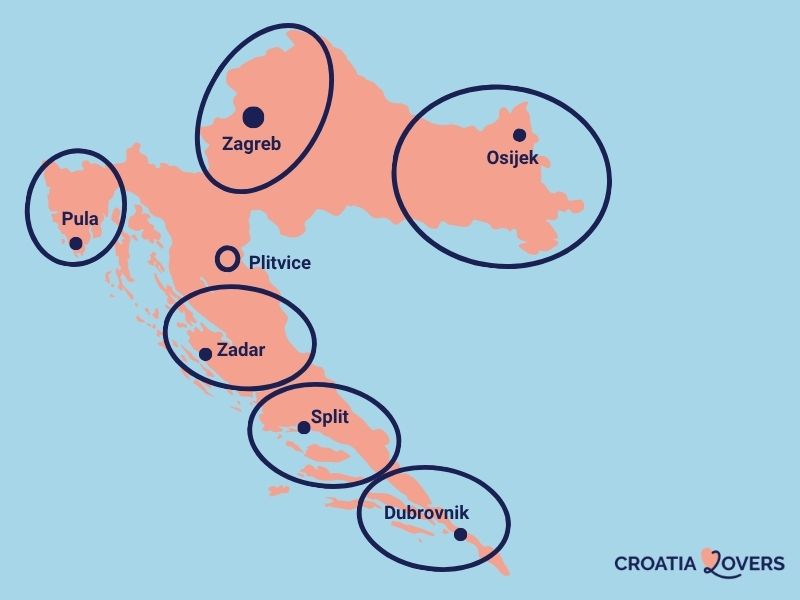
Where to Go in Croatia – Map of Destinations
Croatia stretches along more than 1,700 km of Adriatic coastline, with over a thousand islands, as well as an inland region and a capital city that are well worth a visit.
That’s why we’ve put together a list of our favorite destinations to help you narrow down your plans.
To help you find your way around, you’ll find a map below showing the destinations we’ve selected:
The most beautiful regions
We’ll go over them in detail later in this article to help you choose, but here’s a summary of the 7 destinations:
- Split and Central Dalmatia, known for its UNESCO-listed Roman palace and the neighboring islands of Brač and Hvar
- Dubrovnik and Southern Dalmatia, known for their spectacular city walls and unspoiled islands

- Pula and Istria for their Italian atmosphere, cuisine, and hilltop villages
- Zadar and Northern Dalmatia for its sea organ, sunsets, and national parks
- Zagreb and Central Croatia for their café culture, museums, and the castles of Zagorje

- Osijek and Slavonia, a rural and authentic region, far from the coastal crowds
- And, of course, the Plitvice Lakes, one of Europe’s most beautiful natural parks (though not really a destination for a vacation—see our dedicated section)

OUR ADVICE FOR RENTING YOUR CAR AT Croatia
- Compare prices on our preferred platform: DiscoverCars – one of the best rated sites.
- Choose a car that’s compact enough (some passages are narrow).
- There is a lot of demand, book it early.


1. Split and Central Dalmatia—Where to Go in Croatia?
Why visit?
Split is undoubtedly the liveliest city on the Dalmatian coast. Its historic center is actually the interior of the palace of the Roman Emperor Diocletian, built in the 4th century—a UNESCO World Heritage Site where you can live, eat, and shop amid ancient ruins.
It’s also the best starting point for exploring the islands of Central Dalmatia: Brač, with its iconic Zlatni Rat beach, and Hvar, renowned for its lavender fields and festive atmosphere.

The Most Beautiful Places in Split
- The palace’s basements and the peristyle, the heart of the ancient site
- St. Domnius Cathedral and its bell tower, offering a view of the entire city
- La Riva, the waterfront lined with palm trees and cafés
- Marjan Hill, the city’s green lung, is the perfect spot to watch the sunset

The most beautiful places along the coast and inland:
- Trogir, a small medieval island town listed as a UNESCO World Heritage Site, 30 minutes from Split
- Omiš, a small fortified town nestled at the mouth of the Cetina River, known for its spectacular canyon, rafting and rock-climbing opportunities, and its history as a hideout for pirates who once controlled this stretch of the Adriatic.
- Lake Perucko
- The Klis Fortress, perched on a rocky outcrop overlooking Split, is an ancient Croatian stronghold that withstood Ottoman assaults for centuries and served as the setting for the city of Meereen in the series *Game of Thrones*.

The Most Beautiful Places on the Island of Brač (1-hour ferry ride)
- Zlatni Rat Beach in Bol, famous for its shape, which changes with the currents
- Lots of other beautiful beaches
- The many villages around the island: Bol,

The Most Beautiful Places on the Island of Hvar (1-hour ferry ride)
- The Old Town of Hvar and its Fortica fortress overlooking the harbor
- The lavender fields in the island’s interior, in bloom from late May through July
- The Pakleni Islands, right across the way, accessible by water taxi for a relaxing day out

Where to stay?
- In Split, central location
. See all the top-rated accommodations in Split - In Trogir, for a smaller town and easier access by car
. See all the top-rated accommodations in Trogir - On the island of Hvar—to explore it thoroughly
. See all the top-rated accommodations in Hvar - In Omis, for an adrenalinerush
. See all the top-rated accommodations in Hvar

To Know
- In July and August, book your ferry tickets to the islands several days in advance: the trips fill up quickly.
- Hvar is one of the most expensive and most popular islands in Croatia during the summer—be sure to book your lodging early
- Car traffic is prohibited in Split’s historic center—please park in one of the parking lots on the outskirts
- Plan on spending at least 4 to 5 days to enjoy both Split and one or two islands.

It’s time to book!
Compare everything: companies, prices, schedules and availability.
2. Dubrovnik and Southern Dalmatia
Why visit?
Nicknamed the “Pearl of the Adriatic,” Dubrovnik is famous for its medieval city walls encircling a completely pedestrian-only Old Town built of white stone, a UNESCO World Heritage Site.
It is also one of Croatia’s most popular destinations, particularly since it has served as a backdrop for several TV series and films.
Surrounding the city, Southern Dalmatia offers much quieter islands: the Elaphiti Islands, the island-national-park of Mljet, and the Pelješac Peninsula, renowned for its wine and oysters.

The Most Beautiful Places in Dubrovnik
- A complete walk along the ramparts (about 2 km), offering a 360° view of the city and the sea
- The Stradun, the main street paved with marble, the heart of life in the old town
- The Mount Srđ Cable Car for a Panoramic View of the Entire Bay
- The Rector’s Palace
- Fort Lovrijenac (from *Game of Thrones*)
- See the best attractions in Dubrovnik

The many islands accessible by boat from Dubrovnik
- Lokrum Island, a 15-minute boat ride away, with its botanical garden and peacocks
- The Elaphiti Islands (Šipan, Lopud) for a day trip away from the crowds
- Mljet National Park and its saltwater lakes surrounded by forest
- Bisevo Island and the Blue Cave

The Most Beautiful Places on the North and South Coasts
- The Pelješac Peninsula: vineyards, oysters and mussels from Ston, and the long walls of Ston
- And nearby is the island of Korčula, a charming fortified town that claims to be the birthplace of Marco Polo

Where to stay?
- Staying in Dubrovnik’s Old Town lets you enjoy the quiet streets in the evening, once the day-trippers have left
See our selection of thebest hotels
or go directly to View the top-rated accommodations in Dubrovnik - The Lapad neighborhood, which is a little further out, offers better value for money and access to beaches
- For wine lovers, a night on the Pelješac Peninsula is a great addition
View accommodations on the Pelješac Peninsula - Korčula—if you’d like to explore this beautiful island thoroughly
. View accommodations in Korčula

To Know
- Dubrovnik welcomes several cruise ships a day during peak season—visit the city walls and the Stradun early in the morning to avoid the crowds
- Tickets for the ramparts must be reserved online in advance during the summer
- It is one of the most expensive destinations in Croatia, especially in July and August
- Plan on spending at least 4 to 5 days to enjoy both Dubrovnik and one or two islands.
3. Pula and Istria
Why visit?
Istria, a peninsula in northwestern Croatia, has a distinct identity: strong Venetian and Italian influences, renowned cuisine (truffles, olive oil, wines), and a rolling countryside dotted with hilltop villages reminiscent of Tuscany.
Pula, its largest city, is home to one of the best-preserved Roman amphitheaters in the world.
It’s a destination that’s a little less crowded than Dalmatia, with a gentler coastline and an inland region perfect for exploring by car.

The Most Beautiful Places in Pula
- The Pula Amphitheater (the Arena), one of the six largest surviving Roman amphitheaters
- The Temple of Augustus on the Forum Square
- The Fortress and the History Museum
- The Zerostrasse underground tunnels, dug by the Austro-Hungarian Army to serve as shelters during both world wars
- See the best attractions in Pula

Other Cities in Istria
- Rovinj, a picture-perfect town with cobblestone streets and a bell tower overlooking the peninsula
- Poreč and its Euphrasian Basilica, a UNESCO World Heritage Site for its Byzantine mosaics
- Vrsar, perched on a hill overlooking a quiet harbor
- Novigrad, a small port town that retains the atmosphere of a fishing village

Green Istria and Its Villages
- Motovun, a hilltop village famous for its truffles and its view of the Mirna Valley
- Grožnjan, a village of artists and galleries in the heart of the countryside
- See our selection of the most beautiful towns and villages in Istria

Natural Parks
- The Brijuni Islands, which form a unique archipelago designated as a national park: Here you’ll discover an unspoiled landscape where lush meadows, Mediterranean forests, and secluded coves blend harmoniously. And you can explore Roman and Venetian ruins, as well as buildings dating from the time of Tito
- The Kamenjak Cape Nature Park, at the southernmost tip of the peninsula, known for its wild coves

Where to stay?
- Pula is more convenient if you’re arriving by plane (local airport) or need good transportation connections
See our selection of the best hotels
or go directly to View the top-rated accommodations in Pula - Rovinj is the most charming choice for a night or two
See the top-rated accommodations in Rovinj - Porec is centrally located and full of charm
See our selection of the best hotels
or go directly to the top-rated accommodations in Porec

To Know
- A rental car is highly recommended for exploring the inland villages, which are poorly served by public transportation
- The white truffle season runs from September through December—be sure to book a tour of a truffle farm in advance if you’re visiting during this time
- Rovinj and Poreč are still very crowded in the summer—it’s best to visit them early in the morning or late in the afternoon
A LITTLE MORE patience
All the photos, maps, information and addresses you need to make your stay in Croatia a success will soon be available in a single ebook!
4. Zadar and Northern Dalmatia
Why visit?
Zadar is a city on a human scale, with over 3,000 years of Roman, Venetian, and contemporary history layered one upon another.
It is best known for two unique installations along its waterfront: the Sea Organ, which produces a melody using the waves, and the Greeting to the Sun, a circle of solar panels that lights up at night.
It is also the gateway to the Kornati Archipelago and Krka National Park, often considered a quieter alternative to Plitvice.

The Most Beautiful Places in Zadar
- The Sea Organ and the “Salute to the Sun”—best viewed at sunset
- The Roman Forum and St. Donatus Church, in the Old Town
- The archaeological museum, filled with statues and mosaics
- St. Anastasia Cathedral and its magnificent facade
- See the Best Attractions in Zadar

The Most Beautiful Places Around Zadar
- Šibenik, a historic city built on a maze of stone-paved alleys, famous for its St. James Cathedral—a UNESCO World Heritage Site—and for its role as the gateway to Krka National Park and the Kornati Islands National Park.
- Nin, a small historic town surrounded by salt marshes and sandy beaches, 20 minutes from Zadar

National Parks
- Krka National Park and its waterfalls, where swimming is permitted in certain areas
- A boat tour of the Kornati Archipelago, with its 89 nearly deserted islands and islets
- and Plitvice National Park is also easily accessible

The Island of Pag
- its lunar landscapes
- its cheese-making tradition, including tours of the cheese-making process
- The old town of Pag is worth a visit for its Renaissance architecture and medieval streets.
- traditional saltworks still in operation
- its sandy beaches in Novalja

Where to stay?
- Zadar’s Old Town is the best place to stay—it’s on a human scale and well-connected for day trips
.See our selection of thebest hotels
or go directly to the top-rated accommodations in Zadar - Sibenik is a quieter, seaside alternative, halfway between Zadar and Split
See the top-rated accommodations in Sibenik

To Know
- The Kornati Islands are accessible only by boat—book an organized tour or a private charter from Zadar or Murter
- Krka is very crowded in the summer—arrive as soon as it opens to enjoy the waterfalls before the tour groups arrive
- Zadar is also a good starting point for a day trip to Plitvice (about a 1-hour-40-minute drive)
5. Zagreb and Central Croatia
Why visit?
Zagreb is unlike any other Croatian city: it’s a Central European capital, with its cafés, covered markets, and laid-back atmosphere—a world apart from the coast.
It’s a great place to visit year-round, even in winter, and makes for an excellent 2- to 3-day city break.
Surrounding the city, the Zagorje region is home to castles and vineyard-covered hills that are rarely visited by foreign tourists.

The Most Beautiful Places in Zagreb
- The Upper Town (Gornji Grad), with St. Mark’s Church and its colorful tiled roof
- The Lotrščak Tower and its cannon, which fires every day at noon
- The Dolac Market, just above the main square
- Historic sites related to the war
- The Museum of Broken Relationships: As Moving as It Is Original

The Most Beautiful Places North of Zagreb
- Medvedgrad Castle
- Trakošćan Castle on the shore of its lake,
- the Veliki Tabor Fortress
- Varazdin and its castle

The Most Beautiful Places South of Zagreb
- Samobor, a small, picturesque town known for its local pastry, the kremšnita
- Zumerak Park
- Karlovac, a 16th-century fortified town built in the shape of a six-pointed star, known for the four rivers that surround it

Where to stay?
Zagreb’s city center, located between the Upper Town and the Lower Town, is small enough to explore entirely on foot.
See the top-rated accommodations in Zagreb

To Know
- Zagreb is much less touristy than the coast—it’s a good option for avoiding the crowds in the middle of summer
- Winters there are cold, unlike on the Adriatic coast—be sure to pack warm clothes if you’re visiting between November and March
- Zagreb is also one of the best starting points for a day trip to the Plitvice Lakes (about a 2-hour drive)
6. Osijek and Slavonia
Why visit?
Slavonia, in the far east of the country, is the part of Croatia that most visitors never see: vast agricultural plains, traditional villages, and a cuisine marked by Hungarian influence.
Osijek, its main city, is home to a preserved Baroque fortress, the Tvrđa, on the banks of the Drava River.
It’s a destination for those who want to get off the beaten path and discover a rural, authentic Croatia, far from the coastal crowds.

The Most Beautiful Places in Osijek
- La Tvrđa, Osijek’s old Baroque fortress, now a lively neighborhood filled with cafés
- The walk along the Drava River
- Kopački Rit Nature Park, one of Europe’s largest wetlands, renowned for birdwatching
- Local cuisine: kulen (spicy cured meat) and fiš paprikaš (fish stew with paprika)

The Most Beautiful Places in Slavonia
- The Wine-Growing Villages of Baranja and Their Traditional Wine Cellars
- Dakovo, a town in Slavonia known for its monumental Neo-Romanesque cathedral made of red brick and for its traditional breeding of Lipizzaner horses
- Vukova, a town on the banks of the Danube scarred by the devastating siege of 1991, has since been rebuilt; there, the memorial and the water tower, preserved in its ruined state, serve as a reminder of the heavy toll Slavonia paid during the Croatian War of Independence.

Where to stay?
- Downtown Osijek is the best starting point for exploring the region.
See the top-rated accommodations in Osijek - Dakovo also has a lot of charm
See the top-rated accommodations in Dakovo

To Know
- A car is essential; there is limited tourist transportation in the region.
- Spring and fall are the best seasons for birdwatching at Kopački Rit
- It’s one of the least expensive and least crowded regions in Croatia—perfect for a laid-back getaway
7. The Plitvice Lakes: A Special Case
Why visit?
The Plitvice Lakes are undoubtedly Croatia’s most impressive natural site: 16 turquoise lakes connected by waterfalls, surrounded by forest, which visitors explore via wooden walkways built right at water level.
The park has been a UNESCO World Heritage Site since 1979 and appears on most lists of Europe’s most beautiful natural parks.
Be aware, however: this is not a destination in and of itself. There are no towns nearby, only a few lodging options scattered around the park’s entrances. It’s a stop to add to a broader itinerary, not a base for a vacation.

How to get there and how much time to allow
Plitvice is located inland, roughly halfway between the coast and Zagreb. This makes it an excellent stopover on the route between several destinations on this list:
- From Zagreb: about a 2-hour drive
- From Zadar: about a 1-hour-and-40-minute drive
- From Split: about a 2½-hour drive
- From Pula: about a 3-hour drive
Ideally, plan to spend 2 to 3 days there to enjoy the park at your own pace: one full day for the Upper and Lower Lakes, and a second day for the less-traveled hiking trails or the surrounding area.
If your schedule is tighter, a full-day stopover between two destinations is still possible, but plan to arrive as soon as the park opens.
See our guide to plan your visit.

Where to stay?
Accommodations are mainly located around the park’s two entrances (Entrance 1 and Entrance 2) and include small hotels and homestays.
See the top-rated accommodations near Plitvice Park

To Know
- Tickets must be reserved online in advance: the number of visitors per day is limited during peak season
- Arrive as soon as the park opens to enjoy the lakes before the tour groups arrive
- Swimming is prohibited in all of the park’s lakes
- Be sure to wear sturdy shoes: the walkways can be slippery, especially after it rains
PLAN YOUR TRIP TO Croatia
- Best of
Top Destinations
Top Attractions
Most Beautiful Cities
Most Beautiful Islands
National Parks

- Practical advice
When to go?
Howtorent a car in Croatia
Driving tips
Itineraries: Road Trip—10 Days, 2 Weeks, 3 Weeks