Situated at the north-western tip of Croatia, the Istrian peninsula is captivating for the diversity of its landscapes and heritage. In this article, we share our selection of Istria’s most beautiful towns and villages.
Note: This article talks about towns and villages to visit. If you’d like to discover the best towns to stay in Istria, take a look at our other article.
This opinion is completely independent, based on our experiences. We made our own choices, visited the area anonymously, and paid our bills in full.
Most beautiful towns and villages in Istria: summary + Map
Map
Istria offers a beautiful variety of coastal towns and villages perched in the hinterland, each with its own character.
Here’s the map with our top 15 places to visit:

Which towns in Istria to visit? Quick response:
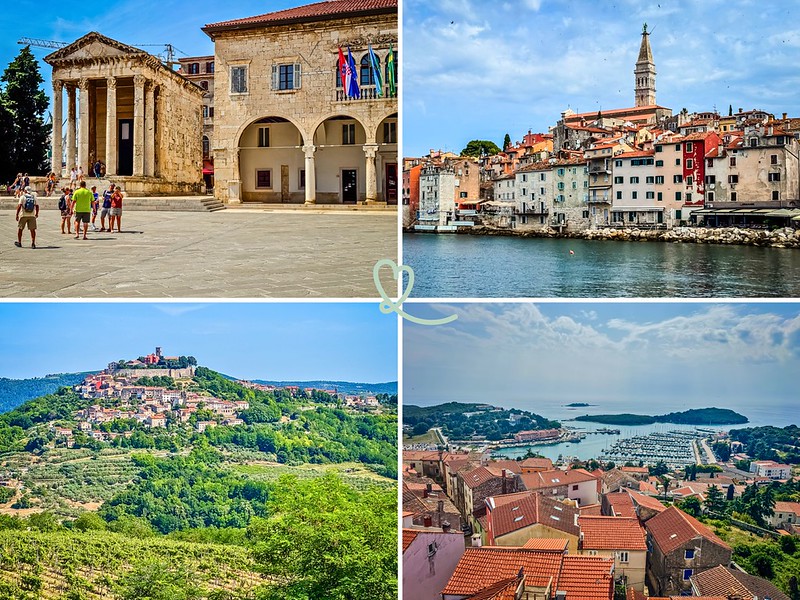
If you only need to visit 4, to get an overview of the different styles:
- Rovinj (romantic coastal town)
- Pula (Roman heritage)
- Motovun (inland hilltop village)
- Poreč (Byzantine mosaics)
1. Rovinj

Why we love it
Rovinj is undoubtedly Istria’s most photogenic town. We were seduced by its cobbled streets that climb up to the church of St. Euphémie, whose steeple dominates the entire peninsula. The colorful houses are reflected in the waters of the harbor, and the atmosphere is reminiscent of Italian fishing villages.
In the evening, the golden light that bathes the facades creates a particularly pleasant atmosphere. We recommend spending at least a full day here to enjoy the old town and nearby beaches.

Attractions
- Sainte-Euphémie church and its 60m steeple, the town’s highest point
- The port and narrow streets of the old town, ideal for getting lost without an itinerary
- The archipelago of the Rovinj islands, accessible by water cab for calm bathing.
- Punta Corrente forest park (Zlatni Rt), perfect for a seaside stroll
- The fish market and the market in Valdibora square to discover local produce
Access
- West coast of Istria
- From Pula = 40min
- From Poreč = 35min
- From Trieste (Italy) = 1h40
OUR ADVICE FOR RENTING YOUR CAR AT Croatia
- Compare prices on our preferred platform: DiscoverCars – one of the best rated sites.
- Choose a car that’s compact enough (some passages are narrow).
- There is a lot of demand, book it early.


2. Pula

Why we love it
Pula is the largest city in Istria and the one with the best-preserved Roman heritage in Croatia. Its amphitheatre, built in the 1st century, is the sixth largest in the world and remains the region’s most emblematic monument. We enjoyed the contrast between the ancient remains and the bustling urban life of the city center.
Beyond the ruins, Pula is also a lively port town with good seafood restaurants and beaches within walking distance. Pula deserves at least half a day for its Roman sites. But it’s also rich in museums, and you can easily spend a week here.

Attractions
- The remarkably well-preserved Roman amphitheatre (Arena), which still hosts concerts in summer.
- The 1st-century Temple of Augustus in the Forum
- The Sergii triumphal arch, a monumental gateway from the 1st century BC.
- Fort Kaštel, offering a panoramic view of the city and home to the Historical and Maritime Museum of Istria
- The beaches of Verudela and Brijuni National Park, accessible by boat from the port
Access
- Southern tip of the Istrian peninsula
- From Rovinj = 40min
- From Rijeka = 1h30
- From Zagreb = 3h
3. Poreč

Why we love it
Poreč owes its fame to the Euphrasian Basilica, a UNESCO World Heritage Site since 1997 for its exceptional 6th-century Byzantine mosaics. We found the old town compact and pleasant to explore, structured according to the original Roman plan whose two main axes can still be seen: the Decumanus and the Cardo Maximus.
Apart from the historic center, the seaside resort offers numerous beaches and a coastal promenade running south along the sea. Poreč is also a good starting point for exploring inland villages.

Attractions
- The Euphrasian Basilica and its gilded 6th-century mosaics, a UNESCO world heritage site
- The Decumanus, the main Roman street lined with Venetian palaces and boutiques
- Marafor Square, a former Roman forum with remains of temples
- The coastal promenade to Île Saint-Nicolas, visible from the waterfront
- The Baredine caves, 8km to the north-east, for an original underground tour
Access
- West coast of Istria, north of Rovinj
- From Rovinj = 35min
- From Pula = 55min
- From Trieste (Italy) = 1h15
WHERE TO SLEEP IN Istria
Our favorites: cities and hotels
Rovinj, for its undeniable charm
Grand Park Hotel – Check photos and availability
Porec, for a well-balanced holiday combining nature, beach and history
Valamar Riviera Hotel – Check photos and availability
Pula, for easy exploring and fine dining
Boutique Hotel Velsabbion – Check photos and availability

See our complete selection of the best destinations in Istria
4. Motovun

Why we love it
Motovun is Istria’s most famous hilltop village, and rightly so. Set atop a hill 277m above sea level, it overlooks the Mirna valley, famous for its white and black truffles.
We were particularly impressed by the panoramic view from the ramparts: a patchwork of vineyards, olive groves and forests stretching as far as the eye can see. but we loved it all. The view as you approach the village, the characterful little streets, the ramparts…
Motovun can be visited in 1 to 2 hours.
In July, the Motovun Film Festival transforms the main square into an open-air cinema.

Attractions
- The medieval ramparts and the circular promenade offering a 360° panorama of the Mirna valley
- Piazza Andrea Antico, the heart of the village surrounded by Venetian buildings
- Truffle tasting in local restaurants and stores: Istrian truffles are renowned throughout Europe.
- The Motovun Film Festival in July, one of Croatia’s most original film festivals.
- Hiking trails in the Motovun forest below the village
Access
- Central Istria, in the Mirna Valley
- From Poreč = 30min
- From Rovinj = 45min
- From Pula = 1h
- The climb from the parking lot below takes about 10 minutes on foot. In summer, parking spaces fill up quickly, so it’s best to arrive in the morning.

5. Vrsar

Why we love it
Vrsar is a small coastal town, less well known than its neighbors, which is precisely what makes it so charming. Perched on a hill overlooking a quiet harbor, it has retained its authentic character. We found a calm atmosphere here, far from the tourist crowds of Rovinj or Poreč.
The sculptor Dušan Džamonja set up his sculpture park here, and Giacomo Casanova mentions the town in his memoirs. The archipelago of 18 islets opposite Vrsar is also an ideal playground for kayaking.
The village itself can be discovered in an hour or two, but you can stay longer if you want to enjoy the beaches.

Attractions
- The old town perched on a hill, with narrow streets leading down to the port
- Dušan Džamonja Sculpture Park, an open-air collection of monumental works of art
- The Vrsar archipelago (18 islets), to explore by kayak or boat
- The 12th-century Romanesque church of Sainte-Marie-de-la-Mer (Sveta Marija od Mora)
- Limski Kanal, a 10km fjord accessible by boat from Vrsar
Access
- West coast of Istria, between Rovinj and Poreč
- From Rovinj = 15min
- From Poreč = 20min
- From Pula = 45min
6. Novigrad

Why we love it
Novigrad is a small port town with the feel of a fishing village. Less touristy than its neighbors, it appealed to us for its authenticity and relaxed pace. We appreciated the quality of its seafood restaurants, reputed to be among the best on the coast.
The compact, well-preserved old walled town can be explored in an hour. The seafront offers beautiful sea views. The town also hosts annual gastronomic festivals dedicated to local produce: truffles, wild asparagus and shellfish.

Attractions
- The fortified old town, surrounded by partly preserved ramparts
- Saint-Pélage parish church and its 18th-century bell tower
- The Lapidarium Museum, dedicated to stone sculpture from Antiquity to the Middle Ages
- The fishing port and its promenade, to watch the return of the boats at the end of the day
- The beaches to the south of the city, including Karpinjan, well equipped for families
Access
- Northwest coast of Istria, between Umag and Porec
- From Porec = 15min
- From Umag = 20min
- From Rovinj = 40min
A LITTLE MORE patience
All the photos, maps, information and addresses you need to make your stay in Croatia a success will soon be available in a single ebook!
7. Grožnjan

Why we love it
Grožnjan is a hilltop village known as the “town of artists”. Abandoned in the 1960s, it has been revitalized by musicians and painters who have set up studios here. We found the narrow streets very charming. You’ll also find art galleries and remarkable views over the green hills. In summer, the village hosts open-air jazz concerts.

Attractions
- The city walls and gates: a medieval enclosure offering spectacular views over the Mirna valley.
- Art galleries and studios: more than 20 galleries by local artists nestled in the cobblestone streets.
- Saints-Vitus-et-Modeste parish church: a fine Baroque edifice with an imposing bell tower.
- Parenzana: the old railroad line has been transformed into a hiking and mountain-biking trail that passes right at the foot of the village.
Access
- Location: Northern Istria, perched on a hill inland from the Slovenian border
- From Umag: 25 min
- From Poreč: 35 min
- From Pula: 1h
8. Labin

Why we love it
Labin is a town perched on the east coast of Istria, offering a different perspective on the region. Its historic medieval center overlooks the bay of Rabac, a seaside resort below. We enjoyed strolling through the restored streets of old Labin, where former mining areas have been transformed into art galleries. The Musée de la Ville traces the mining and cultural history of this charming town.

Attractions
- The medieval old town: a maze of colorful alleyways set on a hill overlooking the sea.
- Labin National Museum: famous for its faithful recreation of a coal mine in the basement.
- Palazzo Battiala-Lazzarini: a Baroque building with red facades that are emblematic of the city.
- Fortica viewpoint: offers a breathtaking view of the seaside resort of Rabac and the island of Cres.
- Dubrova Sculpture Park: an open-air museum at the entrance to the town with over 90 contemporary works.
Access
- Location: South-east coast of Istria, overlooking the seaside resort of Rabac.
- From Pula: 45 min
- From Rijeka: 1h00
- From Rabac (the coast): 5 min.
9. Umag

Why we love it
Umag is the first town you encounter when entering Istria from Slovenia and Italy. Less crowded than Rovinj or Poreč, it offers a compact old center on a peninsula that juts out into the Adriatic.
We enjoyed strolling through the quiet streets and enjoying the view of the Italian coast on a clear day. The town is also known for its family-friendly beaches. It’s a good starting point for exploring northern Istria. Umag is a town that can be visited in a few hours, but the surrounding area is well worth spending more time in.

Attractions
- The old town on the peninsula, with its partly preserved ramparts
- The Assumption parish church and its Venetian bell tower
- The Museum of the City of Umag, to understand local history since Antiquity
- The beaches of Laguna Stella Maris, among the best equipped in northern Istria
- Inland wine and olive oil routes, easily accessible from the city
Access
- North-western tip of Istria, on the Slovenian border
- From Poreč = 35min
- From Trieste (Italy) = 50min
- From Pula = 1h15
10. Opatija (on the peninsula)

Why we love it
Opatija is not technically located in the Istria region, but geographically it is on the neighboring peninsula in the Gulf of Kvarner. We’ve included it in this selection because it’s in the immediate vicinity and makes for an interesting detour.
Once a seaside resort for the Austro-Hungarian aristocracy, the town has preserved its sumptuous Belle Époque villas and subtropical gardens. We enjoyed the Lungomare, a 12km coastal promenade that runs along the sea between Volosko and Lovran. The atmosphere is more elegant and relaxed than on the Istrian coast.

Attractions
- The Lungomare, a 12km coastal promenade linking Volosko to Lovran
- Angiolina Park and Villa Angiolina, cradle of tourism on the Croatian Riviera
- The statue of La Jeune Fille à la Mouette, symbol of the city on the waterfront
- The fishing village of Volosko, renowned for its gourmet restaurants
- The Church of St. James and the Villa Angiolina park, home to exotic plant species
Access
- Kvarner Gulf, east of the Istrian peninsula
- From Rijeka = 20min
- From Pula = 1h30
- From Zagreb = 2h30

It’s time to book!
Compare everything: companies, prices, schedules and availability.
5 other towns and villages to discover
And if you still have time, we also recommend the following towns and villages.
11. Pazin

Pazin is the administrative capital of Istria, located in the geographical center of the peninsula. Its main attraction is the Kaštel, an imposing medieval castle overlooking a deep chasm. In fact, it inspired Jules Verne to write his novel Mathias Sandorf. The Pazinčica chasm can be visited via a path. We found the visit to the castle and the ethnographic museum instructive.
12. Fažana

Fažana is a small fishing port facing the Brijuni Islands, for which it is the main embarkation point. The village has preserved its colorful waterfront and relaxed atmosphere. We enjoyed the restaurants serving fish and grilled sardines on the harbor, a local specialty.
13. Vodnjan

Vodnjan is notable for its Church of St. Blaise, whose 62m steeple is the highest in Istria. The interior houses relics and mummified bodies of saints, a curiosity unique in the region. We also enjoyed the artisanal oil mills around the town, which produce some of the best olive oil in Croatia.
14. Beram
Beram is a small inland village whose reputation rests on the chapel of Sveta Marija na Škrilinah. The 15th-century frescoes that adorn the interior, including the famous Danse Macabre, are among the best-preserved works of medieval art in Croatia. We recommend checking opening times before visiting, as access may require contacting the janitor.
15. Hum

The village is well worth a visit for its narrow medieval streets and stone buildings. We enjoyed tasting biska, a local brandy scented with mistletoe.
DISCOVER Istria


SHE MADE THE TRIP Morgane