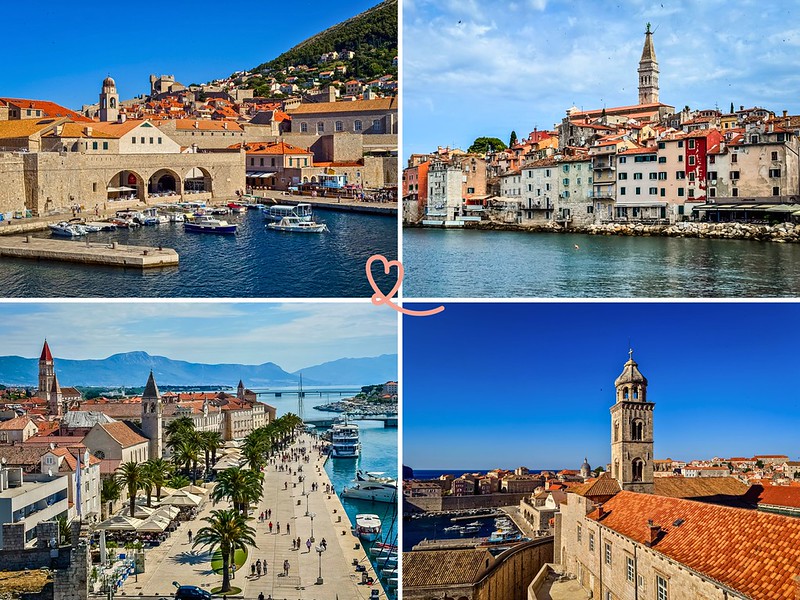
With its beaches, mountains, and white-stone city walls, Croatia boasts a rich architectural heritage: Roman palaces, Venetian alleyways, Baroque castles…
In this article, we share our selection of the most beautiful cities to visit in Croatia. And it’s a tough choice!
This opinion is completely independent, based on our experiences. We made our own choices, visited the area anonymously, and paid our bills in full.
Croatia’s Most Beautiful Cities: Summary + Map
Map
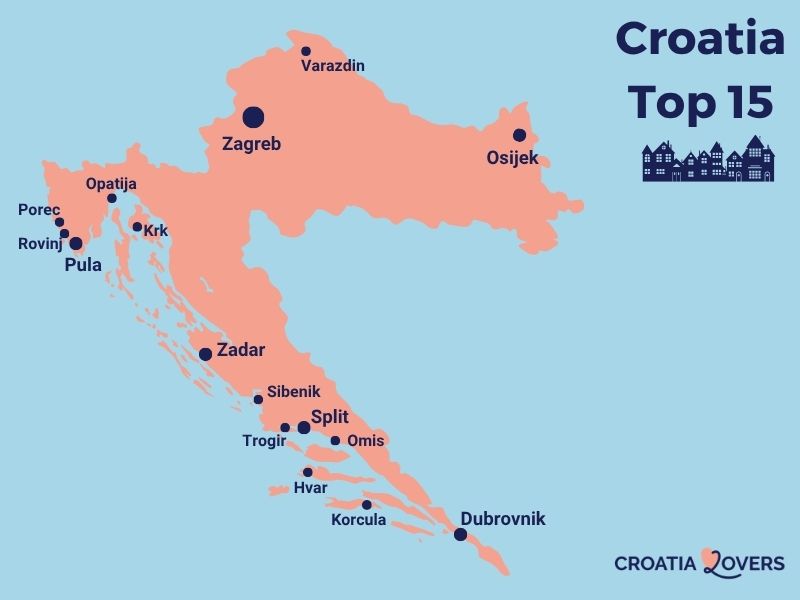
Croatia offers a wide variety of cities and villages, blending Roman heritage, Venetian influence, and Austro-Hungarian style. Let’s start by getting our bearings.
Here is a map featuring our selection of places to visit:
Which cities in Croatia should you visit? Quick answer :
It’s a really tough choice. They’re all very charming. And it depends on what you prefer. If you can only visit 5, to get a sense of the different styles:
- Dubrovnik, for its city walls and its Old Town, a UNESCO World Heritage Site
- Split, for its inhabited Roman palace right in the heart of the city
- Rovinj, for its Venetian charm and its peninsula
- Zadar, for its sea organ and laid-back atmosphere
- Zagreb, for its café atmosphere and museums
1. Dubrovnik

Why we love it
Nicknamed the Pearl of the Adriatic, Dubrovnik left a lasting impression on us with its medieval ramparts that encircle a completely pedestrian-only old town, built of white stone and designated a UNESCO World Heritage Site.
Surrounding the historic center, Southern Dalmatia offers much quieter islands, such as the Elaphiti Islands or Mljet.

Attractions
- A complete walk around the ramparts (about 2 km), offering a 360° view of the city and the sea
- The Stradun, the main street paved with marble that runs through the old town
- The Mount Srđ Cable Car: A View Over the Entire Bay
- The Rector’s Palace and Fort Lovrijenac
- See all of Dubrovnik’s attractions

Advice
- Located in the very south of Dalmatia, with its own airport
- From Split = 3-hour drive
- From Zagreb = a 5.5-hour drive (or a 1-hour flight)
- The best time to visit the ramparts is early in the morning, before the cruise ships arrive.
- Set aside a full day for the old town, and plan a trip to one of the nearby islands if the weather permits.
- See our selection of the best hotels in
or go directly to the top-rated accommodations in Dubrovnik
OUR ADVICE FOR RENTING YOUR CAR AT Croatia
- Compare prices on our preferred platform: DiscoverCars – one of the best rated sites.
- Choose a car that is powerful enough (the roads are steep) but compact (some passages are narrow).
- There is a lot of demand, book it early.


See our tips (coming soon)
2. Split

Why we love it
Split is undoubtedly the liveliest city on the Dalmatian coast. Its historic center is actually located within the palace of the Roman Emperor Diocletian, built in the 4th century: a UNESCO World Heritage Site where you can live, eat, and shop amid ancient ruins.
We really loved this continuity between past and present, which is rare on this scale.
It’s our favorite destination for a trip to Croatia (see our list).

Attractions
- The palace’s basements and the peristyle, the heart of the ancient site
- St. Domnius Cathedral and its bell tower, offering a view of the entire city
- La Riva, the waterfront lined with palm trees and cafés
- Marjan Hill, the city’s green lung, is the perfect spot to watch the sunset
- From Split, you can also take a day trip to Zlatni Rat Beach on the island of Brač or the lavender fields of Hvar.

Advice
- Located in the heart of Central Dalmatia, with its own airport
- From Dubrovnik = 3-hour drive
- From Zadar = 2½-hour drive
- It’s an easy city to explore. The only thing is Marjan Park, which has a hill in the center.
- Plan on spending at least 2 days in the city, but it’s also a great base for a week-long exploration of the region
- See all the top-rated accommodations in Split
3. Rovinj

Why we love it
Rovinj is undoubtedly the most photogenic town in Istria. Built on a former island that is now connected to the mainland, it retains a strong Venetian character, with its colorful houses huddled close together.
We loved getting lost in its cobblestone alleys that wind their way up to the bell tower of St. Euphemia, visible from afar across the entire peninsula.

Attractions
- St. Euphemia Church and its bell tower, the highest point in the old town
- The harbor and its colorful houses, best viewed from the pier
- The cobblestone streets of the peninsula, including the famous Grisia and its art galleries
- The Zlatni Rt Forest Park, right next door, for a peaceful break

Advice
- Located on the west coast of Istria
- From Pula = 40-minute drive
- From Zagreb = 3.5-hour drive
- Generally easy to explore, but there are cobblestones, so avoid shoes with thin heels.
- Allow 1 day
- See top rated accommodations in Rovinj
4. Trogir

Why we love it
Trogir is one of our favorite places. It’s a small medieval island town, situated between the mainland and the island of Čiovo and connected to both by bridges. The entire area is a UNESCO World Heritage Site because of its remarkably well-preserved urban layout.
We appreciated the intimate size of the town, which you can explore entirely on foot in just a few hours. St. Lawrence Cathedral, with its carved Romanesque portal, is the main attraction in the historic center. And we loved it.

Attractions
- St. Lawrence Cathedral and its Romanesque portal
- The Kamerlengo Fortress, on the waterfront
- The waterfront and its promenade lined with boats
- The car-free medieval streets of the historic district

Advice
- Located just 30 minutes from Split, practically across from the airport
- From Split = 30-minute drive
- From Šibenik = 1-hour drive
- Easy to visit in half a day, as a complement to Split
- Easy to explore, very flat
- See all the top-rated accommodations in Trogir
A LITTLE MORE patience
All the photos, maps, information and addresses you need to make your stay in Croatia a success will soon be available in a single ebook!
5. Hvar

Why we love it
The town of Hvar, on the island of the same name, combines an elegant old town, a fortress overlooking the harbor, and a reputation for lively nightlife that attracts visitors from around the world.
We were particularly struck by the view from Fortica Fortress, which overlooks the town, the harbor, and the Pakleni Islands.
The island’s hinterland, covered with fields of lavender in bloom from late May through July, is also worth exploring by bike or car.

Attractions
- Fortica Fortress, which overlooks the harbor
- Svetog Stjepana Square and its cathedral
- The Charm of the Waterfront
- The Pakleni Islands, just across the way, accessible by water taxi

Advice
- An island in Central Dalmatia, accessible only by boat
- From Split = 1-hour high-speed ferry ride (to the town of Hvar)
- From Dubrovnik = no direct connection; expect one transfer
- Book your crossing several days in advance in July and August
- See all the top-rated accommodations in Hvar
6. Zadar

Why we love it
Zadar blends more than 3,000 years of Roman, Venetian, and contemporary history into a city on a human scale that’s much less crowded than Split or Dubrovnik.
We found the atmosphere particularly laid-back, thanks to two unique installations along the waterfront: the Sea Organ, which produces a melody using the waves, and the Greeting to the Sun, a circle of solar panels that lights up at night.

Attractions
- The Sea Organ and the “Salute to the Sun”—best viewed at sunset
- The Roman Forum and the Church of Saint Donat
- St. Anastasia Cathedral and its facade
- The archaeological museum, home to a wealth of statues and mosaics
- See all attractions in Zadar

Advice
- Located in Northern Dalmatia, with its own airport
- From Split = a 2.5-hour drive
- From Zagreb = 3-hour drive
- To Plitvice = 1 hour and 40 minutes by car
- Plan on spending 2 days in the city, but it’s also a good base for exploring Central Dalmatia, Northern Dalmatia, and Plitvice.
- See our selection of the best hotels
, or go directly to the top-rated accommodations in Zadar
7. Šibenik

Why we love it
Unlike other major coastal cities, Šibenik was founded by the Croats themselves rather than by the Romans or the Venetians, which gives it a slightly different identity.
We enjoyed getting lost in its maze of cobblestone alleys that wind their way up from the harbor to St. Michael’s Fortress.
The city also serves as a gateway to Krka National Park and the Kornati archipelago.

Attractions
- St. James Cathedral, a UNESCO World Heritage Site
- The Saint-Michel Fortress, for the view of the city and the islands
- The maze of alleys and stairways in the old town
- A trip to nearby Krka National Park

Advice
- Located halfway between Split and Zadar
- From Split = 1-hour drive
- From Zadar = 1-hour drive
- To Krka National Park = 20-minute drive
- Plan on 1 to 2 days, or more if you want to explore the region
- A city with stairs and slopes
- See the top-rated accommodations in Sibenik
8. Pula

Why we love it
Pula, the largest city in Istria, is home to one of the best-preserved Roman amphitheaters in the world, right in the city center.
We were surprised by the contrast between this ancient monument and the very local atmosphere of the rest of the city.
It’s also a good starting point for exploring the hilltop villages of Green Istria.

Attractions
- The Pula Amphitheater (the Arena), one of the six largest surviving Roman amphitheaters
- The Temple of Augustus, on the Forum Square
- The Fortress and the History Museum
- The Zerostrasse underground tunnels, dug by the Austro-Hungarian Army
- See all attractions in Pula

Advice
- At the southernmost tip of the Istrian Peninsula, with its own airport
- From Zagreb = 3 hours and 20 minutes by car
- From Zadar = 4.5-hour drive
- A rental car is highly recommended for exploring the interior
- A city that’s easy to explore
- Plan on spending at least 2 days visiting attractions and museums
- See our selection of the best hotels
or go directly to View the top-rated accommodations in Pula
9. Poreč

Why we love it
Poreč is built on a small peninsula that has retained the grid-like layout of its Roman origins, making the town easy to explore on foot.
We were very impressed by the Euphrasian Basilica, a UNESCO World Heritage Site known for its exceptionally well-preserved Byzantine mosaics. A visit here is truly a must.
The waterfront, which comes alive in the evening, is a great way to round out a visit to the historic center.

Attractions
- The Euphrasian Basilica and Its Byzantine Mosaics
- The old town on the peninsula, laid out in the Roman style
- The waterfront and its promenade
- Boat trips to the nearby islets
- See all attractions in Poreč

Advice
- On the west coast of Istria, north of Rovinj
- From Pula = 1-hour drive
- From Rovinj = 30-minute drive
- It gets very crowded in the summer, so it’s best to go early in the morning or late in the evening
- Easy to explore
- Allow 1 day
- See our selection of the best hotels
or go directly to View the top-rated accommodations in Porec
10. Zagreb

Why we love it
Zagreb is unlike any other Croatian city: it’s a Central European capital, with its cafés, covered markets, and laid-back atmosphere—very different from the coast.
The Upper Town, with its colorful rooftops, remains our favorite spot for a leisurely stroll.

Attractions
- The Upper Town (Gornji Grad), with St. Mark’s Church and its colorful tiled roof
- The Lotrščak Tower and its cannon, which fires every day at noon
- The Dolac Market, just above the main square
- The Museum of Broken Relationships: As Moving as It Is Original

Advice
- Capital, in the far north of the country, inland
- From Split = a 4.5-hour drive (or a 50-minute flight)
- From Zadar = 3-hour drive
- It’s a great place to visit year-round, including in winter, and makes for an excellent 2- to 3-day city break.
- See the top-rated accommodations in Zagreb
11. Omiš

Why we love it
Omis is nestled at the spectacular mouth of the Cetina River, framed by steep cliffs that stand in stark contrast to the rest of the Dalmatian coast.
We loved immersing ourselves in its past as a pirate hideout; pirates once controlled this stretch of the Adriatic from their perched fortress. And it’s easy to imagine!
Today, it is a popular destination for rafting and rock climbing, in addition to its small, old walled town.

Attractions
- The Cetina Canyon, for rafting or a leisurely boat ride
- Mirabela Fortress, which overlooks the city
- The small, walled old town and its harbor
- The surrounding cliffs, which are very popular with climbers

Advice
- On the coast, between Split and Dubrovnik
- From Split = 40-minute drive
- From Dubrovnik = 2.5-hour drive
- Easy to visit on a day trip from Split
- The old town is very hilly, but it’s worth the effort for the views!
- See all the top-rated accommodations in Hvar
12. Korčula

Why we love it
The town of Korčula, on the island of the same name, sits on a small peninsula whose fishbone-shaped layout allows the sea breeze to flow through the narrow streets.
We enjoyed its much quieter atmosphere compared to Dubrovnik, while still boasting comparable Venetian architecture.
The town also claims to be the birthplace of Marco Polo, a fact commemorated by a house open to visitors.

Attractions
- The old walled city, laid out in a fishbone pattern
- St. Mark’s Cathedral and its square
- Marco Polo’s Alleged Home
- The vineyards near the Pelješac Peninsula

Advice
- An island in southern Dalmatia, near the Pelješac Peninsula
- From Orebić (Pelješac) = 15-minute ferry ride
- From Dubrovnik = about a 2-hour drive and ferry ride
- From Split: a direct ferry ride of about 3 hours during the season
- View accommodations in Korčula
OUR ADVICE FOR RENTING YOUR CAR AT Croatia
- Compare prices on our preferred platform: DiscoverCars – one of the best rated sites.
- Choose a car that is powerful enough (the roads are steep) but compact (some passages are narrow).
- There is a lot of demand, book it early.
See our tips (coming soon)
13. Krk

Why we love it
The town of Krk has preserved much of its medieval fortifications, which surround a cathedral and the Frankopan Castle overlooking the sea.
The island has been connected to the mainland by a bridge since 1980, making it very easy to reach.
And we really enjoyed the atmosphere there.
Attractions
- The Old Town and its Cathedral of the Assumption
- Frankopan Castle and its ramparts
- The village of Vrbnik and its wine cellars
- The beaches of Baška and Stara Baška, in the southern part of the island

Advice
- An island in Kvarner Bay, connected to the mainland by a bridge
- From Rijeka = 30-minute drive
- From Zagreb = 2-hour drive
- Plan on spending at least one day—or more—if you want to explore the entire island
- View accommodations in Krk
14. Opatija

Why we love it
Opatija is the oldest seaside resort on the Adriatic, developed in the late 19th century by the aristocracy of the Austro-Hungarian Empire.
We found its atmosphere to be very different from the rest of the Croatian coast, with its Belle Époque villas, manicured gardens, and grand hotels from a bygone era.
The 12-kilometer-long Lungomare promenade runs along the coast, connecting the fishing village of Volosko to Lovran.

Attractions
- Villa Angiolina and its Croatian Museum of Tourism
- The Lungomare Promenade, along the waterfront
- Angiolina Park and Its Exotic Tree Species
- The fishing village of Volosko, a half-hour walk away

Advice
- Kvarner Bay, a few kilometers from Rijeka
- From Rijeka = 15-minute drive
- From Zagreb = 2-hour drive
- Can be visited in one day
- View accommodations in Opatija
15. Varaždin

Why we love it
Nicknamed “Little Vienna,” Varazdin was briefly the capital of Croatia from 1756 to 1776, leaving it with a remarkably well-preserved Baroque city center.
We were charmed by its pastel-colored facades and entirely pedestrian-only streets, which are very different from the Mediterranean atmosphere of the coast.
Stari Grad Castle, a white fortress surrounded by a moat, rounds out this historic getaway away from the crowds.

Attractions
- Stari Grad Castle and its municipal museum
- King Tomislav Square and its City Hall
- The Cathedral of the Assumption, in the Baroque style
- The Patačić palaces, along the cobblestone streets of downtown

Advice
- In the far north of the country, near Slovenia
- From Zagreb = 1 hour and 15 minutes by car
- From Trakošćan Castle = 40-minute drive
- A nice leg of the journey between Zagreb and Slovenia
- View accommodations in Varazdin
Other major cities to explore
In addition to our main selection, two other major cities are worth visiting if your itinerary allows.
16. Rijeka

Rijeka is a lively port city, less touristy than its neighbors in Kvarner Bay.
We loved its Korzo, the wide pedestrian street lined with cafés featuring Austro-Hungarian architecture, as well as Trsat Castle, which overlooks the city from its hilltop.
See accommodations.
17. Osijek

Osijek, the main city of Slavonia, is home to the Tvrđa, a Baroque fortress that has now become a lively neighborhood filled with cafés.
We enjoyed walking along the Drava River and birdwatching in the nearby Kopački Rit Nature Park.
See accommodations.
Other small towns and villages to explore
And if you still have a little time left, Croatia is full of small towns and villages that are worth a visit. Here are a few of our favorites—though this list is by no means exhaustive, given how rich the country’s urban heritage is.
18. Nin

Nin is a small historic town surrounded by salt marshes and sandy beaches, 20 minutes from Zadar.
We loved its tiny Church of the Holy Cross, often described as the world’s smallest cathedral still in use.
19. Mali Ston

Mali Ston, the twin town of Ston on the Pelješac Peninsula, is connected to Ston by long fortified walls that are among the longest in Europe.
We were particularly impressed by its culinary reputation, with oysters and mussels harvested right beneath the windows of the village restaurants.
20. Rab

The old town of Rab is recognizable from afar by its four Romanesque bell towers rising above the rooftops, including that of St. Mary’s Cathedral.
We also enjoyed the nearby Lopar Peninsula, known for its sandy beaches, which are quite rare in Croatia.
21. Stari Grad

Founded by Greek settlers in the 4th century BCE, Stari Grad is one of the oldest cities in Europe.
We particularly enjoyed its agricultural plain, a UNESCO World Heritage Site, which is still cultivated according to the geometric layout left by the Greeks.
22. Novigrad

Novigrad, in Istria, is a small port town that has retained the atmosphere of a fishing village; it is more low-key than its neighbors, Rovinj and Poreč.
We enjoyed its quieter waterfront and its narrow streets lined with seafood restaurants.
23. Motovun

Motovun is a hilltop village in Green Istria, famous for its truffles and its view of the entire Mirna Valley.
We loved arriving there in the late afternoon, when the low-angled sunlight illuminates the surrounding vineyard-covered hills.
See all of Motovun’s attractions
And the list doesn’t end there: from the hilltop villages of Green Istria to the small fortified towns of Kvarner and the villages of the Dalmatian hinterland, Croatia is brimming with many other hidden gems to discover as you travel.
PLAN YOUR TRIP TO Croatia
- Best of
Top Destinations
; Most Beautiful Cities
; Most Beautiful Islands
; National Parks

- Practical advice
When to go?
How to rent a car in Croatia
Driving tips
Itineraries: Road Trip—10 Days, 2 Weeks, 3 Weeks

- The must-dos
Attractions in Dubrovnik
Attractions in Zadar
Attractions in Split
Attractions in Zagreb
Attractions in Istria
The Plitvice Lakes