Don’t worry. Here’s our complete guide to driving in Croatia, including:
- Safety and driving difficulties
- Rules of conduct
- Road conditions
This opinion is completely independent, based on our experiences. We made our own choices, visited the area anonymously, and paid our bills in full.
Driving in Croatia: What You Need to Know
If you don’t want to read the whole article, at least read this short summary of the essential points to know:
- People drive on the right side of the road there
- The minimum age to drive is 18, but some rental agencies may require drivers to be older—often 21
- Seat belts are required for everyone, both in the front and back seats
- The legal blood alcohol limit is 0.05%, and 0.0% for drivers under the age of 24
- Headlights must remain on day and night, all year round
- Unlike many other destinations, Croatia has several toll highways, particularly between Zagreb and Split
- The country consists of many islands, some of which are accessible only by ferry
- In case of accident – emergency number: 112
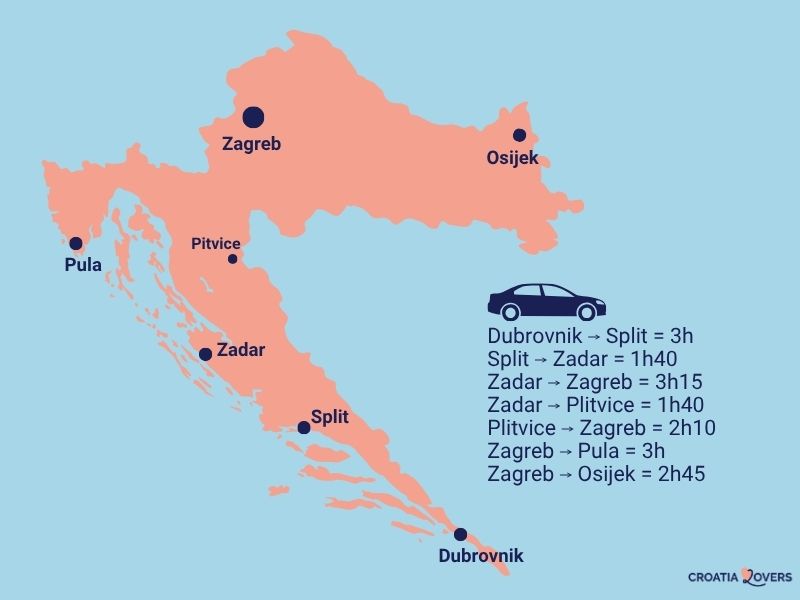
Here are the driving times in the region, to give you an idea of how to get around:
1. Renting the Right Car in Croatia
To make driving easier, it’s best to choose a car that’s suited to the types of roads and conditions. In Croatia, we recommend:
- Not too big, because some streets in old coastal towns are narrow
- A good engine, because some roads in the backcountry and on the mountainous islands are quite steep
- Automatic if possible, since coastal roads are winding and require frequent gear changes
- Learn more in our article on how to rent a car in Croatia (coming soon)
- See great rental offers on our preferred platform

2. Know the rules of conduct
Permit requirements
To drive in Croatia, you need a valid driver’s license from your home country.
If you have a valid driver’s license that includes a license number, a photo, an expiration date, and is written in the Latin alphabet, then you do not need an international driver’s permit.
Otherwise, you must also carry an international driver’s permit.

Age
The minimum age to drive is 18.
However, please note that many car rental agencies may have different age requirements, often 21 years old and at least one year of driving experience.
It is also mandatory to carry the vehicle’s registration documents and a valid form of identification, such as your passport, at all times.
General rules
- In Croatia, people drive on the right side of the road
- Seat belts are required for everyone, both in the front and back seats
- No cell phones while driving, except when using a hands-free device
- Headphones are forbidden
- Children under 12 years of age, or shorter than 1.35 meters, must be seated in the back in an appropriate child safety seat
- Headlights must remain on at all times, day and night, throughout the year

Alcohol and driving
The blood alcohol limit is 0.05 g per liter of blood. For drivers under 24, it drops to 0.0%: there is therefore zero tolerance.
We recommend that you never drink at all if you are driving.

A LITTLE MORE patience
All the photos, maps, information and addresses you need to make your stay in Croatia a success will soon be available in a single ebook!
Mandatory in-car equipment
In Croatia, the following items must be available in the car:
- Reflective warning triangle
- Reflective vest or jacket, kept within easy reach inside the vehicle, not in the trunk
- Replacement bulbs
- First-aid kit (recommended)
- Seats suitable for children under 12 years of age or shorter than 1.35 meters
- In winter, between November 15 and April 15, snow chains or winter tires may be required in certain mountainous areas, particularly on roads in the backcountry.

Compulsory insurance
Liability insurance is required to drive in Croatia.
It is automatically included in the price of all car rentals.
If you are bringing your own vehicle, be sure to bring proof of insurance, specifically a Green Card valid for Croatia.
WHERE TO STAY IN Croatia
See our complete selection of the best destinations in Croatia
See our tips by city:
See our recommendations by hotel type:

3. Preparing for different types of road
Freeways
Croatia has a modern highway network that connects Zagreb to Split, as well as Zagreb to Rijeka.
These roads are in excellent condition and allow for high speeds.
Unlike other Mediterranean destinations, there is a fee to use these highways, via a toll system that we describe in more detail below.
They remain the fastest and most comfortable way to travel between the country’s major cities.

Coastal Roads
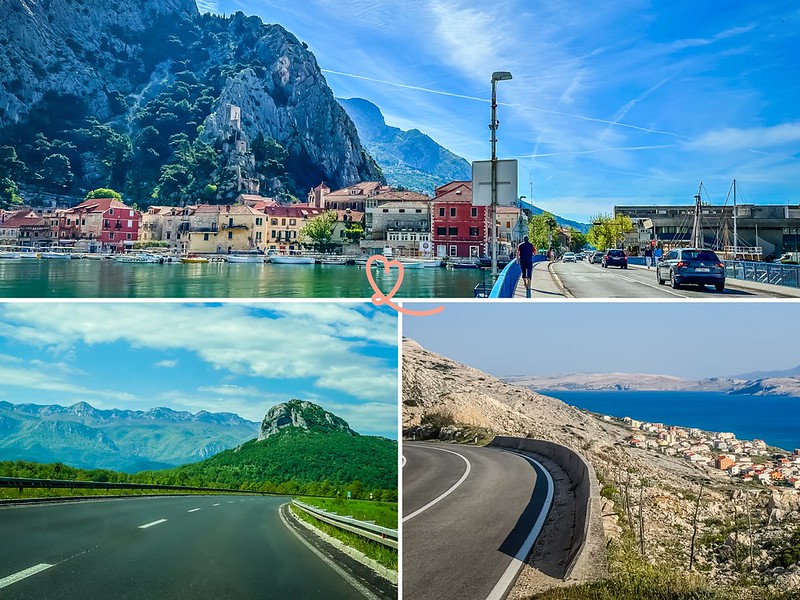
The Jadranska Magistrala, or Adriatic Highway, runs along the entire coast, from Istria to southern Dalmatia. It offers views of the sea, but it’s also more winding and often congested during peak season. We recommend allowing more time than expected for this stretch, especially in July and August.
And on the many islands and along the entire coast, you’ll discover some truly beautiful stretches of road between the sea and the mountains.

Mountain and Backcountry Roads
In the inland areas, particularly around the Velebit region and in central Istria, the roads are narrower and more winding.
They do not present any major difficulties, but do require extra caution, especially at intersections.
Some of the climbs up to Istria’s hilltop villages are also quite steep.

Riding in towns and villages
In old coastal towns, such as the historic centers of Dubrovnik or Rovinj, car traffic is often prohibited or severely restricted.
You’ll therefore need to park outside and continue on foot.
In inland villages, the streets can be narrow: we recommend that you avoid renting a car that’s too large.

The Islands and the Ferries
Croatia has many inhabited islands, including Hvar, Pag, Brač, Korčula, and Krk.
Some are connected to the mainland by a bridge, such as Krk, while others require a ferry—with or without your vehicle.

We recommend that you book your ferry crossing in advance during peak season, as spots for vehicles fill up quickly.
Once on the island, the roads are often narrower and less busy than on the mainland.

A few unpaved roads
To reach certain locations or parking areas, the road isn’t always paved. Drive slowly to avoid getting rocks flying into your windows!

4. Understanding signs and tolls
Speed limits
- Speed limits are indicated on circular signs with a red border and a number
- Speed limits are expressed in kilometers per hour
- 50 km/h in built-up areas
- 90 km/h on the highway
- 110 km/h to 130 km/h on the highway, depending on the section

Road signs
Road signs are standard and written in Latin characters; there is nothing specific you need to know.
Tourist attractions are marked on brown signs.

Tolls
Unlike many island destinations, Croatia has several toll highways, including the A1 between Zagreb and Split.
The toll depends on the distance traveled; a ticket is issued at the entrance, and payment is made at the exit, either in cash or by card.
The bridge connecting the island of Krk to the mainland also requires a toll.
Be sure to set aside a little extra money if your itinerary includes these routes.
5. Safety: understanding potential hazards
Is driving in Croatia dangerous?
No, not particularly. But it’s not “easy” either.
Many travelers hesitate before getting behind the wheel in a country they know little about, but in our opinion, there’s no need to worry unduly.
The highway system is in excellent condition, and the coastal road, although sometimes busy, remains well-marked.
We simply recommend staying alert on mountain stretches and when passing on narrow roads in the interior.

Potential hazards
- The scenery – The coastline can be so beautiful that you might get distracted. Focus on the road and let your passenger enjoy the view.
- Summer Traffic – In July and August, the coastal highway is very busy, especially around Split and Dubrovnik.
- Cyclists —Make sure you have a clear view before passing, especially on backcountry roads.
- Animals – In rural and mountainous areas, animals may cross the road, especially at dawn and dusk.

Specific driving tips
There’s no shame in driving slowly on the winding roads of the hinterland or the islands.
If you’re traveling during peak season, set out early in the morning to avoid traffic jams on the coastal road.
Also, be sure to check ferry schedules if your itinerary includes a trip to an island, as the number of crossings is sometimes limited.

What to do in the event of an accident
If people are injured or there is a conflict, the emergency number is 112.
The best order of action is:
- contact emergency services
- contact the police
- contact your rental provider
6. And the rest: parking, fuel…
Fuels and service stations
- Unleaded gasoline is called “bezolovni benzin”
- Diesel is called “dizel”
- There are many gas stations along major highways and in coastal cities
- On smaller islands, they may be harder to find: be sure to fill up before boarding a ferry
Parking in town
In cities, parking is generally paid and organized into time-limited zones.
We recommend parking in lots on the outskirts of the old towns rather than trying to find a spot in the narrow streets of the city center.
In Dubrovnik and Split, parking lots near the city walls fill up quickly during peak season.

Parking at beaches and attractions
Parking conditions vary greatly from one attraction to another.
At Plitvice Lakes, the parking lots are large but fill up quickly during peak season.
Along the coast, some coves have only a few parking spaces: we recommend arriving early in the morning.

The Most Beautiful Roads in Croatia
Be sure to drive along Croatia’s most scenic roads, such as:
- The Jadranska Magistrala, between Istria and Dalmatia
- The coastal road around the Istrian Peninsula
- The road leading to Krka National Park
- Crossing the Pelješac Bridge
- The Road Through Pag’s Lunar Landscapes
Frequently asked questions
Do you need a car in Croatia?
It depends on what you’re looking for in a vacation.
To explore the countryside, Plitvice Lakes, or the small villages of Istria, we highly recommend renting a car.
But if you’re staying exclusively in a major city like Dubrovnik or Split, public transportation and organized tours are more than enough.
Can you take the ferry with your rental car?
Yes, most ferry companies accept rental cars.
However, be sure to check with your rental agency to see if your contract allows this type of trip, as certain conditions may apply.
We also recommend that you book your ferry crossing in advance during the high season.
PLAN YOUR TRIP TO Croatia
- Best of
Top Destinations
Top Attractions
Most Beautiful Cities
Most Beautiful Islands
National Parks

- Practical advice
When to go?
Howtorent a car in Croatia
Driving tips
Itineraries: Road Trip—10 Days, 2 Weeks, 3 Weeks