With more than a thousand islands and islets scattered along its coastline, Croatia boasts one of the most diverse archipelagos in the Mediterranean: trendy islands, national park islands, car-free islands, and monastic islets…
In this article, we share our selection of the most beautiful Croatian islands to visit. And there’s plenty to choose from!
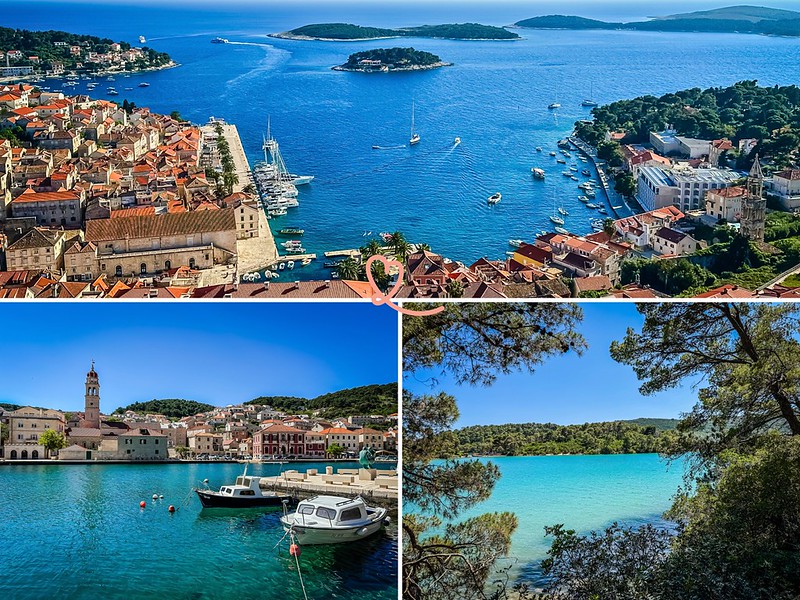
This opinion is completely independent, based on our experiences. We made our own choices, visited the area anonymously, and paid our bills in full.
Croatia’s Most Beautiful Islands: Summary + Map
Map
Some Croatian islands are just a 10-minute boat ride apart, while others require a several-hour crossing from the mainland. Let’s start by getting our bearings.
Here is the map showing our selection of places to visit:
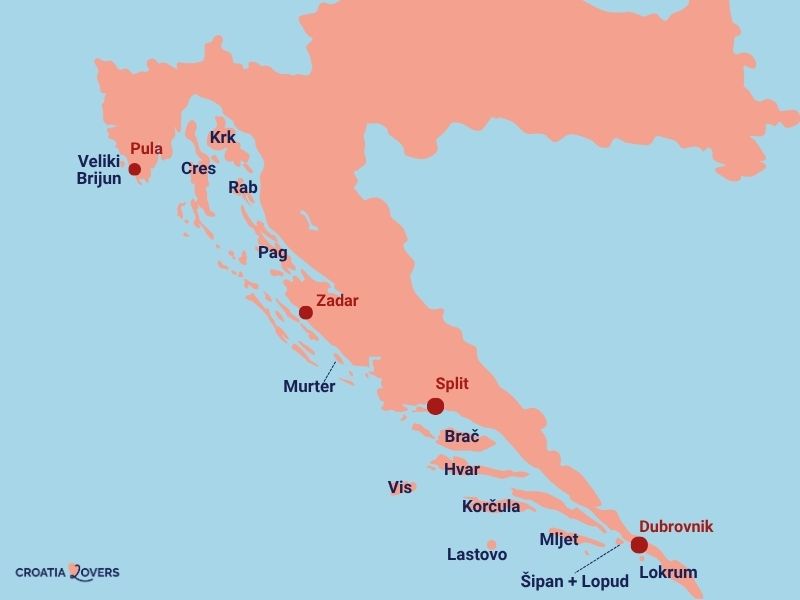
Which Croatian islands should you visit? Quick answer :
It’s a really tough choice: each island has its own unique character, ranging from a festive atmosphere to protected natural areas and historical heritage. If you could only visit 5 of them:
- Hvar, for its nightlife and the Stari Grad Plain, a UNESCO World Heritage Site
- Korčula, for its walled city and its connection to Marco Polo
- Brač, for Zlatni Rat Beach and its white limestone
- Mljet, for its national park and salt lakes
- Vis, for its unspoiled authenticity and its Blue Grotto
1. Hvar

Why we love it
Hvar is the most cosmopolitan of the Dalmatian islands, known for its nightlife, but it is also home to two UNESCO World Heritage sites: the town of Hvar itself and, above all, the Stari Grad plain, cultivated according to the ancient layout established by Greek settlers in the 4th century BCE.
We enjoyed the climb up to Fortica Fortress, which overlooks the harbor, the old town, and the Pakleni Islands. We also loved the laid-back lifestyle in Stari Grad, which is much quieter than its neighbor

Attractions
- Fortica Fortress, which overlooks the harbor and the Pakleni Islands
- The Stari Grad Plain, designated a UNESCO World Heritage Site for its ancient agricultural layout
- St. Stephen’s Cathedral and Svetog Stjepana Square
- The lavender fields in the countryside, in bloom from late May through July
- The Pakleni Islands, just across the way, accessible by water taxi

Access
- An island in Central Dalmatia, accessible only by boat
- From Split = 1-hour high-speed ferry ride (to the town of Hvar)
- From Dubrovnik = no direct connection; expect one transfer
- Book your crossing several days in advance in July and August
- Plan on spending 2 to 3 days so you can also explore Stari Grad and the countryside
- See all the top-rated accommodations in Hvar
2. Korčula

Why we love it
Korčula is situated on a small peninsula whose fishbone-shaped layout allows the sea breeze to flow freely through the narrow streets.
We enjoyed its much quieter atmosphere compared to Dubrovnik, while still finding similar Venetian architecture.
The city also claims to be the birthplace of Marco Polo, as commemorated by a house open to visitors.
Finally, we enjoyed the nearby vineyards on the Pelješac Peninsula, which is connected to the island by a short ferry ride.

Attractions
- The old walled city, laid out in a fishbone pattern
- St. Mark’s Cathedral and its square
- Marco Polo’s Alleged Home
- The vineyards of the Pelješac Peninsula, nearby
- The village of Lumbarda and its sandy beaches, in the south of the island

Access
- An island in southern Dalmatia, near the Pelješac Peninsula
- From Orebić (Pelješac) = 15-minute ferry ride
- From Dubrovnik = about a 2-hour drive and ferry ride
- From Split: a direct ferry ride of about 3 hours during the season
- Plan on spending 2 days in the city and on the island
- Book your ferry
- See the top-rated accommodations in Korčula
OUR ADVICE FOR RENTING YOUR CAR AT Croatia
- Compare prices on our preferred platform: DiscoverCars – one of the best rated sites.
- Choose a car that’s compact enough (some passages are narrow).
- There is a lot of demand, book it early.


3. Brač

Why we love it
The third-largest island in the Adriatic, Brač owes its reputation to Zlatni Rat, a white pebble beach shaped like a point that changes direction depending on the wind.
We loved its mountainous landscape, dotted with white stone quarries that have been in use since Roman times to build palaces and monuments.
The Blaca Hermitage, a 16th-century monastery carved into the rock and accessible only on foot, also left a lasting impression on us with its seclusion.
The maestral, a steady afternoon wind, also makes the southern coast one of the best windsurfing spots in Europe.

Attractions
- Zlatni Rat Beach in Bol, whose tip changes shape depending on the wind
- The Blaca Hermitage, a 16th-century monastery carved into the cliff
- The port of Supetar, nestled among stone houses and lush vegetation
- The Dragon Cave in Murvica, adorned with ancient sculptures
- The windsurfing spots on the south coast, popular thanks to the mistral
- The village of Pucisca and its sculptures

Access
- Off the coast of Split
- From Split: a 50-minute ferry ride to Supetar
- From Makarska = 1-hour ferry ride to Sumartin
- A high-speed catamaran also provides direct service between Split and Bol during the season
- Plan on 2 days to visit both Supetar and Bol
- Book your ferry
- See the top-rated accommodations on Brač
4. Screw

Why we love it
Vis is the most remote of Croatia’s inhabited islands, and this isolation has long worked in its favor: closed to foreigners until 1989 due to its history as a Yugoslav military base, it has remained untouched by mass tourism.
We loved its laid-back atmosphere, nestled between the fishing village of Komiža and the town of Vis, built on the ruins of the ancient Greek colony of Issa.
From Komiza, a boat takes you to the Blue Cave on the neighboring island of Bisevo, where sunlight turns the water a deep blue, and to numerous coves with emerald waters.

Attractions
- The Blue Cave of Bisevo,
- The fishing village of Komiza, overlooked by Mount Hum
- The ruins of the Greek colony of Issa, in the town of Vis
- The military bunkers and tunnels scattered across the island
- The beaches of Stiniva and Srebrna, among the most popular

Access
- The island farthest from the mainland, accessible only from Split
- From Split: about 2 hours and 30 minutes by regular ferry, or 1 hour and 20 minutes to 2 hours by catamaran
- No direct connections to neighboring islands such as Hvar or Brač
- The Blue Grotto is open to the public only from April through early November
- Plan to spend at least 2 to 3 days enjoying the island
- Book your ferry or excursion
, or day trip from Split - See the top-rated accommodations in Vis

It’s time to book!
Compare everything: companies, prices, schedules and availability.
5. Mljet

Why we love it
Mljet is the most forested of the Croatian islands, and its western part forms the oldest national park in the Adriatic, established in 1960.
You can kayak around the park’s two saltwater lakes, Veliko Jezero and Malo Jezero, which are connected to the sea by a narrow channel.
On the large lake lies a small island with a 12th-century Benedictine monastery, now converted into a restaurant.
We also visited the Cave of Ulysses on the southern coast, whose name recalls the legend of the Greek hero who took refuge here after a shipwreck.

Attractions
- The national park’s salt lakes, perfect for exploring by kayak or bike
- The islet of Sainte-Marie and its 12th-century Benedictine monastery
- Ulysses’ Cave, on the island’s southern coast
- The villages of Polače and Pomena, gateways to the park
- The quiet coves along the coast, far from the most popular lakes

Access
- An island in southern Dalmatia, between Korčula and Dubrovnik
- From Dubrovnik = about a 1-hour catamaran ride to Sobra
- From Prapratno (Pelješac) = 45-minute car ferry ride to Sobra
- We recommend renting a car, scooter, or bike to get around
- Plan to spend at least one full day at the national park
- Book your ferry to
or your day trip from Dubrovnik - See the top-rated accommodations in Mljet
6. Pag

Why we love it
Pag surprises visitors with its lunar landscape, shaped by the bora, a strong wind that strips the island’s eastern side bare.
We tasted paški sir, a hard sheep’s-milk cheese whose unique flavor comes from the salt carried by the wind, as well as lamb raised on these arid lands.
The town of Pag retains a peaceful atmosphere and a lace-making tradition recognized by UNESCO, while Novalja and its Zrće Beach attract a more party-oriented crowd.
We enjoyed the stark contrast between the deserted coves in the south and the electric atmosphere of the open-air clubs in the north.

Attractions
- The town of Pag, its UNESCO-listed architecture, and its historic alleyways
- Zrće Beach, near Novalja, known for its nightlife
- Salt Marshes and Artisanal Sheep Cheese Production
- The coves of Ručica, Beritnica, and Sveti Duh, which are quieter
- The summit of Sveti Vid (350 m), for a hike with a view of the island

Access
- Croatia’s fifth-largest island, with the country’s longest coastline
- Free access via the Pag Bridge, to the south
- From Prizna = a 15-minute ferry ride to Žigljen, to the north
- From Zadar = about a 1-hour drive
- Plan on 2 days to combine the historic city with the northern beaches
- Book your ferry
- See the top-rated accommodations in Pag
A LITTLE MORE patience
All the photos, maps, information and addresses you need to make your stay in Croatia a success will soon be available in a single ebook!
7. Lokrum

Why we love it
Lokrum is a protected nature reserve, just a 10-minute boat ride from Dubrovnik, yet a world away from its hustle and bustle.
We enjoyed strolling beneath the eucalyptus trees in the botanical garden, founded in 1959, and coming across the peacocks that roam freely on the island.
The medieval Benedictine monastery, where several scenes from the TV series *Game of Thrones* were filmed, is just a few minutes’ walk from the pier.
We also climbed up to Fort Royal, built by the French and later completed by the Austrians, for an unobstructed view of Dubrovnik’s old town.

Attractions
- The Botanical Garden and Its Collection of Eucalyptus Trees
- The Benedictine monastery, part of which has been converted into a museum
- Fort Royal, the island’s highest point (91 m)
- Peacocks roaming freely in the nature reserve
- The rocky beaches, including a naturist area to the south

Access
- An island off the coast of Dubrovnik, designated entirely as a nature reserve
- From the Old Port of Dubrovnik = about a 10-minute boat ride
- Combined ticket (ferry ride and admission) available for purchase on-site or online
- No lodging on the island; best visited as a day trip
- Plan to spend half a day in the garden and touring the island
- See excursions from Dubrovnik
8. Lastovo

Why we love it
Nicknamed the “Imperial Island” by the Romans, Lastovo and its archipelago have been part of a nature park since 2006, and its remote location kept it isolated from tourism for a long time; it remained closed to visitors until 1989.
We loved its main village, built in an amphitheater-like layout on a hill rather than facing the sea—a distinctive feature stemming from a historical fear of pirate attacks.
The 15th- and 16th-century stone houses there are topped with chimneys called “fumari,” each one unique and once a symbol of wealth.
We also took advantage of the island’s exceptionally clear night sky, ideal for stargazing far from any light pollution.

Attractions
- The village of Lastovo, built in an amphitheater-like formation on a hill
- Fumari chimneys, adorning 15th- and 16th-century houses
- Zaklopatica Bay, a natural harbor popular with boaters
- The 14th-century Church of Saints Cosmas and Damian
- Stargazing, made easier by the absence of light pollution

Access
- The southernmost island of the Dalmatian archipelago, located within a natural park
- From Split = about 3 hours by catamaran (via Hvar and Vela Luka)
- From Korčula (Vela Luka) = 1 hour to 1 hour and 45 minutes by ferry
- From Dubrovnik = seasonal catamaran service
- Plan to spend at least 2 days enjoying the island’s tranquility
- Book your ferry
- See the top-rated accommodations in Lastovo
9. Krk

Why we love it
Connected to the mainland by a bridge since 1980, Krk is the most accessible island in the Adriatic and shares with Cres the title of Croatia’s largest island.
We enjoyed the medieval fortifications of the town of Krk, which surround a cathedral and a Frankopan castle overlooking the sea.
The village of Vrbnik, perched on a cliff, is renowned for its wine cellars and its local grape variety, žlahtina.
Finally, we enjoyed the beaches of Baška and Stara Baška, in the south of the island, which are more secluded than the rest of the coastline.

Attractions
- The Old Town of Krk and its Cathedral of the Assumption
- Frankopan Castle and its ramparts
- The village of Vrbnik and its wine cellars
- The beaches of Baška and Stara Baška, in the southern part of the island
- The Krk Bridge, which connects the island to the mainland

Access
- An island in Kvarner Bay, connected to the mainland by a toll-free bridge
- From Rijeka = 30-minute drive
- From Zagreb = 2-hour drive
- A ferry is also available from Valbiska to the island of Cres (25 min)
- Plan on spending 1 to 2 days exploring the entire island
- See the top-rated accommodations in Krk
10. Rab

Why we love it
The old town of Rab is recognizable from afar by its four Romanesque bell towers rising above the rooftops, including that of St. Mary’s Cathedral.
We enjoyed strolling along the three parallel streets that form the layout of the old town, built on a narrow peninsula.
The Lopar Peninsula, in the north of the island, is renowned for its sandy beaches—a rarity in Croatia—including the famous Rajska Plaža (Paradise Beach).
We also enjoyed the island’s more family-friendly atmosphere, as it’s less crowded than Hvar or Krk.

Attractions
- The Old Town and its four Romanesque bell towers
- St. Mary’s Cathedral and its bell tower
- Paradise Beach (Rajska Plaža), on the Lopar Peninsula
- The pine forests of Dundo Park, on the western part of the island
- The coves accessible on foot or by water taxi from Lopar

Access
- Between Zadar and Istria
- From Stinica (mainland) = ferry to Mišnjak, about 15 minutes
- From Krk = connection available via Baška and the catamaran
- From Zadar or Rijeka = a combination of driving and ferry
- Plan to spend 2 days exploring the city and the Lopar Peninsula
- Book your ferry
- See the top-rated accommodations in Rab
11. Veliki Brijun

Why we love it
Veliki Brijun, the main island of the Brijuni Archipelago off the coast of Istria, is like an open-air museum.
We enjoyed exploring the ruins of a 1st-century BCE Roman villa in Verige Bay, followed by the safari park created for former Yugoslav President Tito, where zebras, llamas, and Lanka the elephant—a gift from India in 1974—still live.
More than 200 dinosaur footprints, dating from the Cretaceous period, can also be seen at several sites on the island, which children especially enjoy.
We also enjoyed exploring the island by bike or on a small tourist train, since cars are not allowed there.

Attractions
- The ruins of the Roman villa in Verige Bay
- The safari park, with zebras, llamas, and Lanka the elephant
- Dinosaur tracks from the Cretaceous period, scattered across the island
- The Archaeological Museum and the exhibition dedicated to Tito
- The ethnographic park, a reconstruction of an Istrian farm

Access
- Archipelago off the coast of Fažana, in southwestern Istria
- From Fažana = about a 20-minute ferry ride
- From Pula to Fazana = 15-minute drive
- A car-free island, reserved for bicycles and electric vehicles
- This tour is usually organized as a guided excursion from Fažana
- Plan to spend a day touring the island
- See the available options for exploring this national park
- And you can even sleep there! Check availability at the Neptun Hotel
WHERE TO STAY IN Croatia
See our complete selection of the best destinations in Croatia
See our tips by city:
See our recommendations by hotel type:

12. Sipan

Why we love it
Šipan is the largest and most rural of the Elaphiti Islands, renowned for its olive groves and fortified Renaissance summer residences.
We enjoyed walking or biking between its two villages, Šipanska Luka and Suđurađ, along a fertile field bordered by old stone walls.
The Skočibuha family palace in Suđurađ bears witness to the island’s rich past as a vacation destination for the aristocracy of Ragusa.
We also enjoyed the island’s overall tranquility, where a few goats occasionally cross visitors’ paths.

Attractions
- The Skočibuha Family’s Fortified Palace in Suđurađ
- The villages of Šipanska Luka and Suđurađ, connected by a rural road
- The olive groves and vineyards of the hinterland
- The many churches and chapels scattered across the island
- Walks or bike rides between the two villages
Access
- The largest of the Elaphiti Islands, northwest of Dubrovnik
- From the port of Gruž (Dubrovnik) = regular ferry service, about 1 hour
- Often combined with Lopud and Koločep on a day trip
- An island not well-suited for visitors in a hurry; best explored at a leisurely pace
- Plan on spending half a day to a full day
- Book your ferry to
or your day trip to the Elaphiti Islands from Dubrovnik - See the top-rated accommodations in Sipan
13. Lopud

Why we love it
Lopud, in the heart of the Elaphiti archipelago, can be explored entirely on foot, as there are no cars on the island.
We enjoyed Šunj Beach, one of the few stretches of fine sand in the region, whose shallow waters are ideal for families.
The village is dominated by a 15th-century Franciscan monastery that offers an unobstructed view of the harbor and the neighboring islands.
We also came across the ruins of patrician residences, a legacy of the era when the aristocracy of Ragusa (the former name of Dubrovnik) spent their summers there.

Attractions
- The sandy beach at Šunj, with its shallow waters
- The 15th-century Franciscan monastery and its view of the harbor
- The ruins of patrician villas and ancient churches
- Excursions to the other Elaphite Islands, Koločep and Šipan
- Rent pedal boats to explore the bay
Access
- The central island of the Elaphiti Archipelago, northwest of Dubrovnik
- From the port of Gruž (Dubrovnik) = regular ferry service, about 50 minutes
- A car-free island, perfect for exploring on foot
- Day trips are also available from the Old Town
- Plan on spending half a day to a full day
- Book your ferry to
or your day trip to the Elaphiti Islands from Dubrovnik - See the top-rated accommodations in Lopud
14. Murter – Jezera

Why we love it
Murter is the most convenient gateway to Kornati National Park, a UNESCO-listed archipelago comprising more than 89 islands and islets, almost all of which are uninhabited.
We enjoyed strolling through the covered alleyways of Murter’s old town, where the stone houses evoke the island’s past as a Roman resort town.
The village of Betina, known for its traditional shipbuilding, and the village of Jezera, which has received numerous awards for its commitment to the environment, round out the visit nicely.
We finally got to enjoy the sandy beach at Slanica, which is quite rare in this part of Dalmatia.

Attractions
- A boat tour in Kornati National Park
- The sandy beach at Slanica, in the heart of the island
- The village of Betina, known for its traditional shipyards
- The Port of Jezera, recognized for its commitment to environmental sustainability
- Diving clubs, for exploring the surrounding seabed

Access
- An island connected to the mainland by a drawbridge, in Tisno
- From Šibenik = about a 30-minute drive
- The bridge is open only from 9:00 a.m. to 9:30 a.m. and from 6:00 p.m. to 6:30 p.m.
- Three marinas (Hramina, Betina, Jezera), which are very popular with boaters
- Plan for one day, plus a trip to the Kornati Islands if the weather permits
- Book your ferry
- See the top-rated accommodations in Murter
15. Cres

Why we love it
Cres shares with Krk the title of the largest island in the Adriatic, but its atmosphere remains much wilder, with dense forests to the north and arid pastures to the south.
We loved the town of Cres, with its colorful, Venetian-style facades, as well as the medieval village of Lubenice, perched 378 meters above sea level overlooking the sea.
The griffon vulture conservation center in Beli is home to the world’s only population of this bird of prey that nests directly on cliffs overlooking the sea.
We finally got to taste Cres lamb, whose distinctive flavor comes from the diet of the free-range sheep.

Attractions
- The medieval village of Lubenice, perched at an elevation of 378 meters
- The Griffon Vulture Conservation Center in Beli
- The town of Cres and its small port with Venetian influences
- Lake Vrana, a freshwater reservoir with restricted access
- Sveti Ivan Beach, below the village of Lubenice
Access
- A Kvarner Island, tied with Krk for the title of the largest island in the Adriatic
- From Brestova (Istria) = 20 to 25 minutes by ferry to Porozina
- From Valbiska (Krk) = 25-minute ferry ride to Merag
- Connected to the island of Lošinj by a bridge, with no need for a ferry
- Plan on 2 days to explore both the forested north and the arid south
- Book your ferry
- See the top-rated accommodations in Cres
Other Islands to Explore
And if you still have a little time, Croatia has over a thousand islands and islets. Here are a few more of our favorites—though this list is by no means exhaustive, given the sheer richness of the Croatian archipelago.
16. Dugi Otok (Kpranati)

Dugi Otok, the “long island” of the Zadar archipelago, stretches 45 km long and is only 1 to 4 km wide.
We loved the limestone cliffs of Telašćica Nature Park, which plunge steeply into the sea, as well as the sandy beach at Sakarun, a rarity in the region.
It is also the best maritime gateway to Kornati National Park, located directly across the water.
20. Vir Island

Vir, connected to the mainland by a bridge near Zadar, has become a popular beach destination for families.
We loved its long pebble and sandy beaches, as well as the view of the Ljubačka Vrata Bridge at sunset.
The island is easy to visit for a day trip or as part of a stay in Zadar.
17. Lošinj

Lošinj, connected to Cres by a bridge, owes its reputation to its Mediterranean gardens and its air, which has been considered particularly pure since the Austro-Hungarian era.
We enjoyed the lively port of Mali Lošinj and the nearby, more laid-back village of Veli Lošinj.
The island is also home to a large dolphin population in the waters surrounding it.
18. Šolta

Šolta, less than an hour by ferry from Split, remains much quieter than its neighbors Hvar and Brač.
We loved the little port of Maslinica and its colorful houses, as well as the olive groves that cover much of the island.
The inland village of Grohote is a great way to round out the visit.
19. Silba
Silba, located between Zadar and Lošinj, is a small, entirely pedestrian-only island where even bicycles are few and far between.
We enjoyed the absolute tranquility of its narrow streets lined with historic houses and its sandy beach at Sotorišće.
It’s an ideal stopover for anyone looking to escape the summer crowds.
21. Pelješac (peninsula)

This strip of land between Dubrovnik and Korčula is renowned for its vineyards, which produce some of Croatia’s finest red wines.
We enjoyed the city walls of Ston and Mali Ston—among the longest in Europe—as well as the village’s culinary reputation for its oysters and mussels.
The port of Orebić, across from Korčula, is a great way to round out an itinerary in the region
And the list doesn’t end there: from the Kornati archipelago to the small islands of Kvarner and the scattered islets off the coast of Northern Dalmatia, Croatia is full of many other hidden gem islands waiting to be discovered as you travel.
PLAN YOUR TRIP TO Croatia
- Best of
Top Destinations
; Most Beautiful Cities
; Most Beautiful Islands
; National Parks

- Practical advice
When to go?
Howtorent a car in Croatia
Driving tips
Itineraries: Road Trip—10 Days, 2 Weeks, 3 Weeks

- The must-dos
Attractions in Dubrovnik
Attractions in Zadar
Attractions in Split
Attractions in Zagreb
Attractions in Istria
The Plitvice Lakes