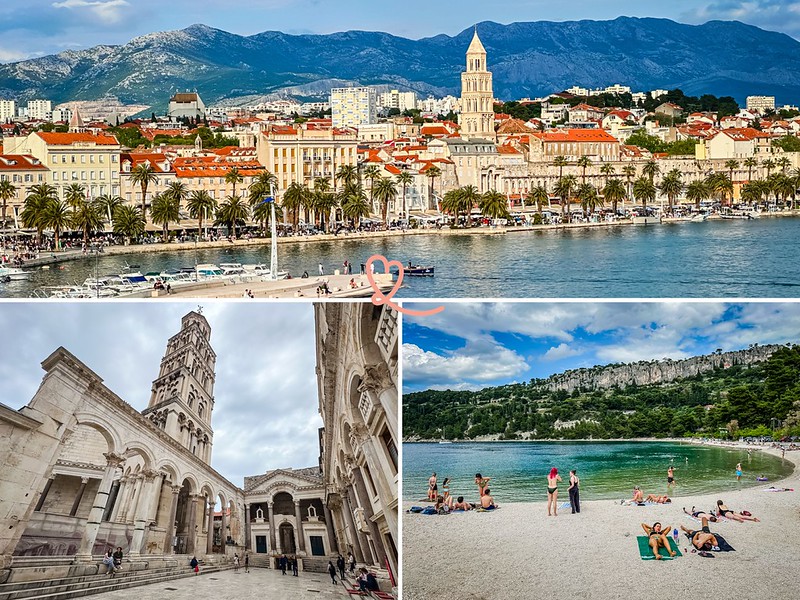
Split stands out as a must-see destination in Croatia. We were struck by how this city literally lives within a 1,700-year-old Roman palace, where ancient alleyways, the cathedral, and café terraces blend into everyday life. With its historic sites, city beaches, and excursions to the islands, Split appeals to history buffs and travelers seeking relaxation alike.
Check out our selection of the best attractions in Split, illustrated with photos that will make you want to go there.
This opinion is completely independent, based on our experiences. We made our own choices, visited the area anonymously, and paid our bills in full.
Top Attractions in Split: Map
Let’s start with a map to help you find your way around; we’ve included all the places on our main list:
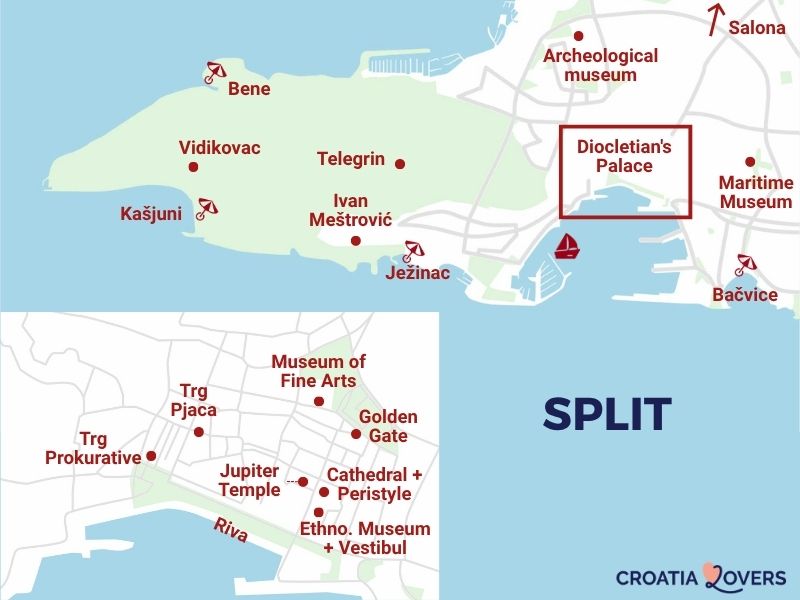
It’s one of Croatia’s must-see cities. If you’re short on time and only have one day in Split, here’s our advice:
- The Elements of the Palace of Diocletian
- The Cathedral and its
- Explore the waterfront and its narrow streets
1. Gates and Alleys of the Old City

Why visit?
Split’s Old Town is organized around four monumental gates that once marked the ramparts of Diocletian’s Palace. We recommend starting with the Golden Gate (Porta Aurea), the most imposing of the four, before visiting the Iron Gate, the Silver Gate, and the Bronze Gate, each leading to a different neighborhood.
Between these four entrances, a maze of cobblestone alleys will lead you from one small square to the next. We loved how each gate tells a different story about the city’s history, from its military past to its maritime heritage.
And try to find the super-narrow alley called “Let Me Pass”!

Practical advice
- Duration of the tour: Allow 1.5 to 2 hours to explore the four gates and the surrounding alleys.
- Challenges and Accessibility for People with Disabilities: uneven cobblestone pavement in some areas; narrow alleys that may make it difficult for wheelchairs or strollers to pass through
- Directions: Right in the heart of the historic center, within walking distance of the Riva
- A guided walking tour offers a deeper understanding of the history of these gates and the old town: See options
2. Saint-Domnius Cathedral and its bell tower

Why visit?
St. Domnius Cathedral stands on the site of Emperor Diocletian’s former mausoleum, making it one of the oldest cathedrals in the world to retain its original structure. We found the irony of history quite fascinating: a persecutor of Christians now rests beneath a Catholic place of worship. Inside, columns brought from Egypt and 13th-century wood carvings depict the Passion of Christ.

You can then climb the nearby bell tower, which also dates from the 13th century, to enjoy an unobstructed view of the rooftops of the old town and the harbor. We loved the style of this very elegant bell tower.
See more photos in our dedicated article.

Practical advice
- Duration of visit: 30 to 45 minutes for the cathedral; allow an additional 20 minutes to climb the bell tower
- Hours: The cathedral is open daily, generally from 8 a.m. to 8 p.m. in the summer and with reduced hours the rest of the year; the bell tower follows roughly the same schedule and is closed during religious services.
- Challenges and Access for People with Limited Mobility: The climb up the bell tower involves a narrow, steep staircase with approximately 200 steps; it is not accessible to people with limited mobility and is not recommended for people with claustrophobia;
- A dress code (shoulders and knees must be covered) is required to enter the cathedral
- Prices: starting at €9 for basic admission (cathedral, crypt, baptistery), with combination tickets up to €15 that include the treasury, the bell tower, and the clock tower
WHERE TO STAY IN Split
Our favorites: neighborhoods and hotels
Marina –
Hotel Ambasador – check photos and availability
Old Town –
Piazza Heritage Hotels – check photos and availability
Bacvice, on the coast –
Hotel Park Split – check photos and availability

3. Diocletian’s Palace: Peristyle, towers, vestibule, and basements

Why visit?
Built in the 4th century for Emperor Diocletian, this fortified palace is not a static museum but the living heart of Split, where more than 3,000 residents still live within its walls. We were particularly impressed by the peristyle, a central colonnaded courtyard where an Egyptian sphinx over 3,500 years old stands. It is complemented by the cathedral tower, and the ensemble is spectacular.
You’ll also explore the vestibule and its dome, as well as the basements—vaulted rooms that served as a filming location for the series *Game of Thrones*.

Practical advice
- Duration of the tour: 2 to 3 hours for a complete tour of the palace and its buildings
- Hours: The palace itself is a public space open 24 hours a day, year-round; the basement levels of the City Museum are open daily, generally from 9 a.m. to 5 p.m.
- Accessibility and Challenges: The main entrances and the Porte d’Or entrance are accessible without steps, but the narrow corridors inside the palace may pose challenges for visitors with limited mobility.
- Admission: Admission to the palace and the peristyle is free; admission to the underground chambers, the cathedral, the Temple of Jupiter, and the cellars requires a fee, which varies by building
4. Riva, the waterfront promenade

Why visit?
La Riva is the iconic promenade that runs along Split’s waterfront, right at the foot of the southern ramparts of Diocletian’s Palace. We enjoyed sitting on a terrace there to watch the comings and goings of locals and ferries heading out to the islands.
Lined with palm trees, cafés, and restaurants, this pedestrian promenade connects the old town to the harbor and is the main route to most of the attractions in the city center. In the evenings, you’ll come across everything from impromptu belote players to street musicians.
See more photos.

Practical advice
- Duration of visit: 30 to 45 minutes on foot, longer if you stop at a terrace
- Opening hours: free access at all times
- Challenges and Access for People with Disabilities: a flat, wide path, accessible to strollers and wheelchairs
5. People’s Square and Republic Square

Why visit?
Split is more than just its Roman palace: People’s Square (Trg Pjaca) and Republic Square (Trg Prokurative) offer a striking architectural contrast. We found it interesting to walk directly from one to the other to appreciate the difference in styles: Pjaca, the medieval heart of the city lined with Gothic and Renaissance facades, followed by Prokurative, a neoclassical square with arcades inspired by St. Mark’s Square in Venice. You’ll get a sense of the different eras that have shaped the city, from the Middle Ages to the Austrian occupation.

Practical advice
- Duration of visit: 30 to 45 minutes for both locations
- Opening hours: free access at all times
- Challenges and Accessibility for People with Disabilities: paved ground, generally flat and accessible
- Directions: a short walk west of the Palace of Diocletian, right in the heart of the historic center
6. Kašjuni Beach

Why visit?
Nestled on the southern slope of the Marjan Peninsula, Kašjuni Beach offers a relaxing experience. We enjoyed its setting surrounded by pine trees, which provide natural shade on a summer day. You’ll find a mix of pebbles and concrete here, as well as a beach bar to extend your day. This beach is ideal for those seeking a bit more peace and quiet, while still being within walking distance of downtown and Marjan Park.

Practical advice
- Opening hours: free access at all times
- Challenges and Access for People with Disabilities: Access is partially via a trail within Marjan Park; the area is not fully wheelchair-accessible.
- Prices: Free; the beach bar charges for drinks on site
- Directions: on the southern slope of Marjan Park, about a 20- to 30-minute walk from downtown
- Parking: A few spots available nearby; limited during peak season
- Dining: an on-site beach bar
7. Sail to the Blue Lagoon and the Three Islands

Why visit?
A boat tour departing from Split will take you to the Blue Lagoon and three islands in the Dalmatian archipelago. We recommend this excursion as a nice change of pace after spending several days exploring the narrow streets of the historic center. You’ll alternate between swimming in the open sea, free time on the islands, and cruising along the coast—usually over the course of a full day. It’s also a chance to see Split from the water, a perspective few visitors think to explore.

Practical advice
- Schedule: Morning departures from the port of Split; return in the late afternoon
- Directions: Departure from the port of Split, right next to the Riva
- See options and availability
8. Vidikovac and the Chapel of St. Jerome

Why visit?
Vidikovac, also known as Vidilica, is the first viewpoint you reach when climbing from the Varoš neighborhood toward Marjan Hill. We enjoyed stopping there to catch our breath while taking in the view of the Old Town’s rooftops and the harbor.
The small Saint-Jérôme Chapel, nestled nearby, adds a touch of history to the walk. You’ll also find a café there where you can take a break before continuing the climb to the summit of Marjan, if you’d like to keep hiking.

Practical advice
- Duration of visit: 20 to 30 minutes, longer if you stop for coffee
- Hours: Open to the public at all times; the café operates according to its own hours.
- Challenges and Access for People with Disabilities: a stone staircase leading up from Varoš; not wheelchair accessible and not recommended for strollers
- Rates: free of charge
- Directions: a 10- to 15-minute walk from the Varoš neighborhood, west of the Old Town
9. Marjan Park to the Telegrin Lookout

Why visit?
Marjan Park is a wooded peninsula that has been protected since 1964 and serves as Split’s “green lung.” We recommend hiking to the summit of Telegrin, the highest point at 178 meters, for a panoramic view that takes in the Old Town, the Split Canal, and the islands of Brač and Šolta.
The trail from Varoš has about 314 stone steps before it joins the paved road leading to the summit. Along the way, you’ll pass a botanical garden and a playground, making for a hike with a variety of scenery.

Practical advice
- Duration of visit: 1 hour to 1 hour and 30 minutes for the round trip to Telegrin from Varoš
- Hours: The park is open to the public at all times
- Challenges and Access for People with Disabilities: a steep climb up a stone staircase followed by a dirt path with some loose stones; not wheelchair accessible; hiking shoes recommended
- Admission: Free; public park with no admission fee
- Directions: Main entrance from the Varoš neighborhood, west of the Old Town; the park is a car-free zone
10. Ivan Meštrović Gallery

Why visit?
This gallery is housed in the former summer villa of Croatian sculptor Ivan Meštrović, considered the country’s greatest artist of the 20th century. We were struck by the quality of the works—nearly 200 sculptures in marble, bronze, and wood—spread across two floors and throughout the garden overlooking the sea. You can also visit the nearby Kaštilac, a chapel that houses additional wooden reliefs by the same artist. The combined ticket grants access to both sites, allowing for a complete immersion in Meštrović’s work.

Practical advice
- Directions: Šetalište Ivana Meštrovića 46, about a 15-minute walk from downtown, in the Meje neighborhood
- Duration of visit: 1 to 1.5 hours for the gallery; longer if you include a visit to Kaštilac
- Hours: Tuesday through Sunday, generally from 8 a.m. to 6 p.m. during peak season (May through September) and from 9 a.m. to 4 p.m. or 5 p.m. the rest of the year; closed on Mondays
- Challenges and Access for People with Disabilities: Two-story building; information regarding wheelchair access is pending
- Prices: Combined ticket with Kaštilac for around 12€
- Visit the official website for more info here.
- Book your ticket now to save time!
11. Salona

Why visit?
Just 5 km northeast of Split lie the ruins of Salona, the ancient capital of the Roman province of Dalmatia and the birthplace of Emperor Diocletian. We loved the tranquility of this site, which is much less crowded than Diocletian’s Palace, where you can take your time admiring an amphitheater that once held more than 15,000 spectators.
You’ll also discover the thermal baths, a forum, an aqueduct, city walls with several gates, and the Basilica of Manastirine, where the city’s first Christian martyrs—including Saint Domnius—were buried. A small museum, the Tusculum, rounds out the tour near the entrance.

Practical advice:
- Directions: 5 km northeast of Split, in the town of Solin; take bus No. 1 from downtown Split; get off near Caffe Bar Salona at the main entrance; by car, the main entrance is on Ulica Frane Bulića
- Parking: Parking is available near the amphitheater if you enter the site from its southern end
- Duration of visit: Allow at least 1.5 to 2 hours to explore the entire site
- Hours: 9 a.m. to 8 p.m. in the summer and 9 a.m. to 6 p.m. in the winter. Closed on holidays.
- Price: €8 when combined with admission to the archaeological museum
- Learn more about the archaeological museum’s website here
- Challenges and Access for People with Limited Mobility: The site is not accessible to people with limited mobility; there are gravel paths and stone stairs in some areas that may be slippery; sturdy shoes recommended; approximately a 15-minute walk in the sun to the amphitheater, at the farthest end of the site
- From Split, excursions to the Klin Fortress also include the ruins of Salona— see the options
12. Temple of Jupiter

Why visit?
Built to the west of the peristyle, the Temple of Jupiter is an integral part of the Diocletian Palace complex. We find it remarkable that it has survived the centuries after being converted into a baptistery, even though it was originally dedicated to the worship of the Roman god. An Egyptian sphinx still stands guard at its entrance, echoing the one at the neighboring peristyle. You’ll appreciate the simplicity of this building compared to the cathedral, yet it is just as much a testament to the grandeur of imperial Roman architecture.
And be sure to look up to admire the magnificent ceiling.

Practical advice
- Tour duration: 15 to 20min
- Hours: generally the same as those of the nearby cathedral
- Accessibility Challenges and Access for People with Disabilities: Narrow entrance; additional information regarding accessibility for people with disabilities is needed
- Prices: Buy a combined ticket that includes the temple
13. Split Ethnographic Museum

Why visit?
Housed in Diocletian’s Palace, the Split Ethnographic Museum showcases the traditions and ways of life in Dalmatia through costumes, textiles, and everyday objects. We recommend this visit to those who wish to complement their historical exploration of the city with a more cultural perspective. In particular, you’ll see collections of traditional costumes and items related to local crafts, which place Split’s architectural heritage in the context of daily life in the past.
The atmosphere there is calm and conducive to exploration, with a classic layout and a smooth flow of visitors. It also provides accessto the terrace of the Vestibule of Diocletian’s Palace. We loved admiring the bell tower of St. Domnius Cathedral in Split from this different angle, while listening to the voices of traditional Croatian singers echoing through the vestibule below.
See more photos.

Practical advice
- Location: inside the Palace of Diocletian, right in the heart of the historic center
- Visit duration: 45min to 1h
- Hours: In the summer, at least from 9 a.m. to 6 p.m. Monday through Friday, Saturdays from 10 a.m. to 5 p.m., and Sundays from 10 a.m. to 2 p.m. In the winter, it closes at 4 p.m. and is closed on Sundays.
- Challenges and Access for People with Disabilities: The museum is located in the palace’s historic buildings; wheelchair access may be limited.
- Prices: Adults: €5
- Visit the official website here for the latest updates.
14. Bačvice Beach

Why visit?
Bačvice is Split’s most iconic beach, just 1 km from the Old Town. We enjoyed its fine sand and gradually deepening water, ideal for families and casual swimmers alike. This is where picigin originated—a local ball game recognized as part of UNESCO’s Intangible Cultural Heritage, in which players take turns in shallow water to keep a small ball from touching the water. You can watch or try it out for yourself before enjoying the bars and restaurants in the complex bordering the beach in the evening.

Practical advice
- Duration of visit: flexible; allow at least 1 to 2 hours to enjoy swimming
- Opening hours: free access at all times
- Challenges and Access for People with Disabilities: The concrete section is wheelchair-accessible; the sandy section is more difficult to access; the water has a gentle slope.
- Prices: Free; lounge chairs, umbrellas, and jet skis available for rent on site
- Directions: About 1.2 km southeast of the historic center; accessible on foot or by bus
- Parking: Several public parking garages nearby, which are often very crowded in the summer
- Dining: a complex of restaurants, bars, and clubs built right behind the beach
15. Pazar Market and Fish Market

Why visit?
The Pazar is Split’s fruit and vegetable market, located just behind the Silver Gate of the palace. We love to stroll there early in the morning to watch the locals shop among the colorful stalls. Just a few steps away, the fish market completes this immersion in local daily life, with its characteristic briny scents. There you’ll find fresh fruit, vegetables, cheese, and fish caught that very day—an excellent way to get a sense of Dalmatian eating habits away from the tourist restaurants.

Practical advice
- Tour duration: 20 to 30min
- Schedule: Generally in the morning, every day; please check for the most up-to-date specific times
- Accessibility and Challenges for People with Disabilities: The outdoor area is generally accessible, but the floor may be slippery in the fish market section.
- Prices: Free, open access to the stalls
- Directions: Just behind the Silver Gate, east of the Old City
And lots of activities!

Split is also an excellent base for outdoor activities in the hinterland and along the Dalmatian coast. We recommend these excursions to those who want to combine cultural heritage with thrilling experiences during their stay.
- Canyoning
- Rafting on the Cétina River with its emerald waters and waterfall
- Kayaking by Day or by Night
- Diving
- Off-road ATV Riding Inland: Where Nature Meets Historic Architecture

Things to Do in Split: Other Ideas
Other Museums in Split
In addition to the Meštrović Gallery and the Ethnographic Museum, Split is home to many other museums.
- Split City Museum (Muzej grada Splita): Located in a Gothic palace in the Old Town that once belonged to the Papalić family, this museum traces more than 2,000 years of the city’s history through paintings, Roman artifacts, and everyday objects.
- Museum of Fine Arts (Galerija umjetnina): Housed in the city’s former hospital, this museum features more than 400 works spread across several floors, tracing the history of Croatian art from the 14th century to the present day, ranging from religious icons to paintings by old masters such as Paolo Veneziano and Albrecht Dürer. See more photos.

- Archaeological Museum: Founded in 1820, it is Croatia’s oldest museum; its collections span antiquity, with many artifacts from the nearby site of Salona, and it has a branch in Solin.
- Maritime Museum: nestled in the courtyard of the 16th-century Venetian fortress of Gripe, it features ship models, torpedoes, and artillery pieces that trace Dalmatia’s maritime tradition from ancient times to the age of steam-powered ships. See more photos.
- Split Cathedral Treasury Museum: Located inside St. Domnius Cathedral itself, this small museum houses precious liturgical objects such as icons, reliquaries, and ancient manuscripts . See more photos.

- Natural History Museum and Zoo: Located on Marjan Hill, this museum features mineralogy and geology collections, as well as a small zoo, from which exotic animals have been gradually removed since 2006.
- Museum of Croatian Archaeological Monuments: The country’s only museum entirely dedicated to Croatian cultural artifacts from the Middle Ages—spanning the 7th to the 15th centuries—it houses, among other things, Europe’s largest collection of clay figurines and Croatian Latin epigraphic monuments from this period.

- Museum of Illusions: Address: Ul. Andrije Kačića Miošića 2, Split, located just behind Diocletian’s Palace; open daily, generally from 9 a.m. to 9 p.m. or 10 p.m., depending on the season; expect to pay about €12 for an adult and €9 for a child; the nearest bus stop is H N K, served by lines 1, 5, 5A, 6, 16, 18, and 22; paid parking is a 5-minute walk away. Book your ticket now to save time!
- Game of Thrones Museum: Address: K. Zvonimira 6, Split; please check for specific hours, which are known to vary by season. Book your ticket now to save time!
- Diocletian’s Dream (virtual reality experience): inside Diocletian’s Palace. Book your ticket now to save time!
Other Churches in Split
In addition to St. Domnius Cathedral, Split is home to several other religious buildings worth visiting. We suggest including one or two of these churches in your itinerary if you’re interested in Dalmatian religious architecture. You’ll find that each of these churches reflects a different period and style, ranging from the Middle Ages to the Baroque era.
- St. Martin’s Church: nestled above the Golden Gate, within the very thickness of the north wall of Diocletian’s Palace, this early Christian chapel from the 5th–6th centuries is one of the smallest and oldest churches in the city;
- St. Francis Church: Built in the 13th century by the Friars Minor, it houses a painted Gothic crucifix from the early 15th century as well as the tombs of prominent Croatian figures.

- Church of Our Lady of the Bell Tower (St. Arnir Chapel): This Romanesque belfry, built around 1100 atop the ramparts near the Iron Gate, houses a small chapel dedicated to Saint Arnir, Archbishop of Split, who was martyred in the 11th century, and stands next to the ruins of a former convent destroyed under French rule in the early 19th century.
- Church of the Holy Spirit: a small, unassuming church in Split’s Old Town
- St. Dominic’s Church: built in the 13th century east of the palace ramparts, right next to the Silver Gate, this church and its Dominican convent were rebuilt in the Baroque style between 1666 and 1682, before undergoing major renovations in the 1930s.

Other Beaches in Split
In addition to Bačvice and Kašjuni, Split has many other beaches. We find this variety invaluable: each one offers a different atmosphere, ranging from quiet coves to developed shorelines. This allows you to plan your own beach itinerary based on your mood for the day.
- Prva Voda Beach,
- Bene Beach,
- Jezinac Beaches,
- Obojena Beach
- Kastelet Beach,
- Žnjan City Beach (under construction),
- Ovčice Beach,
- Trstenik Beach,
- Firule Beach

Other Places in Split
To continue exploring Split, there are a few other places worth visiting. We’re mentioning them for curious travelers who have some extra time.
- Sustipan Memorial Park, for a walk among the pine trees with a view of the sea
- Josip Jurj Strossmayer Park, a public park and a refreshing retreat in the city
- several small palaces scattered throughout the old town
- and the city’s theater

Things to Do in Split with Kids
Split is a great destination for a family vacation. We especially recommend the Museum of Illusions, whose interactive exhibits entertain visitors of all ages, as well as Bačvice Beach, with its gently sloping shoreline and games of picigin that your children can enjoy watching or playing. The Natural History Museum and Zoo are also great options for families. You can also opt for a quad bike or kayaking outing if your children are older.
Things to Do in Split When It Rains
On rainy days, Split still has enough to offer to keep you busy for a whole day.
The city has plenty of museums, so there’s no time to get bored!

Tours Around Split
Split is an excellent starting point for several excursions in the surrounding area. In fact, it’s one of our favorite destinations for a vacation in Croatia. Below, we highlight three destinations that are easily accessible from the city, each offering a different side of Dalmatia.
Trogir

This small medieval town, a UNESCO World Heritage Site, is located about a 30-minute drive from Split. We recommend spending half a day there strolling through its Venetian-style streets and visiting its cathedral.
Klis: Fortress and Olive Museum

Perched on a limestone ridge, Klis Fortress overlooks the region and was notably used as a filming location for *Game of Thrones*. You’ll love the sweeping view of Split and the coast from its ramparts.
If you’d rather not drive, check out the guided tour options.
Krka

Krka National Park and its waterfalls are a must-see nature excursion from Split. We recommend setting aside a full day to fully enjoy the trails and views of the waterfalls.
If you don’t want to drive, check out the guided tour options.
Is Split worth a visit?
Yes, Split is definitely worth a visit. We were captivated by the way the 1,700-year-old Diocletian’s Palace continues to house a vibrant city, with shops, cafés, and homes. With its ancient heritage, urban beaches within walking distance, and easy day trips to the islands or the countryside, Split offers a rare combination of attractions for a city of its size.


Helpful Tips for Visiting Split
Where is Split located?
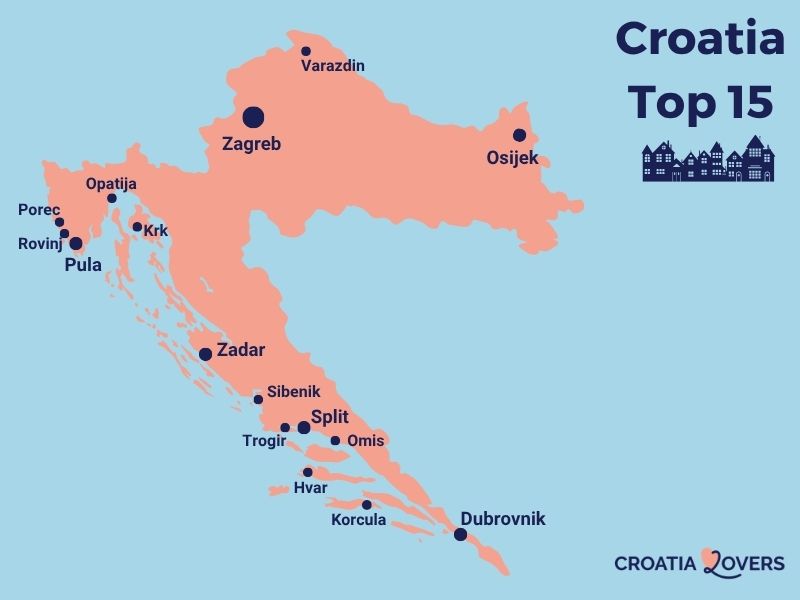
- Split is located on the central coast of Dalmatia, in Croatia
- From Split to Zagreb: about 400 km by car; allow 4.5 to 5 hours
- From Split to Zadar: about 156 km by car; allow 1 hour and 45 minutes
- Here is a map to help you find your way:
How do I get to Split?
Split Airport is located about 24 km from downtown. An Airport Shuttle runs from the airport to the train station, followed by a 10-minute walk to downtown. Split is also accessible by ferry from several Dalmatian islands and by long-distance bus from major Croatian cities.

It’s time to book!
Compare everything: companies, prices, schedules and availability.
Parking in Split
Split’s historic center is a pedestrian zone, so parking is available in paid parking lots on the outskirts of the old town, at a rate of about €1.50 per hour. We recommend arriving early in the morning during peak season, as parking spots become scarce as the day goes on.
Getting Around in Split
The Old Town and its immediate surroundings are easy to explore on foot. To reach more distant sites such as the Meštrović Gallery or Bačvice Beach, local buses—specifically lines 1, 3, 5, 6, and 16—cover most of the city. You can buy your tickets directly from the driver or at kiosks near the main stops.
Split also has a hop-on, hop-off bus for exploring tourist attractions— get your ticket

Where to Eat in Split
We recommend choosing restaurants located just off the Riva for more reasonable prices and more authentic cuisine. The Pazar Market and the nearby fish market are also excellent places to put together a meal with fresh, local produce.
Split also has some wonderful restaurants. We enjoyed Soul Kitchen, Konoba Marjan, and Fig.

Visiting Split in Winter
In winter, Split offers a more peaceful atmosphere, without the crowds of the high season. We find this time of year ideal for exploring Diocletian’s Palace at a leisurely pace, even though some water sports and boat tours are suspended or operate on a reduced schedule.
PLAN YOUR TRIP TO Croatia
- Best of
Top Destinations
Top Attractions
Most Beautiful Cities
Most Beautiful Islands
National Parks

- Practical advice
When to go?
Howtorent a car in Croatia
Driving tips
Itineraries: Road Trip—10 Days, 2 Weeks, 3 Weeks