Dubrovnik in winter offers a different experience from the high season. The old town, a UNESCO World Heritage Site, has a calmer atmosphere, its medieval ramparts can be explored without the summer crowds, and its museums can be visited with serenity. We were won over by this off-season Dubrovnik.
Here are our tips for visiting Dubrovnik in winter: activities, weather, temperatures… Plus, information on how to spend Christmas or New Year in this unusual city.
This opinion is completely independent, based on our experiences. We made our own choices, visited the area anonymously, and paid our bills in full.
Dubrovnik in winter: is it worth it?
Our review
Yes, visiting Dubrovnik in winter is absolutely worth it. The city loses its crowds but retains all its character: the medieval ramparts, the baroque old town and the deep-blue Adriatic are there, intact and much more accessible. We particularly enjoyed exploring the white limestone streets of the UNESCO-listed historic center, without the crowds that characterize July and August. The monuments are visited in a tranquil atmosphere that allows you to really immerse yourself in the place.
We invite you to consult our full article on what to do in Dubrovnik for more ideas for your stay.

WHERE TO STAY IN Dubrovknik
Our favorites: neighborhoods and hotels
Old Town –
Hotel Villa 5DB – check photos and availability
Lapad and Babin Kuk –
Hotel Royal Neptune – check photos and availability
North Shore –
Hôtel Ninon Bed & Breakfast – check photos and availability
Ploče District –
Excelsior Hotel – check photos and availability

Benefits
- The old town and ramparts are less crowded than in summer.
- Lodging rates drop significantly outside the holiday season.
- Most museums, monuments and historic sites remain open.
- The festive atmosphere of Christmas and New Year adds a warm dimension to the holiday.
- Parking near the old town is easier than in high season.

Disadvantages
- Some museums and attractions reduce their opening hours between November and March.
- Ferries to the islands are less frequent, and even suspended on some routes.
- The island of Lokrum is closed to visitors in winter.
- Shorter days limit outdoor exploration time.
- Cool evening temperatures mean warm clothing is essential.
- Some restaurants and accommodation close in low season.

OUR ADVICE FOR RENTING YOUR CAR AT Croatia
- Compare prices on our preferred platform: DiscoverCars – one of the best rated sites.
- Choose a car that’s compact enough (some passages are narrow).
- There is a lot of demand, book it early.


Weather, temperatures and conditions
Winter in Dubrovnik is mild. Daytime temperatures generally oscillate between 8°C and 14°C, with cooler nights around 5°C to 8°C. Snow is rare in the city, although it can fall on the surrounding hills. Precipitation is more frequent than in summer: December and January are among the wettest months of the year. The bora, a cold, dry north-easterly wind, can blow in spells, making temperatures much lower. Days are shorter, with around 9 hours of daylight in December.

What to do in Dubrovnik in winter
Dubrovnik offers a wide range of winter activities. The must-see sites of the old town remain accessible, and museums can be visited in ideal conditions. Here are our suggestions for making the most of the city in the off-season.
Walking the medieval city walls is Dubrovnik’s most emblematic experience. These 14th-century fortifications encircle the entire old town for almost 2km. In winter, you can discover them without the summer crowds, allowing you to fully appreciate the panoramic views over the orange-tiled roofs and the Adriatic Sea. We advise you to climb it in the morning for the best light. Book a guided tour of the ramparts.

A LITTLE MORE patience
All the photos, maps, information and addresses you need to make your stay in Croatia a success will soon be available in a single ebook!
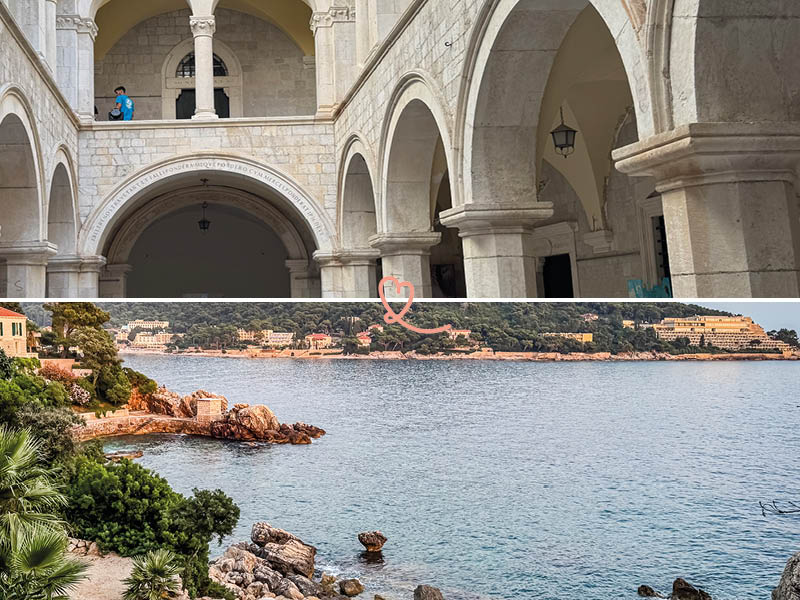
The old town reveals itself differently in winter. We enjoyed getting lost in the alleys that run up the hillside and discovering nooks and crannies that the summer crowds make hard to appreciate. Take a guided tour of the historic center.
The Rector’s Palace, former seat of government of the Republic of Ragusa, is one of the city’s finest examples of Gothic-Renaissance architecture. We were fascinated by its loggia with elaborate columns and the sculpted details of its capitals. Inside, the Cultural-Historical Museum traces the history of the city-state through period furniture, official portraits and ancient coins.

Subscribe to our Newsletter
- Get away from it all with Region Lovers’ beautiful destinations!
- Once a month
- Advertising-free

Mount Srd, which rises 412m above the city, is the best viewpoint of Dubrovnik. A cable car takes you from the old town to the summit in just a few minutes. In winter, the climb offers unobstructed views of the city walls and the Adriatic Sea without the summer heat. At the summit, the Imperial Fort, built by Napoleon in the 19th century and defended during the 1991-1992 siege, houses a museum dedicated to the Croatian War of Independence. We recommend the climb at the end of the day. For thrill-seekers, a zip-line over Dubrovnik is also available.

DISCOVER Dubrovnik

Perched on a 37m rock to the west of the old town, Fort Lovrijenac is one of the most impressive fortresses on the Dalmatian coast. Built in the 11th century to defend the town against Venetian attempts to seize the bay, it bears the Latin inscription “Non bene pro toto libertas venditur auro” – “Freedom cannot be sold for all the gold in the world”. Fans of the Game of Thrones series will recognize it as the setting for King’s Landing’s Red Fortress. We were blown away by the 180° view of the sea from its terraces. Book your visit in the footsteps of Game of Thrones.

Winter is also the ideal time to explore Dubrovnik’s museums without hurrying. The Maritime Museum, housed in Fort St. John, traces the evolution of local shipping since antiquity through over 5,000 objects. The Red History Museum immerses visitors in the Yugoslav period from 1945 to 1991 through an interactive scenography. The Museum of Modern Art (MOMAD), the Cathedral of the Assumption and its exceptional treasure, and the Palais Sponza, a rare 16th-century Gothic-Renaissance building, complete a dense and varied museum offering.

Dubrovnik’s proximity to a number of excursions remains accessible in winter:
- Kotor and Perast in Montenegro – about a 2-hour drive, a UNESCO-listed old Venetian town surrounded by medieval ramparts
- Mostar and the Kravica waterfall in Bosnia-Herzegovina – the UNESCO-listed 16th-century Ottoman Old Bridge and its turquoise pools
- Cavtat and the Konavle vineyards – 18km to the south, a tranquil Dalmatian atmosphere and a tasting of local wines

To find out more, read our article on what to do in Dubrovnik!

How to get to Dubrovnik
- The town lies at the southernmost point of the Croatian Dalmatian coast, on the border with Montenegro.
- Approx. 20min from Dubrovnik-Čilipi International Airport (direct flights from all over Europe in season) – view and compare flights
- About 4h30-5h by bus or rental car from Split
- Seasonal ferry service from Split, the Dalmatian Islands and Bari (Italy)
- Approx. 6 hours by car from Zagreb via A1 and Pelješac bridge (avoids Bosnian border)

It’s time to book!
Compare everything: companies, prices, schedules and availability.
Christmas in Dubrovnik
Spending Christmas in Dubrovnik is an experience like no other. The old town is decked out in lights and decorations, highlighting its white limestone facades and medieval alleyways. Christmas markets are set up in the squares of the historic center, with stalls selling local produce, Dalmatian crafts and seasonal gourmet specialties. We enjoyed strolling through this festive atmosphere, which contrasts pleasantly with the city’s usual calm in the low season. Concerts and entertainment are held in churches and squares, offering a varied cultural program throughout December.
It’s also an opportunity to discover the town’s restaurants. You can enjoy Dalmatian cuisine, based on fish and seafood from the Adriatic and wines from the Pelješac vineyards, in a warm and friendly atmosphere. We recommend that you reserve your table in advance for festive evenings, as good addresses often sell out during the festive season. Why not try the famous 360 restaurant?

New Year’s Eve in Dubrovnik
Celebrating New Year’s Eve in Dubrovnik is a memorable experience. The old town retains its festive Christmas atmosphere and the end-of-year celebrations are lively. The squares of the historic center bring residents and visitors together to welcome the New Year in a convivial atmosphere that we found particularly warm. Concerts and special events are organized at various venues in the old town for the evening of December 31.
You can also make this a gastronomic evening. Many restaurants offer special menus for New Year’s Eve: we advise you to book well in advance, as the best tables are snapped up quickly. The following day, an early morning stroll along the almost deserted ramparts, under the winter light, is in our opinion one of the most beautiful ways to start a new year in Dubrovnik.