Have you decided to visit Dubrovnik in 2 days? It’s the ideal time to discover this ancient fortified city on the Dalmatian coast, where medieval history, Baroque heritage and the Adriatic Sea meet. We were seduced by the beauty of the old town, the strength of the ramparts and the gentleness of the coastline.
Our itineraries will guide you through Dubrovnik. Make the most of your stay with our practical tips and numerous photos.
This opinion is completely independent, based on our experiences. We made our own choices, visited the area anonymously, and paid our bills in full.
Practical tips for a 2-day visit to Dubrovnik
What can you see in Dubrovnik in 2 days? Is it long enough?
Two days in Dubrovnik will allow you to see the essentials: the medieval city walls, the Baroque old town, the main museums, the beaches and, why not, an excursion to the island of Lokrum. It’s a good length of time to immerse yourself in the atmosphere of the city, which is, after all, small. If you’d like to add an excursion to the Elaphite Islands, the Blue Grotto or the surrounding area, a third day is welcome.
See all our ideas for activities in our article on what to do in Dubrovnik.
Map of tourist attractions in Dubrovnik
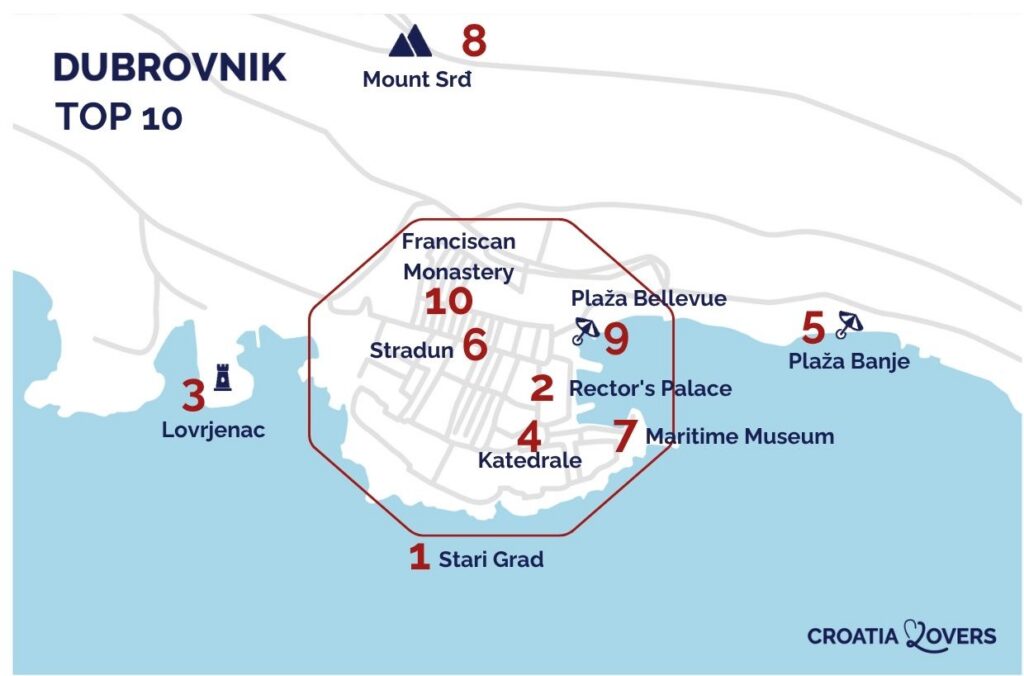
To help you find your way around our itinerary below, here’s our map of Dubrovnik’s main tourist attractions:
Getting around and parking in Dubrovnik
The city bus network is efficient and inexpensive. Lines 1A and 1B connect the Old Town (Pile stop) with the port of Gruz and the Lapad district. Tickets can be purchased from the driver for around €2, or are included in the Dubrovnik Pass. The Old Town can be visited entirely on foot. If you’ve rented a car, please note that the Old Town is entirely pedestrianized: it’s impossible to enter by car. The nearest parking lot to the Pile Gate is Parking Ilijina Glavica (approx. €5/hr). In high season, parking spaces are scarce, so it’s best to park on the outskirts and take the bus to the center.
Dubrovnik Pass
We highly recommend the Dubrovnik Pass if you’re planning several visits: it includes access to the city walls, Fort Lovrijenac, the Rector’s Palace, the Maritime Museum, MOMAD and several other municipal museums, as well as unlimited use of the city buses. The 1-day pass costs €40, while the 3-day pass costs €50, and pays for two or three visits. Note that the Red History Museum is not included. Full details on the official Dubrovnik Pass website.
Where to sleep in Dubrovnik
When it comes to accommodation, there are several areas to choose from. In or near the old town, you’ll be closer to the sites, but the prices are higher. The Lapad district, 4 km to the west, offers more spacious hotels, beaches and restaurants. Find out more about our selection of the best hotels and areas to stay in Dubrovnik.
WHERE TO STAY IN Dubrovknik
Our favorites: neighborhoods and hotels
Old Town –
Hotel Villa 5DB – check photos and availability
Lapad and Babin Kuk –
Hotel Royal Neptune – check photos and availability
North Shore –
Hôtel Ninon Bed & Breakfast – check photos and availability
Ploče District –
Excelsior Hotel – check photos and availability

Our ideal itinerary: 2 days in Dubrovnik
Looking for two days in Dubrovnik? Between the medieval ramparts, the baroque old town, Fort Lovrijenac, the island of Lokrum and the panoramic view from Mount Srd, you’re sure to appreciate the diversity of this Dalmatian city.

Day 1 – 9am: Walking the ramparts
The first day begins on the ramparts, when they open at 9am. These medieval fortifications, whose construction dates back to the 14th century, completely encircle the old town for almost 2km. From the top of the walls, with views over the orange-tiled roofs, we admired the Adriatic Sea and surrounding islands. The looped route allows you to see the city from all angles, both on the seaside and inland. Allow around 2 hours for the entire tour. Admission is €40 for adults, included in the Dubrovnik Pass. Read all our tips in our article dedicated to Dubrovnik’s ramparts here. You can also book a guided tour to learn more.

Day 1 – 11 a.m.: Stroll through the old town

From the heights of the ramparts, wander down into the narrow streets of the old town, a UNESCO World Heritage site since 1979. We enjoyed wandering through this labyrinth of white limestone, lively squares and Baroque facades. We also enjoyed leaving the Stradun for the hillside alleys, which are quieter and just as interesting. Don’t miss the 15th-century Grande Fontaine d’Onofrio, or the Renaissance palaces along the way. Allow 1h30 for a leisurely stroll. Access is free from Porte Pile or Porte Ploče. You can also take a guided tour of the historic center. You can also read our article on Dubrovnik’s Old Town here.

OUR ADVICE FOR RENTING YOUR CAR AT Croatia
- Compare prices on our preferred platform: DiscoverCars – one of the best rated sites.
- Choose a car that is powerful enough (the roads are steep) but compact (some passages are narrow).
- There is a lot of demand, book it early.


See our tips (coming soon)
Day 1 – 12pm: A break at the Franciscan Monastery

Nestled just inside the Porte Pile, the Franciscan Monastery is a little-known spot for visitors in a hurry. We recommend a stop! Founded in the 14th century, it houses one of Croatia’s oldest Romanesque-Gothic cloisters, whose intricately carved double columns provide a tranquil backdrop before lunch. Also on site is one of Europe’s oldest surviving pharmacies, open since 1317. Admission is included in the Dubrovnik Pass. Open daily from 9 a.m. to 6 p.m., allow between 30 minutes and 1 hour.
Day 1, 1pm: Lunch
For lunch, we recommend a konoba in the side streets of the old town, far from the touristy addresses of the Stradun. Restaurant Kopun is a benchmark for authentic Dalmatian specialties, including roast rooster Ragusan style. Restaurant Konoba Dubrava, meanwhile, offers fine local cuisine in a warm and welcoming setting.
Day 1 – 2:30 p.m.: Rector’s Palace

The Rector’s Palace is one of Dubrovnik’s most representative monuments of Gothic-Renaissance architecture. Formerly the seat of government of the Republic of Ragusa, it housed the elected rector, whose term of office lasted just one month. Its collections trace the history of this city-state through period furniture, official portraits and ancient coins. We were particularly impressed by the loggia with its elaborate columns adorning the façade and the sculpted details of the capitals. Allow 1 hour for a classic visit. Open daily from 9am to 6pm. Price: €15, included in the Dubrovnik Pass.

A LITTLE MORE patience
All the photos, maps, information and addresses you need to make your stay in Croatia a success will soon be available in a single ebook!
Day 1 – 4pm: Assumption Cathedral and its treasures

Our next stop is the Cathedral of the Assumption, built in the Baroque style between the 17th and 18th centuries. Here we discovered a treasure trove worthy of note: gold and silver reliquaries, a polyptych attributed to Titian and a reliquary of the skull of St. Blaise, patron saint of the city. Admission to the cathedral is free; a visit to the treasure is €4 (cash only, shoulders must be covered). Open Monday to Saturday, 9am to 5pm, Sunday 11am to 5pm. Allow 30 minutes to 1 hour.
Day 1 – 5pm: Banje Beach

A 5-minute walk from Porte Ploče, Banje Beach is, in our opinion, Dubrovnik’s most emblematic beach. It offers a view of the ramparts and the island of Lokrum, with clear water. A good late afternoon swim before heading back to the Stradun. Access is free, although some areas offer deckchairs for a fee.
Day 1 – 7pm: Stradun entertainment

In the evening, the Stradun becomes even more animated. Baroque facades light up and café terraces rustle. We enjoyed strolling at this hour, when the locals join the travelers for a Dalmatian-style passeggiata. It’s the perfect time to enjoy a pre-dinner drink and observe the life of this pedestrian thoroughfare that crosses the old town from east to west.
Day 1 – 8pm: Dinner
For your first dinner, we recommend Restaurant Nautika, a renowned restaurant overlooking the sea and the ramparts. Here, Dalmatian cuisine is prepared with care, highlighting the products of the Adriatic sea. We think it’s a great way to round off your first day.
DISCOVER Dubrovnik

Day 2 – 9:30 am: Red History Museum

The Museum of Red History is, in our opinion, one of the city’s most original visits. Located away from the old town in the former TUP graphite factory founded in 1953, this private museum offers an immersion into the Yugoslav period from 1945 to 1991 through a well-designed interactive scenography. We found the room devoted to Goli Otok, the Communist-era prison island, particularly interesting. Not included in the Dubrovnik Pass. Price: €9 for adults. Open daily from 9.30 a.m. to 8.30 p.m. The museum is located in the Gruž district, a 30-minute walk from the center or a 10-minute bus ride (lines 1A, 1B, 3). See our tips in our dedicated article.

Day 2 – 11 a.m.: Fort Lovrijenac

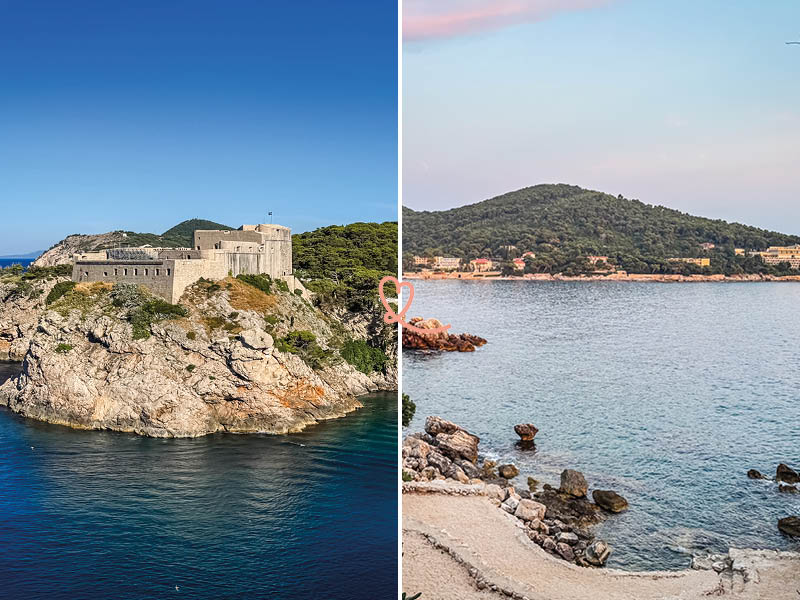
Continue your second day at Fort Lovrijenac, perched on a 37 m rock to the west of the old town. Built in the 11th century to defend the town against Venetian attempts to seize the bay, it bears the Latin inscription “Non bene pro toto libertas venditur auro”, which translates as “Freedom cannot be sold for all the gold in the world”. Fans of the Game of Thrones series will recognize it: it has served as the backdrop for the Red Fortress of King’s Landing in several seasons. We recognized it at first glance! The 180° view of the sea and ramparts from its terraces is well worth the detour. The fort is a 5-minute walk from Porte Pile and is included in the Dubrovnik Pass. Open daily from 8 a.m. to 6.30 p.m. in season. Allow 30 minutes to 1 hour.

Day 2 – 1pm: Lunch
Head for the port or the old town for lunch. In our opinion, the Proto Fish Restaurant is a good address for lovers of fresh fish and seafood from the Adriatic, in a well-kept setting. A well-deserved lunch break before an afternoon on the water.
Day 2 – 2:30 pm: Escapade on the island of Lokrum

Just 600m off the coast of the old town, the island of Lokrum is a nature reserve that can be reached in ten minutes by shuttle bus from the old port. Covered with pines, centuries-old olive trees and Mediterranean plants, it’s home to a botanical garden founded in the 19th century by Archduke Maximilian of Austria. We were charmed by the peacocks that roam freely between the ruins of the Benedictine monastery. An inland sea lake offers calm waters for swimming. The island is also well known to Game of Thrones fans: the Qarth throne room was filmed here. Round-trip shuttle: €5 to €8. Allow half a day. Find all excursions to Lokrum here.

Subscribe to our Newsletter
- Get away from it all with Region Lovers’ beautiful destinations!
- Once a month
- Advertising-free

Day 2 – 5pm: Sunset on Mont Srd by cable car

To see Dubrovnik from the heights, Mount Srd, at 412m, is in our opinion the best vantage point. A cable car takes you from the old town to the summit in just a few minutes, with beautiful views of the orange roofs, the Adriatic Sea and the island of Lokrum all along the way. We recommend the climb at the end of the day: the light on the ramparts is pleasant at this time of day. At the top, the Imperial Fort houses a museum dedicated to the Croatian War of Independence. There’s also a bar and a panoramic restaurant where you can extend your visit. Price: €25 return, including fort. The bottom station is at Petra Krešimira IV, a 10-minute walk from the Ploče Gate. Further information on the official Dubrovnik cable car website.

Day 2 – 8pm: Dinner
To round off your stay, we recommend the famous Restaurant 360, a 1-Michelin-star gourmet restaurant set on the ramparts. Its contemporary Mediterranean cuisine showcases Croatian seafood and local produce (€150-200 per person, reservation required on 360dubrovnik.com).

Alternative 1: Dubrovnik with children
Visiting Dubrovnik with the family? The city lends itself well to travel with children. The pedestrianized Old Town is accessible and stimulating, the sea is close by and there’s no shortage of activities. Here’s our selection of activities and places suitable for young and old.
Family activities
- Karaka pirate ship cruise to the Elaphite Islands: a sea excursion aboard an authentic wooden sailing ship to the Elaphite archipelago. An original and fun way for children to discover the Dalmatian coastline. Book your pirate cruise here.
- Lokrum Island getaway: a 10-minute shuttle ride from the old port, this nature reserve is popular with families for its free-roaming peacocks, sea lake for swimming and monastery ruins to explore. Find all excursions to Lokrum here.
- Game of Thrones tour of the Old Town: a dedicated guided tour of the limestone streets, medieval staircases and fortifications, taking in the settings of the series. Ideal for teenage and adult fans of the series, but also open to those who know little about it. Book your Game of Thrones visit here.
- Mont Srd cable car: the ascent to 412 m above sea level offers views of the entire old town and the Adriatic Sea. The cable car ride itself is very popular with children. Price: €25 return.
- Swimming at Plage Banje: just outside Porte Ploče, this accessible beach offers views of the ramparts and clear water. An ideal moment of relaxation for the whole family.
Places to visit with the family
- Musée des Illusions: located in the old town, this interactive museum offers visual experiences and playful installations that delight children and adults alike. A good option for younger visitors.
- Musée Maritime: housed in Fort Saint-Jean, the museum’s model ships and old-fashioned navigation instruments will appeal to young and old alike. The large 19th-century merchant sailing ships are particularly fascinating for children. Price: €10, included in the Dubrovnik Pass. Read our article dedicated to the Maritime Museum.
- The short version of the ramparts: even on a shortened tour, walking part of the ramparts allows children to understand the power of these medieval fortifications and observe the sea from the battlements. Included in the Dubrovnik Pass.
- The Stradun and its ice-cream parlors: this limestone-paved pedestrian thoroughfare is ideal for a family ice-cream break.
Where to eat with the family
- Restaurant Barba: a street food address appreciated for its takeaway local burger specialties.
- Restaurant Holy Burek: burek, puff pastries filled with meat or cheese, ideal for a quick, local and economical family meal.
- Restaurant Gradska Kavana Arsenal: an iconic café and restaurant overlooking the old harbor, with accessible and varied cuisine to satisfy both young and old.

It’s time to book!
Compare everything: companies, prices, schedules and availability.
Alternative 2: Dubrovnik culture and history
For history, art and heritage enthusiasts, Dubrovnik offers a fine concentration of museums and monuments in a small space. Here’s our selection for a day dedicated entirely to culture.
Museums to visit
- Rector’s Palace: former seat of government of the Republic of Ragusa, this Gothic-Renaissance palace houses Dubrovnik’s Cultural-Historical Museum. Period furniture, official portraits and ancient coins trace the history of this city-state. Price: €15, included in the Dubrovnik Pass.
- Assumption Cathedral: its treasury houses gold and silver reliquaries, a polyptych attributed to Titian and the reliquary of the skull of St. Blaise, patron saint of the city. Admission to the cathedral free, treasure €4.
- Franciscan Monastery: founded in the 14th century, it houses one of Croatia’s oldest Romanesque-Gothic cloisters and a pharmacy in operation since 1317. Included in the Dubrovnik Pass.
- MOMAD, Dubrovnik Museum of Modern Art: housed in the Villa Banac, it exhibits works by Croatian artists of the 19th and 20th centuries. A must for art lovers wishing to discover local creativity. Included in the Dubrovnik Pass.
- Museum of Red History: immerse yourself in the Yugoslav period from 1945 to 1991 through a well-designed interactive scenography. One of the city’s most original tours. Not included in the Dubrovnik Pass. Price: €9.
Monuments and galleries
- Palais Sponza: one of the few buildings to escape the 1667 earthquake, this 16th-century Gothic-Renaissance masterpiece is one of the most successful buildings in the old town. Its façade and loggia are well worth a visit.
- War Photo Limited: a photojournalism gallery in the old town, whose exhibitions focus on contemporary conflicts with a committed artistic approach. An address outside the usual tourist circuit.
Cultural dining
- Restaurant Zuzori: fine cuisine combining fish and seafood from the Adriatic in a pleasant setting. A good address for lunch between two visits.
- Restaurant Pjerin: a gourmet restaurant offering creative Mediterranean cuisine in a refined setting. The perfect place to dine after a day of cultural visits.
Alternative 3: Dubrovnik between sport and nature
We also find Dubrovnik to be a great place for outdoor activities: kayaking along the city walls, strolling through the Lapad forest park, swimming and thrills above the old town. Here’s our selection for a day focused on nature and sport.

Sports and water activities
- Kayak along the ramparts: departing from the old town, kayak along the Adriatic side of the ramparts to sea caves carved into the limestone rock. Accessible to beginners, supervised by guides. Allow 3 to 4 hours. Book your kayak trip here.
- Tyrolean traverse over the old town: from the heights above Dubrovnik, you’ll fly over the orange-tiled roofs and the Adriatic Sea. A short activity but with a view that few other options offer. Book your zip line here.
- Scuba diving: the crystal-clear waters of the Adriatic around Dubrovnik offer excellent conditions for exploring the seabed. Several operators offer diving trips for all levels. Find out more about diving excursions in Dubrovnik here.
- Hike to Mont Srd: for the more sporty, the climb to the top of Mont Srd takes around 1h30 and offers beautiful views of the bay along the way. Free, accessible from the old town.
Nature walks
- Lokrum Island: nature reserve 600 m from the old town, covered in Mediterranean vegetation, with a botanical garden, a sea lake for swimming and monastery ruins to explore. Round-trip shuttle: €5 to €8. Excursions to Lokrum here.
- Lapad Forest Park: the Lapad peninsula, 4 km west of the center, offers pleasant shady paths for a stroll away from the hustle and bustle of the old town, with a more local atmosphere.
- Banje, Bellevue, Buža or Uvala: each beach has its own character. Banje offers a view of the ramparts, Bellevue the tranquility of the cliffs, Buža the wilderness of the landscaped rocks, and Uvala the proximity of Lapad. Most are pebble beaches.
Where to eat in nature
- Proto Fish Restaurant: a good address for fresh fish and seafood from the Adriatic, in a well-kept setting near the port.
- Restaurant Pantarul: bistronomic restaurant in the Lapad district, offering creative cuisine with local produce in a relaxed atmosphere. Ideal after a day of sport in the neighborhood.
- Bura Bistro & Bar: creative cuisine based on local produce in a relaxed atmosphere. Good value for money, far from the touristy center.
DISCOVER Dubrovnik
Discover Dubrovnik differently: excursions

Dubrovnik is also a good starting point for exploring the surrounding area. Just a few nautical miles to the northwest, we enjoyed the Elaphites archipelago, a group of three inhabited islands (Koločep, Lopud and Šipan) with wild coves and quiet villages. The peacefulness of Lopud, with its sandy beaches rare to this coastline, is particularly appreciated. A scheduled ferry or organized excursion is all you need for a day’s escape.
We also suggest a trip to the Blue Grotto (Modra špilja), located on the island of Bisevo. Sunlight filters through an underwater opening and bathes the interior in an intense blue, especially in the middle of the day on a clear day. We recommend booking this tour in advance, as places are limited.
For a quieter getaway, we also liked the small town of Cavtat, 18 km south of Dubrovnik. It can be reached in 20 minutes by boat and offers a tree-lined waterfront and Venetian palaces in a much more peaceful atmosphere than the old town.
Find all our recommendations in our guide to the best excursions from Dubrovnik.

Things to know about your weekend in Dubrovnik
The weather in Dubrovnik
Dubrovnik enjoys a Mediterranean climate, with warm, sunny summers and mild winters. In July and August, temperatures reach 28 to 32°C. Spring (May, June) and autumn (September, October) offer more pleasant temperatures, between 18 and 24°C, and remain the best times to visit the city on foot. In winter, temperatures fluctuate between 8 and 15°C, and the city takes on a more local and tranquil atmosphere. We particularly appreciate this season for the quality of the light and the quietness of the alleyways.

The crowds in Dubrovnik
Dubrovnik is one of the most popular destinations on the Mediterranean. In July and August, the city walls, the Stradun and the emblematic sites are very busy, not least due to the cruise liners that pour in thousands of visitors every day. We advise you to visit in May, June or September for a more comfortable experience, or to arrive early in the morning for the ramparts and museums. Remember to book your tickets in advance in high season, especially for the ramparts. Outside high season, accommodation prices drop significantly.

Adapt your itinerary when it rains
On rainy or windy days, there are several options. The Red History Museum, MOMAD, the Maritime Museum and the Rector’s Palace are good alternatives for a sheltered morning. The Franciscan Monastery and the War Photo Limited gallery are also interesting stops on overcast days. The cafés and restaurants of the Stradun and the side streets invite you to take a leisurely stroll. We found the old town particularly charming on a grey day: the alleyways are less busy and the atmosphere is more intimate.
To prepare your stay in the best conditions, find all our suggestions in our guide to what to do in Dubrovnik, our guide to the best excursions from Dubrovnik and our selection of the best hotels and areas to stay in Dubrovnik.