Immerse yourself in Dubrovnik’s fascinating history with a visit to the Maritime Museum, housed in Fort St. John, one of the city’s most emblematic fortifications.
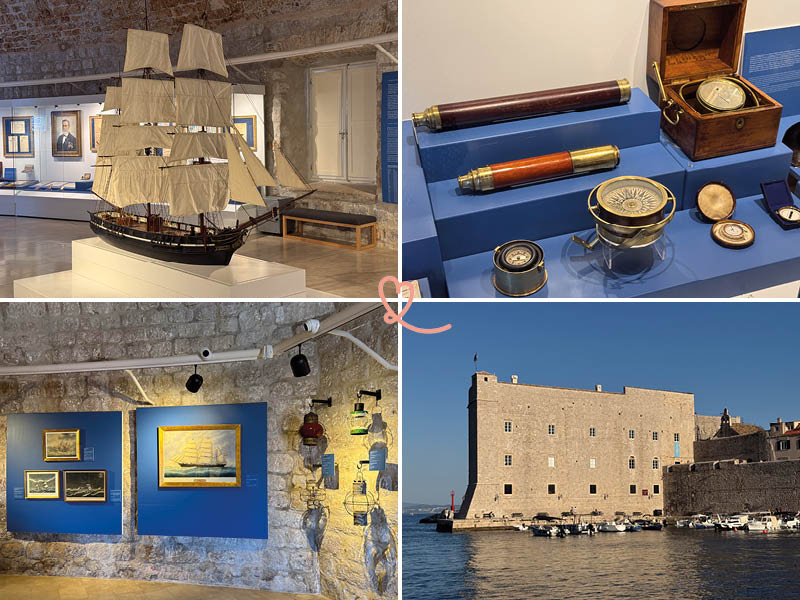
The collection of ship models, old maps, weapons, navigational instruments and everyday objects illustrates centuries of trade and travel.
A fascinating visit that will appeal to history buffs and the curious alike!
In this article, discover our photos and practical tips to help you prepare your visit to the Dubrovnik Maritime Museum.
This opinion is completely independent, based on our experiences. We made our own choices, visited the area anonymously, and paid our bills in full.
Why visit Dubrovnik’s Maritime Museum
Is the Maritime Museum worth it? Our opinion:
Yes, even for those who aren’t keen on maritime history! It’s as much worth a visit for its contents as for its setting. Housed in Fort Saint-Jean, one of the city’s most emblematic fortifications, it offers a unique historical setting that immediately immerses visitors in the port atmosphere of yesteryear.
Its collection of over 5,000 objects traces the evolution of local navigation from Antiquity to the 20th century, through ship models, old maps, navigational instruments, weapons and accounts of sailors’ lives. An instructive and immersive visit, revealing the extent to which the sea has shaped Dubrovnik’s identity and prosperity. One of the city’s top attractions!

WHERE TO STAY IN Dubrovknik
Our favorites: neighborhoods and hotels
Old Town –
Hotel Villa 5DB – check photos and availability
Lapad and Babin Kuk –
Hotel Royal Neptune – check photos and availability
North Shore –
Hôtel Ninon Bed & Breakfast – check photos and availability
Ploče District –
Excelsior Hotel – check photos and availability

Why is Dubrovnik’s Maritime Museum famous?
Dubrovnik’s Maritime Museum owes its fame as much to its location in the fortress of St. John, built in 1346 to protect the harbour entrance, as to the story it tells. It was in this bay, already frequented by the Greeks in the 4th century BC, that the city originated. Without abundant natural resources, the inhabitants turned to the sea very early on, developing expertise in navigation and trade. From simple agreements with Adriatic ports, Dubrovnik extended its network to the Mediterranean, then to England, Portugal, America and even India in the 16th and 17th centuries.
The museum illustrates this exceptional history, rooted in a place that was for a long time the beating heart of the city’s naval power.

Our favorite
During our visit, we particularly enjoyed the ship models, and we fell in love with Gaspar Fonelli’s model of a nava, a large 19th-century merchant sailing ship. These impressive three- or five-masted ships were between 50 and 80 meters long, and could carry up to 4,000 tons of goods with a crew of 15 to 40 men. This model, once used as a teaching aid at the Dubrovnik Nautical Academy, was entrusted to the museum in 1858.

History in brief
- 1346: Construction begins on Fort Saint-Jean, to protect the entrance to Dubrovnik’s port.
- 16th century (2nd half): The fort takes on its current appearance, as a key element in the city’s fortification system.
- 19th century: The fort is rebuilt on three levels; the old artillery embrasures are replaced by tall windows.
- 1872: Founding of Dubrovnik’s Patriotic Museum, which already included a maritime collection.
- 1952: The Maritime Museum moves into Fort Saint-Jean.
- 1987: Integration of the Maritime Museum into the Dubrovnik Museums, of which it becomes one of the constituent units.

How to find us: Maritime Museum, Dubrovnik
Where is the Maritime Museum?
- St. John’s fortress in Dubrovnik
- In the heart of the old town, close to the old port

How to get there?
The museum is located within the city walls of Dubrovnik’s Old Town.
The easiest way to get there is on foot, as the city is entirely pedestrianized.
St. John’s Fortress is easily identifiable thanks to its strategic position overlooking the old port.
Parking
The Dubrovnik Maritime Museum has no dedicated parking facilities, as the city is entirely pedestrianized. Parking is available outside the city limits.
OUR ADVICE FOR RENTING YOUR CAR AT Croatia
- Compare prices on our preferred platform: DiscoverCars – one of the best rated sites.
- Choose a car that’s compact enough (some passages are narrow).
- There is a lot of demand, book it early.


Useful tips: duration, schedules, eating…
Best time to visit
We recommend visiting the museum in the early morning or late afternoon, to avoid the busiest times.
A LITTLE MORE patience
All the photos, maps, information and addresses you need to make your stay in Croatia a success will soon be available in a single ebook!

Length of visit and main difficulties
The Dubrovnik Maritime Museum takes 1 hour to visit. Maritime history buffs will need more time to study the various objects in detail.
Please note that there are no lockers or checkrooms for large items of luggage.
Access involves several staircases. The museum is not accessible to the PMR public.
The visit is quiet and several benches are available, but the visit requires good attention to the many signs (only in English).

Advice on how to visit
Follow the chronological tour, starting on the second floor, which traces the rise of the Ragusine navy and shipbuilding, from its beginnings to the fall of the Republic. The second floor presents the rebirth of the fleet and maritime activity, followed by their evolution up to the Second World War and the contemporary period.
Visiting with children
The Dubrovnik Maritime Museum offers a play area for the little ones, with games and a ship reproduction. However, there are no audio guides or interactive experiences suitable for older children.

Schedules and rates
- Opening hours: Tuesday to Sunday, 10am to 7pm (closed on Mondays)
- Prices: Included in the dubrovnik pass
- Official website: dumus.hr
ACTIVITIES IN Dubrovnik

Guided tours
The Dubrovnik Maritime Museum does not offer guided tours or audio guides. However, the many explanatory panels in English and Croatian will enhance your visit.

Catering
There are no restaurants in the Dubrovnik Maritime Museum, but we did spot the Cogito Coffee-Shop (Stajeva ul. 5) just below the museum, ideal for a post-tour break. Look out for our article on the best addresses in Dubrovnik!
DISCOVER Dubrovnik

A museum turned towards the sea
Fort Saint-Jean, guardian of Dubrovnik’s harbour
The Maritime Museum has a spectacular setting in Fort Saint-Jean, one of the most imposing fortifications in the old town. Built as early as the 14th century to protect the entrance to the port, this defensive building impresses with its massive walls.
From the windows, you can enjoy a breathtaking view of the Adriatic Sea and the port below.

A modern scenography to tell the maritime story
Inside, the scenography has been designed to make the visit pleasant and clear. The spaces are bright and well laid out, allowing visitors to move naturally between the different eras. The dominant blue of the visuals and lighting subtly evokes the sea, and accompanies visitors throughout their visit. This sober yet effective aesthetic choice enhances the collections while creating a soothing atmosphere.

Immerse yourself in Dubrovnik’s maritime history
A varied collection of exceptional pieces
The richness of the Dubrovnik Maritime Museum’s collections lies in the variety of its exhibits. Here you can admire superb ship models, precious antique charts, navigational instruments and objects from the everyday life of sailors.

Some of the exceptional pieces are particularly eye-catching, but our favorite were probably the many paintings of boats in the middle of a storm – an inexhaustible and fascinating motif!

An educational trail from Antiquity to the present day
The museum’s chronological tour captivated us with its ability to tell Dubrovnik’s maritime history from antiquity to the 20th century. The second floor traces the rise of the Ragusine navy and shipbuilding, from its origins to the fall of the Republic. The second floor then illustrates the rebirth and development of the fleet, following its evolution through to the Second World War and modern times.

We appreciated the clarity of the explanations and the dialogue with the technology. In fact, there’s also a multimedia presence to help visitors understand, among other things, how boats are made and the different types of marine traffic over the years.

Subscribe to our Newsletter
- Get away from it all with Region Lovers’ beautiful destinations!
- Once a month
- Advertising-free

Frequently asked questions
Is it possible to combine a visit to the Maritime Museum with a tour of Dubrovnik’s city walls?
Yes, you can combine a visit to the Maritime Museum with a tour of Dubrovnik’s city walls. The museum is located in the Saint-Jean fortress, a strategic point on the ramparts. So you can start your tour from the ramparts, stop off at the Museum and then continue to the end of the ramparts.

Is the Dubrovnik Maritime Museum family friendly?
Dubrovnik’s Maritime Museum caters for all ages, but is especially recommended for maritime history buffs. There’s also a play area for the little ones, with games and a ship reproduction to keep them occupied while their parents visit. However, the lack of audio guides and interactive features limits the experience for older children. Stroller access is possible, but there is no lift.