On holiday in Dubrovnik? Don’t miss a visit to the Franciscan Monastery.
Founded in 1317 and rebuilt after the earthquake of 1667, this site blends Romanesque-Gothic and late-Gothic architecture with Renaissance touches. In addition to its magnificent cloister, we were fascinated by the richness of its collections. From medieval manuscripts and liturgical objects to the instruments in the pharmacy – one of the oldest still in use!
In this article, you’ll find some useful tips to help you prepare for your visit to the Franciscan Monastery of Dubrovnik.
This opinion is completely independent, based on our experiences. We made our own choices, visited the area anonymously, and paid our bills in full.
Why visit the Franciscan Monastery of Dubrovnik?
Is the Franciscan Monastery worth it? Our opinion:
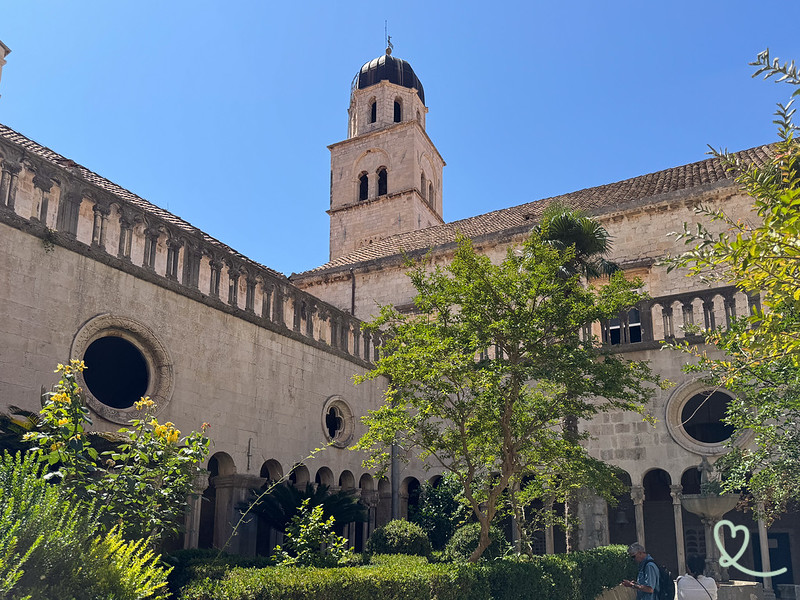
Yes, Dubrovnik’s Franciscan Monastery is well worth a visit. Its architecture blends Romanesque, Gothic and Renaissance styles, with a remarkable cloister. With its 120 sculpted columns, it is considered one of the most beautiful in Croatia.
The museum also houses some remarkable treasures, including illuminated manuscripts, a collection of liturgical objects and even works of art. Above all, it offers a peaceful ambience in the heart of the old town. For us, it’s one of Dubrovnik’s must-sees!

WHERE TO STAY IN Dubrovknik
Our favorites: neighborhoods and hotels
Old Town –
Hotel Villa 5DB – check photos and availability
Lapad and Babin Kuk –
Hotel Royal Neptune – check photos and availability
North Shore –
Hôtel Ninon Bed & Breakfast – check photos and availability
Ploče District –
Excelsior Hotel – check photos and availability

Why is the Franciscan Monastery famous?
The monastery is famous for many reasons. Its cloister is considered to be one of the finest examples of Romanesque-Gothic architecture in Croatia, with its 120 columns featuring different capitals. The monastery is also known for its rich library containing over 20,000 volumes, including illuminated medieval manuscripts.
But above all, it houses one of the three oldest pharmacies in Europe still in operation, founded in 1317.

Our favorite
In addition to its peaceful cloister, the monastery also boasts a fine collection of works of art. Among them, we fell in love with a painting by Vlaho Bukovac (1855-1922), one of the most important Croatian painters of his time. This double portrait of the artist’s wife, entitled The New Ring, is both poetic and mysterious.

History in brief
- Around 1317-1343: Foundation of the Franciscan monastery and opening of the pharmacy
- 1456: Construction of the late Gothic cloister by master mason Mihoje Brajkov from Bar,
- 1667: Major reconstruction after the terrible earthquake
- 1991: 37 missiles hit the monastery during the siege of Dubrovnik, severely damaging it and necessitating major restoration work.
We were also impressed to discover the remains of a shell hole on one of the museum’s walls.

How to find us: Franciscan Monastery, Dubrovnik
Where is the Franciscan Monastery?
- Located at 4 Poljana Paska Miličevića, in Dubrovnik’s Old Town.
- Just a 3-minute walk from Porta Pile.
How to get there?
The Franciscan Monastery can be reached on foot from Porta Pile, about 200 meters away (a 3-minute walk).
To get there, you can opt for the car, although parking is difficult on the outskirts of the old town. The easiest way is by public transport (bus lines 1 and 6 serve the Pile Gate stop) or cab (cab ranks are available in front of Porta Pile).
Parking
As the monastery is located in the old town, which is entirely pedestrianized, there is no reserved parking for visitors. You’ll need to find out about the parking lots at the entrance to the town.
OUR ADVICE FOR RENTING YOUR CAR AT Croatia
- Compare prices on our preferred platform: DiscoverCars – one of the best rated sites.
- Choose a car that is powerful enough (the roads are steep) but compact (some passages are narrow).
- There is a lot of demand, book it early.


See our tips (coming soon)
Useful tips: duration, schedules, eating…
Best time to visit
To enjoy the peace and quiet of the Franciscan Monastery, it’s best to visit when it opens at 9 a.m. or in the late afternoon. The site is quite busy even on weekdays.
Length of visit and main difficulties
Allow 30 minutes for a visit if you’re in a hurry, and 1 hour for a complete tour of the Franciscan Monastery. Note that photography is forbidden inside.
There are no checkrooms or lockers, and accessibility for the disabled is only partial, as the site has a few steps.

Advice on how to visit
The tour is self-guided.
A LITTLE MORE patience
All the photos, maps, information and addresses you need to make your stay in Croatia a success will soon be available in a single ebook!

Visiting with children
The Franciscan Monastery doesn’t offer any special facilities for children, but it’s an enjoyable visit even for families.
Schedules and rates
The monastery is open daily:
- Summer: 9 a.m. to 6 p.m.
- Winter: 09h to 14h
Admission is €6 per person, but if you opt for the Dubrovnik Pass, entry is free. Find out more on the official website here.

Guided tours
We did not find any guided tours offered directly by the monastery.
It’s best to contact the tourist office directly, as many organizations offer guided tours of the old town, including various historic sites.

Catering
There are no on-site restaurants at the Franciscan Monastery. You’ll find plenty of restaurants and cafés in Dubrovnik’s old town, just a few minutes’ walk away.
If you’re looking for an authentic address for a quick bite to eat, we recommend the Taj Mahal Restaurant. A real delight!
DISCOVER Dubrovnik

Explore the monastery cloister
Frescoes and sculpted capitals
The monastery’s Romanesque-Gothic cloister truly amazed us with its fine architectural details. Built in the 14th century, it features 120 double columns forming a harmonious gallery around the central garden. We took time to observe each capital, each one different from the next, carved with remarkable precision. You’ll discover interwoven plant motifs, fantastic animal figures and even expressive human representations. The semicircular arches rest on these slender columns, creating a particularly photogenic play of light and shadow.

Under the arcades, take the time to look up and admire the sublime frescoes, although partially erased by time. They illustrate the life of Saint Francis and add a narrative dimension to the space.

The peaceful, symbolic ambience of the garden
At the center of the cloister lies a Mediterranean garden that invites contemplation. We particularly enjoyed sitting on one of the stone benches to enjoy the peace and quiet. The garden is organized geometrically, typical of medieval monastic gardens where each element has a symbolic dimension. Note the central octagonal fountain, topped by an elegant carved column. This fountain was not only decorative, but was also used for the monks’ ablutions. The aromatic and medicinal plant beds are a reminder of the monastery’s pharmaceutical activity. Look out for the orange, laurel and cypress trees that provide shade and their distinctive scents.


A monastery like no other: with a museum and a pharmacy
The Franciscan Monastery has many facets that make it much more than just a place of worship. There’s a pharmacy, a museum and a library.
Discover one of Europe’s 3 oldest pharmacies
The monastery’s pharmacy, founded in 1317, is one of the three oldest in Europe still in use. We were impressed by the exceptional preservation of the old dispensary, which has spanned seven centuries of history. Admire the 17th-century ceramic jars, finely decorated and bearing the Latin names of the substances they contained. The precious wooden cupboards still house marble mortars, precision scales and various period apothecary instruments. We learned that Franciscan monks had advanced knowledge of botany and medicine, growing their own medicinal plants in the cloister garden. The preserved records testify to the importance of this pharmacy, which supplied remedies not only to Dubrovnik’s inhabitants but also to the ships calling at the port. The modern pharmacy at the entrance to the monastery still exists, although it sells more basic products than in the past.

The rich collections of the monastery’s museum and library
The monastery’s museum presents a varied collection of liturgical objects and works of art that captivate the eye. We were particularly impressed by the collection of medieval illuminated manuscripts, veritable masterpieces of calligraphy and illumination. You’ll discover richly decorated mass books, breviaries with gold and silver lettering, and historical chronicles recounting life in Dubrovnik over the centuries. The library boasts over 20,000 volumes, including some extremely rare incunabula dating back to the early days of printing.

We admired the gold and silver reliquaries, precious chalices and gold-thread-embroidered liturgical vestments that testify to the wealth of the Franciscan order. A section of the museum features paintings by Italian and Croatian masters, including several polyptychs depicting scenes from the life of St. Francis of Assisi. The showcases also display objects from the monks’ daily lives: their robes, liturgical musical instruments and tools used in the scriptorium.

Subscribe to our Newsletter
- Get away from it all with Region Lovers’ beautiful destinations!
- Once a month
- Advertising-free

Frequently asked questions
Is the monastery pharmacy still in business?
Yes, the Franciscan Monastery pharmacy is still in operation today. Founded in 1317, it is one of the three oldest pharmacies in Europe still in operation. You’ll find the modern pharmacy at the entrance to the monastery, where you can buy classic products. The historic old dispensary, with its 17th-century ceramic jars and period apothecary instruments, can be visited as part of the monastery museum.

Is it better to visit the Franciscan Monastery or the Dominican Monastery in Dubrovnik?
Both monasteries are well worth a visit, as they offer complementary experiences.
The Franciscan Monastery boasts an exceptional Romanesque-Gothic cloister with 120 carved columns and a historic pharmacy that is unique in Europe. We found its central garden particularly soothing.
The Dominican Monastery, on the other side of the old town, boasts an impressive collection of paintings by Venetian and Croatian masters in its museum.
If you have to choose, we recommend the Franciscan Monastery for its more striking architecture. Especially as it’s included in the Dubrovnik Pass.