Are you planning a trip to the Dalmatian coast and can’t decide between two of Croatia’s must-see destinations: Dubrovnik or Split?
We’ve walked along the ramparts of one and through the ancient streets of the other, and here we share our Dubrovnik vs. Split showdown, along with our tips and photos.
- Heritage and the Old Town
- Atmosphere and Local Life
- Location for exploring the region
- Lodging
- Beaches and Cuisine
- …
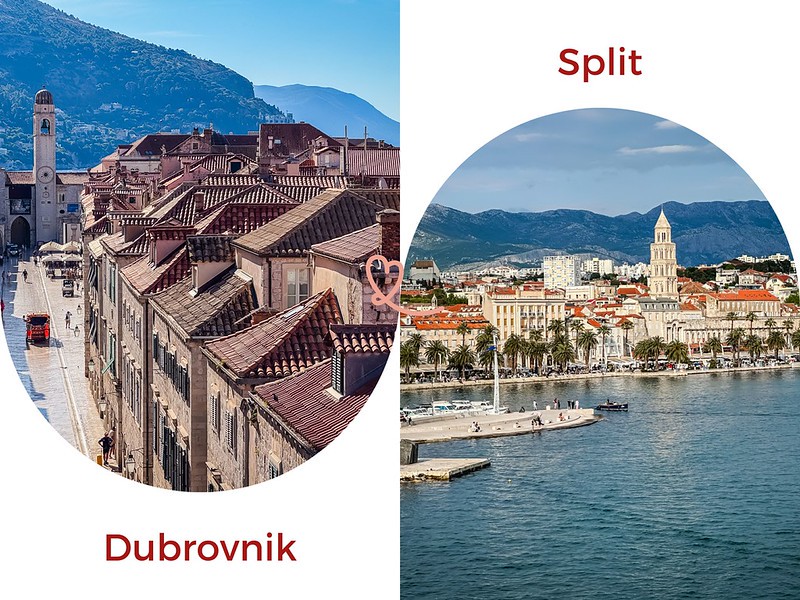
This opinion is completely independent, based on our experiences. We made our own choices, visited the area anonymously, and paid our bills in full.
Dubrovnik or Split: A Comparison at a Glance
Short answer
Both cities are among the most beautiful destinations along the Dalmatian coast, but they each tell a different story.
- Dubrovnik is a fortified medieval city-state, surrounded by 14th-century ramparts and designated a UNESCO World Heritage Site: we find it more compact, better maintained, but also more crowded and more expensive.
See the top-rated accommodations in Dubrovnik. - Split, on the other hand, was built right inside a 4th-century Roman palace: narrow streets, shops, and homes coexist there on a daily basis, giving the city a less rigid character. We also appreciated that Split serves as a gateway to many Dalmatian islands and national parks, whereas Dubrovnik is more remote in the south of the country.
See the top-rated accommodations in Split.

Depending on what you’re looking for…
- For its medieval heritage and city walls: Dubrovnik
- A city that comes alive all year round, even outside of the tourist season: Split
- for easy access to the islands: Split
- For a tighter budget: Split
- For nightlife and evening entertainment: Dubrovnik
- As for the beaches: it’s a tie—both focus on pebble beaches and developed coves
- For Game of Thrones fans: a tie
- …


It’s time to book!
Compare everything: companies, prices, schedules and availability.
Heritage, City Walls, and the Old Town
Heritage in Dubrovnik
In Dubrovnik, the city’s heritage is visible at a glance: the 14th-century city walls completely encircle the Old Town for nearly 2 km, and it takes about 2 hours to walk the entire circuit. We highly recommend this walk—preferably early in the morning—to enjoy the beautiful light on the orange-tiled roofs before the tour groups arrive.

Within the city walls, the Stradun connects Pile Gate to Ploče Gate over a distance of about 300 meters, lined with Baroque facades of remarkable uniformity. We were also struck by the wealth of monuments concentrated within such a small area: the Rector’s Palace, the Cathedral of the Assumption and its treasury, and Fort Lovrijenac, which has become famous since its appearance in *Game of Thrones*.
See the best attractions in Dubrovnik.
Heritage in Split
The historic heart of Split is not a static site, but Diocletian’s Palace itself, built in the 4th century and still home to several thousand residents. We find this quite unusual: people live there, shop there, and sleep there, among the columns of the peristyle and the vaulted cellars that also served as a setting for *Game of Thrones*.

St. Domnius Cathedral stands on the site of the emperor’s former mausoleum, making it one of the oldest cathedrals in the world to retain its original structure, and its bell tower offers an unobstructed view of the city after climbing 200 steps. Outside the palace, the Riva—a palm-lined seaside promenade—extends the tour all the way to the harbor.
See the best attractions in Split.
Our review
Both cities boast first-rate ancient and medieval heritage, but the experience differs. Dubrovnik feels like a complete, self-contained whole—almost like a movie set. Split, on the other hand, feels more like an ordinary neighborhood, which lends it an extra touch of authenticity. Our preference, for the richness of its heritage: Dubrovnik.
Hotel Options: Dubrovnik vs. Split
Hotels in Dubrovnik

The hotels in Dubrovnik are of a very high standard, but they are also among the most expensive in Croatia. Read our article on where to stay in Dubrovnik. We recommend:
- Beach Resort: Royal Neptune Hotel – See prices, photos and availability
- In the Old Town: Scalini Palace Hotel – see prices, photos and availability
- Charming and romantic: Hotel Ninon Bed & Breakfast – see prices, photos and availability
Hotels in Split

In Split, there’s a wide variety of options, and we find the value for money to be generally better than in Dubrovnik. Read our article on where to stay in Split. We recommend:
- View and Rooftop Pool: Hotel Ambasador Split – See prices, photos and availability
- In the Diocletian’s Palace: Hotel Villa Split – see prices, photos and availability
- Shopping and City Center: Piazza Heritage Hotel – see prices, photos and availability
Our review
We prefer Split’s hotels for their value for money, especially at Diocletian’s Palace, where sleeping among the Roman ruins remains a truly unique experience. Dubrovnik, however, still offers some exceptional accommodations, particularly for travelers seeking a high-end beach vacation.
OUR ADVICE FOR RENTING YOUR CAR AT Croatia
- Compare prices on our preferred platform: DiscoverCars – one of the best rated sites.
- Choose a car that’s compact enough (some passages are narrow).
- There is a lot of demand, book it early.


Beaches: Dubrovnik or Split?
Beaches in Dubrovnik

Dubrovnik isn’t strictly speaking a beach destination, but there are several spots worth visiting. Banje Beach, just outside the Ploče Gate, offers a direct view of the city walls and Lokrum Island. The quieter Bellevue Beach is nestled at the foot of the cliffs west of the Old Town. Note that most of these beaches are pebbly.
Beaches in Split

In Split, Bačvice Beach, just 1 km from the Old Town, remains the most iconic: its fine sand and gently sloping waters make it ideal for families, and it was here that picigin—a local ball game recognized as part of UNESCO’s Intangible Cultural Heritage—was born. For a quieter spot, Kašjuni Beach, nestled on the side of the Marjan Peninsula, offers the shade of pine trees.
Our review
A tie on this criterion. Neither city is a beach destination in its own right, but each offers pleasant beaches within walking distance of the historic center.

Best gastronomic offer
Restaurants in Dubrovnik

Dalmatian cuisine focuses on high-quality ingredients: fish and seafood from the Adriatic, local olive oil, and wines from the Pelješac vineyards. In Dubrovnik, we recommend stepping into a konoba—one of these family-run taverns—rather than the restaurants on Stradun, which are often more touristy. For a more refined evening, Restaurant 360—a Michelin-starred establishment located on the city walls—offers contemporary Mediterranean cuisine with a panoramic terrace overlooking the old harbor.
Restaurants in Split

In Split, we recommend choosing restaurants just off the Riva for more reasonable prices and more authentic cuisine. The Pazar Market and the nearby fish market are also excellent places to pick up fresh ingredients for a meal. Among our favorites are Soul Kitchen, Konoba Marjan, and Fig.
Our review
We have a slight preference for Split, where the restaurants off the beaten path seemed more affordable to us without sacrificing quality. Dubrovnik, however, remains a must-visit for an exceptional gourmet dinner.

Excursions and Islands Around the Two Cities
Excursions from Dubrovnik

From Dubrovnik, you can visit:
- The Blue Cave: A Light Show
- Lokrum Island, a 10-minute boat ride away, with its botanical garden and peacocks
- The three inhabited islands of the Elaphiti Islands: Koločep, Lopud, and Šipan
- The magnificent island of Midjet and its nature reserve
- Kotor and Perast, in Montenegro, about a 1.5-hour drive away
- Mostar and the Kravica Waterfall, in Bosnia and Herzegovina, about a 2½-hour drive away
- See our complete list of the best day trips from Dubrovnik

Tours from Split

From Split, you can visit:
- Trogir, a small medieval town listed as a UNESCO World Heritage Site, a 30-minute drive away
- The Klis Fortress, which overlooks the region
- Krka National Park and Its Waterfalls
- The Roman ruins of Salona, 5 km to the northeast
- The islands of Hvar, Brač, and Šolta by ferry

Our review
Based on this criterion, we prefer Split, whose central location makes it easier to explore the Dalmatian islands and the hinterland. Dubrovnik, however, remains the better choice for combining a trip to Croatia with a getaway to Montenegro or Bosnia and Herzegovina.
Directions and Location for Exploring the Region
Dubrovnik is located in the far south of Croatia, on the border with Bosnia and Herzegovina and Montenegro. Split is more centrally located on the Dalmatian coast, halfway between Zagreb and Dubrovnik. This difference in location greatly affects the day trips available from each city.
- Dubrovnik to Split = 3-hour drive
- Split to Zadar = 1 hour and 45 minutes by car (156 km)
- Split to Zagreb = a 4.5- to 5-hour drive
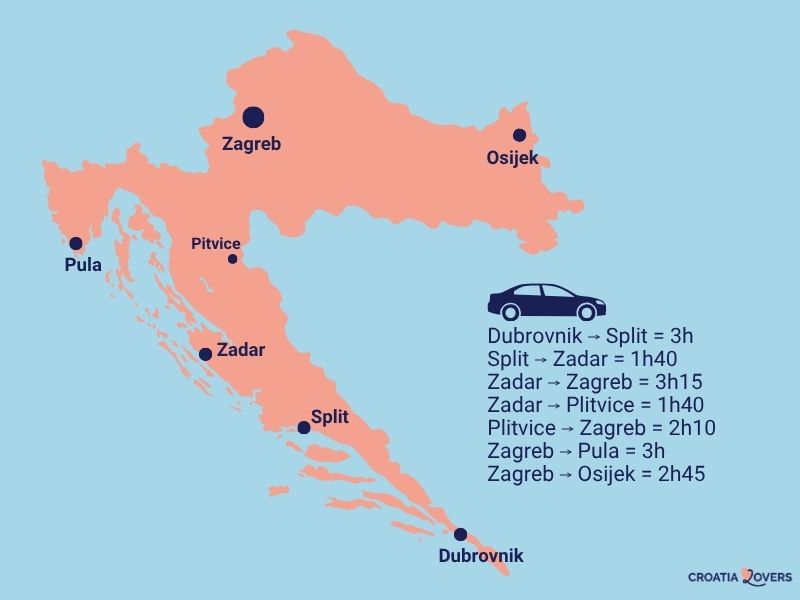
From Split, you can easily reach the Dalmatian archipelago: Hvar, Brač, and Vis are all accessible by ferry in less than 2 hours. And the Krka and Plitvice National Parks are a 1.5-hour and 3-hour drive away, respectively. This is why we consider Split to be the best base for a trip that combines cities, islands, and nature.
From Dubrovnik, day trips tend to head more toward neighboring Montenegro or Bosnia and Herzegovina and its Old Bridge in Mostar. But there are still day trips to some very beautiful islands, both man-made and natural: Lorkum, Miljet…

Dubrovnik-Čilipi Airport is located 22 km from the city center, while Split Airport is 24 km away: the two cities are therefore comparable in this regard, and both are connected to many European capitals.
Getting Around in These Two Cities
Getting around Dubrovnik
Dubrovnik’s Old Town is entirely pedestrian-only: cars aren’t allowed there. The city bus system provides efficient service connecting the Old Town, the Lapad Peninsula, and the port of Gruž. You can buy a ticket from the driver for about €2.

Getting Around in Split
In Split, too, you can explore the historic center entirely on foot. To reach more distant sites such as the Meštrović Gallery or Bačvice Beach, local bus routes cover most of the city. Split also has a hop-on, hop-off bus for exploring tourist attractions— buy your ticket

Our review
Equality. Both old towns are easy to explore on foot, and the bus networks cover the outlying neighborhoods.
Is it possible to visit Dubrovnik and Split on the same trip?
Yes, it’s actually one of the most popular routes in Croatia. The drive between the two cities takes about 3 hours (225 km), or you can take a long-distance bus. Many travelers combine these two stops with a visit to Trogir or one of the islands along the way.
And why not other cities in Croatia?
Along the Dalmatian coast, there are other towns worth visiting. See our list of the most beautiful towns in Croatia.
PLAN YOUR TRIP TO Croatia
- Best of
Top Destinations
; Most Beautiful Cities
; Most Beautiful Islands
; National Parks

- Practical advice
When to go?
How to rent a car in Croatia
Driving tips
Itineraries: Road Trip—10 Days, 2 Weeks, 3 Weeks

- The must-dos
Attractions in Dubrovnik
Attractions in Zadar
Attractions in Split
Attractions in Zagreb
Attractions in Istria
The Plitvice Lakes