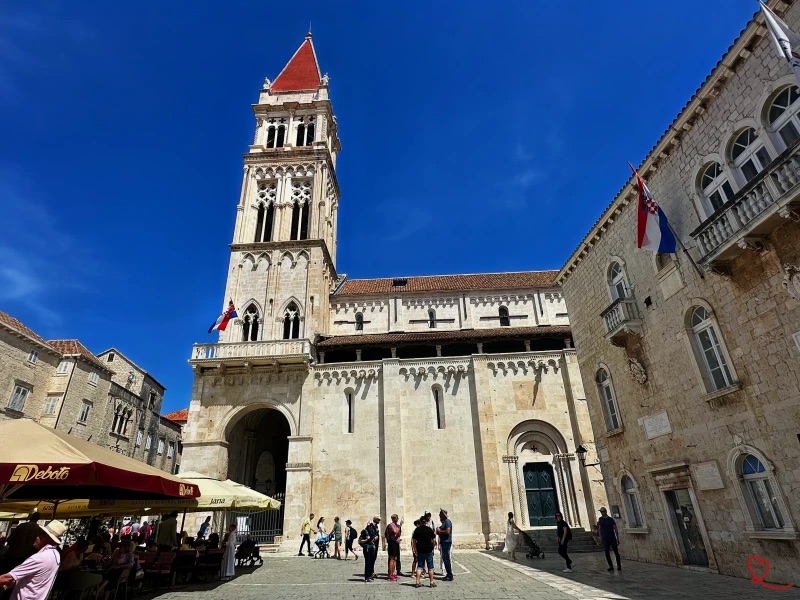
St. Lawrence Cathedral in Trogir stands as the most imposing monument in this old town, a UNESCO World Heritage Site. This three-nave Catholic basilica harmoniously blends Romanesque and Gothic styles, offering a remarkable testament to the region’s architectural history.
In this article, we share our helpful tips with photos to help you prepare for your visit and fully enjoy this historic site.
This opinion is completely independent, based on our experiences. We made our own choices, visited the area anonymously, and paid our bills in full.
Why Visit St. Lawrence Cathedral in Trogir
Is St. Lawrence Cathedral in Trogir worth a visit? Our take:
Yes, St. Lawrence Cathedral is well worth a visit. Its Romanesque portal by Master Radovan and the Chapel of St. John offer a remarkable glimpse into medieval religious art, while the climb up the bell tower reveals panoramic views of the old town and its surroundings. It is one of Trogir’s must-see gems.

Why is St. Lawrence Cathedral in Trogir famous?
St. Lawrence Cathedral is renowned for its western portal, completed around 1240 by Master Radovan. This portal, a masterpiece of Romanesque sculpture in Croatia, features finely carved biblical scenes and animal motifs that attest to exceptional craftsmanship.
Architecturally, the cathedral exemplifies a medieval fusion of the Romanesque style—evident in its massive structure—and the Gothic style—visible in its vaults and slender bell tower. This combination reflects the evolution of artistic trends between the 12th and 15th centuries.

Located in the heart of the historic center of Trogir, one of Croatia’s most beautiful cities, the cathedral stands out as an imposing monument that defines the Old Town. Its presence contributes significantly to the heritage value that earned Trogir its designation as a UNESCO World Heritage Site.

Our favorite moments
- A close look at Master Radovan’s carved gate, where every detail tells a richly carved biblical story,
- The striking contrast between the lively bustle of the square in front of the cathedral and the soothing calm of the interior chapels,
- The climb up to the bell tower, despite its narrow staircase, is rewarded with a unique panoramic view of the rooftops of Trogir and the Adriatic Sea,
- A moment frozen in time on a stone terrace, surrounded by columns, offering a breathtaking view of the historic rooftops and the timeless atmosphere of the old town.
WHERE TO STAY IN Trogir
Our favorites: neighborhoods and hotels
In the Old Town –
Hotel Monika – check photos and availability
On the island of Ciovo –
Brown Beach House Hotel – check photos and availability
On the mainland, a modern city—
, Bellevue Hotel— check photos and availability

See our selection of the best hotels in Trogir
Directions: St. Lawrence Cathedral in Trogir, Trogir
Where is St. Lawrence Cathedral in Trogir located?
- Located on the main square, Trg Ivana Pavla II, in the heart of Trogir’s Old Town
- In the historic center, a UNESCO World Heritage Site
- Right next to the harbor and the medieval ramparts
- Easily visible from the cobblestone streets and surrounding squares
How to get there
Trogir’s Old Town is entirely pedestrian-only, making a walking tour a must. You can reach Trogir by bus or boat from Split, then easily make your way to the cathedral through the cobblestone streets of the historic center.
Parking
Paid parking is available outside the Old Town, a short walk from the cathedral.

OUR ADVICE FOR RENTING YOUR CAR AT Croatia
- Compare prices on our preferred platform: DiscoverCars – one of the best rated sites.
- Choose a car that’s compact enough (some passages are narrow).
- There is a lot of demand, book it early.


Useful tips: duration, schedules, eating…
Best time to visit
Many tourists take a day trip to Trogir from Split.
Choose early in the day or late in the afternoon to avoid the crowds.
Length of visit and main difficulties
Allow between 1 and 2 hours to explore Saint-Laurent Cathedral and its various areas. The climb up to the bell tower, via a steep and narrow spiral staircase, may be difficult for people with limited mobility.
Advice on how to visit
For a smooth tour, start at the western portal of Master Radovan, then explorethe three-nave interior. Continue on to St. John’s Chapel and the treasury, and finish by climbing the bell tower.

Visiting with children
We did not find any activities specifically designed for young visitors at St. Lawrence Cathedral in Trogir, such as a game booklet or a tailored tour. The visit therefore remains primarily focused on exploring the heritage for visitors of all ages.
Schedules and rates
- Hours:
Monday through Saturday: 8:00 a.m. to 4:00 p.m. for the cathedral and the tower
8:00 a.m. to 3:30 p.m. for ticket sales and the Museum of Sacred Art - Adult admission:
6 € for the cathedral only
10 € (includes access to the bell tower)
12 € (includes access to the bell tower and the collection of sacred art) - See the latest news on the official website here.
Guided tours
Guided tours offer a deeper look at Saint-Laurent Cathedral , with explanations of its architecture and medieval history.
A LITTLE MORE patience
All the photos, maps, information and addresses you need to make your stay in Croatia a success will soon be available in a single ebook!

The Romanesque gateway at Radovan, a sculpted narrative at the entrance
The Sculptures on the West Portal
The western portal of St. Lawrence Cathedral , created around 1240 by Master Radovan, is a remarkable example of Romanesque sculpture in Croatia. This masterpiece showcases a rich sculptural language, blending biblical scenes and ornamental motifs that invite careful examination.

We particularly appreciated the intricate details, especially the stylized human figures and animals that come together to form a complex visual narrative. This portal invites viewers to appreciate the technical mastery and religious symbolism characteristic of the medieval period.

For you, this portal is the perfect starting point for your tour, as it showcases Romanesque art at its most expressive. Don’t leave without taking the time to admire these sculptures, which bear witness to Trogir’s artistic richness in the 13th century.
Read the details before entering
Before entering St. Lawrence Cathedral , take a moment to admire the façade, where Master Radovan’s western portal stands out for its monumental scale. The sculptures—including nearly life-size stone lions—create a striking presence that invites close observation. The exterior architecture, primarily Romanesque, serves as a backdrop for this richly sculpted decor, blending human figures and animal motifs with remarkable finesse.

On the archivolt, a series of small figures depicts the months of the year through scenes of medieval daily life, adding a narrative and temporal dimension to the ensemble. This detail highlights the iconographic richness of the portal, which remains a masterpiece of Romanesque sculpture in Dalmatia, while also foreshadowing emerging Gothic influences. The arrangement of the scenes invites a gradual and careful examination of the façade.
The relationship between the portal and the exterior structure reflects the cathedral’s long architectural evolution, spanning the 13th to the 17th centuries. The Romanesque façade, enhanced by Gothic and Renaissance elements , provides a cohesive framework that highlights the sculpted decoration. We recommend that you begin your tour with this detailed examination, which will deepen your understanding of the interior spaces and the history of the monument.

The basilica and its vaults
St. Lawrence Cathedral in Trogir features a three-nave basilica layout, a classical design that divides the interior space into three distinct sections, separated by massive columns. This structure facilitates smooth movement and provides a clear view of the choir.

Externally, the cathedral features predominantly Romanesque architecture, which is particularly evident in the façade and the carved western portal. These elements reflect the first phase of construction, characterized by the simplicity and grandeur typical of the Romanesque style.
In contrast, the interior is distinguished by its Gothic ribbed vaults, which span the naves and lend the space a lighter, more airy feel. This stylistic evolution reflects the lengthy construction period, which spanned the 13th to the 15th centuries, gradually incorporating Gothic innovations.

This succession of styles vividly illustrates the cathedral’s architectural history, in which the austere Romanesque exterior gives way to a more refined Gothic style inside. This contrast enriches the visit by offering a tangible glimpse into the evolution of medieval art in Dalmatia.
During your visit, take the time to admire the details of the vaults and columns, which are a testament to remarkable craftsmanship. This interplay between strength and lightness is one of the features that makes Saint-Laurent Cathedral particularly interesting.
The Chapel of Saint John and his tomb
The Chapel of St. John within St. Lawrence Cathedral in Trogir is dedicated to St. John of Trogir, bishop and patron saint of the city. It houses his tomb, a central site of local devotion that bears witness to the deep bond between the community and its spiritual protector. This sanctuary plays an important role in the religious life of Trogir, particularly during the annual celebrations that bring the residents together.

This chapel is also a masterpiece of 15th-century Dalmatian religious art. It is distinguished by its refined sculptures and marble decorations, created by local artists such as Ivan Duknović. These artistic elements illustrate the region’s cultural richness and enhance the cathedral’s heritage value.
During your visit, you’ll be able to appreciate the blend ofspiritual history andartistic excellence that makes St. John’s Chapel a place that is both sacred and beautiful. This site invites contemplation while offering a valuable glimpse into the religious traditions that have shaped Trogir over the centuries.
The atmosphere inside the chapels

Away from the hustle and bustle outside, the interior chapels offer a more serene atmosphere, bathed in soft light that highlights the religious details. These spaces invite peaceful contemplation, conducive to careful observation.
EXPLORE Trogir
- Attractions in Trogir
- Best Hotels in Trogir
- St. Lawrence Cathedral
- Fortress

The slender bell tower and the views of Trogir
A building that blends Venetian Gothic and Renaissance styles
The bell tower of Saint-Laurent Cathedral rises 47 meters, reflecting a construction process that spanned the 14th to the 16th centuries. This lengthy construction period explains the coexistence of different architectural styles, which are layered one atop the other in its elevation. You can thus discern the successive influences that shaped its construction.

The upper levels of the bell tower display a strong Gothic influence, particularly evident in the pointed arches and slender openings. This part of the bell tower is a fine example of the Venetian Gothic style, which is distinguished by its elegance and decorative finesse—a legacy of cultural exchanges between Dalmatia and Venice.

As you make your way up to the summit, you’ll notice Renaissance motifs adorning the upper sections, marking a notable stylistic transition. These decorative details reflect the region’s artistic evolution over the centuries and enrich your understanding of the bell tower’s architecture before you begin your ascent.
Go up to see the old town
From the top of the bell tower of St. Lawrence Cathedral, the view stretches across the entire old town of Trogir, with its red-tiled roofs and characteristic narrow streets. This vantage point offers a unique visual experience, allowing visitors to appreciate the site’s medieval layout and the architectural density that characterizes this UNESCO World Heritage Site.

As you climb higher, the view opens up to the nearby Adriatic Sea, as well as the port of Trogir and the surrounding islands, notably the island of Čiovo. This vantage point offers valuable insight into the connection between the city and its maritime surroundings, deepening your understanding of its history and geography.

The ascent is via a steep, narrow spiral staircase, which may pose a challenge for some visitors. We therefore suggest that you assess your physical condition and expectations before attempting this climb, which remains, however, a must-do for anyone who wants to fully enjoy the view and atmosphere of Trogir.
The Treasury and the Cathedral’s Living Role
Relics and Religious Artifacts
St. Lawrence Cathedral in Trogir houses a treasury where religious artifacts that bear witness to its spiritual and cultural role are preserved. This collection includes relics of saints, gold and silver chalices, and embroidered liturgical vestments, some of which date back to the Middle Ages. These pieces illustrate the richness ofDalmatian goldsmithing and the cathedral’s importance in local liturgy.

Among the major artifacts, the reliquary of Saint John stands out for its craftsmanship and historical significance. These objects are valuable not only for the materials from which they are made, but also for their role in religious ceremonies and their connection to the history of Trogir. Preserving these treasures in a dedicated space provides a better understanding of the cathedral’s religious function over the centuries.

We particularly appreciated how the treasury highlights the continuity between past and present in Trogir’s religious life . As you explore this space, you’ll come to understand the importance of the cathedral not only as an architectural structure but also as the guardian of a living religious heritage, which is still celebrated on the feast of St. Lawrence every August 10.

A landmark at the heart of Trogir’s life
St. Lawrence Cathedral plays a central role in the spiritual and cultural life of Trogir. Dedicated to St. Lawrence, a 3rd-century martyr, it is the city’s main place of religious worship. Every year, the feast of Saint Lawrence on August 10 is marked by important religious ceremonies that bring residents together around their spiritual heritage.

In addition to traditional religious services such as Masses, baptisms, and weddings, the cathedral also hosts cultural events such as concerts of sacred music. These events reinforce its role as a vibrant place, where tradition and artistic expression come together, in the heart of Trogir’s old town.
For residents and visitors alike, St. Lawrence Cathedral remains an unmissable landmark. It embodies not only the local faith but also the continuity of the cultural traditions that shape life in Trogir, closely tied to its rich historical and architectural heritage.
History in brief
Here are the key dates to keep in mind to understand the history of St. Lawrence Cathedral in Trogir:
- 1123: Destruction of the previous building by the Saracens,
- 1213: Reconstruction began on the foundations of an earlier early Christian cathedral,
- Construction spanned the 17th century, reflecting the coexistence of various architectural styles.
Subscribe to our Newsletter
- Get away from it all with Region Lovers’ beautiful destinations!
- Once a month
- Advertising-free

Frequently asked questions
Can you climb the bell tower of St. Lawrence Cathedral in Trogir?
Access to the bell tower of Saint-Laurent Cathedral is via a narrow, steep spiral staircase, the final section of which consists of a ladder or a metal walkway. This layout requires a fair amount of physical effort and may be daunting for people who are prone to vertigo.
A warning sign states that you climb at your own risk, as the bell tower is not equipped with modern safety features. It is also recommended that you avoid climbing at the top of the hour, when the bells ring, due to the intense noise, which can be startling.
At the summit, the view makes the climb worthwhile: you’ll enjoy a remarkable panorama of Trogir’s old town, the Adriatic Sea, and the surrounding islands. This experience offers a unique perspective from which to appreciate the city’s historic and natural setting.
PLAN YOUR TRIP TO Croatia
- Best of
Top Destinations
Top Attractions
Most Beautiful Cities
Most Beautiful Islands
National Parks

- Practical advice
When to go?
Howtorent a car in Croatia
Driving tips
Itineraries: Road Trip—10 Days, 2 Weeks, 3 Weeks