Located in the south of theIstrian Peninsula, Pula boasts one of Europe’s best-preserved Roman heritage sites, right in the heart of a city that faces the sea. We find that few cities offer such a harmonious blend of ancient ruins, bustling alleyways, and beaches that are within walking distance or just a few minutes’ drive away.
In this article, we share 8 reasons to visit this city.
This opinion is completely independent, based on our experiences. We made our own choices, visited the area anonymously, and paid our bills in full.
Is Pula worth visiting?
Yes, Pula is definitely worth a visit. We were particularly impressed by its Roman amphitheater—one of the best-preserved in the world—as well as its old town, where ancient ruins can be found on every street corner. You’ll also enjoy its beaches, which are easily accessible from downtown, and its status as the perfect gateway for exploring Istria.
We list the reasons in more detail below. You can also take a look at our selection of the city’s top attractions.

Reason 1 – Remarkably well-preserved Roman heritage
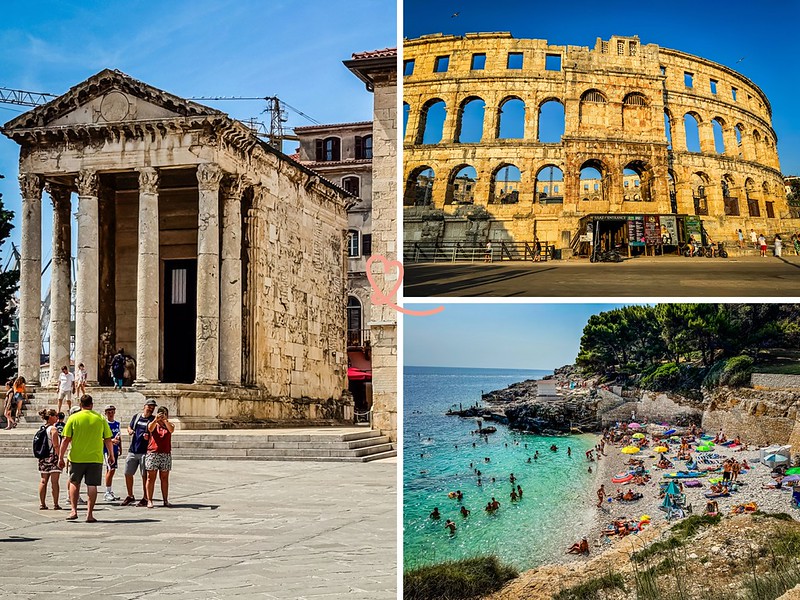
Pula is home to one of the best-preserved Roman amphitheaters in the world. Built in the 1st century, it is comparable in size to the Colosseum in Rome and still stands in the heart of the city. Buy your ticket to save time!

Nearby, the Temple of Augustus, with its façade of Corinthian columns, frames the Forum square, while the Arch of the Sergii, erected between 29 and 27 B.C., and the ancient gates Porta Gemina and Porta Herculea serve as a reminder that the modern city grew out of the ancient fortified settlement. You’ll even come across the foundations of the more modest Little Roman Theater on the central hill.

WHERE TO STAY IN Pula
Our favorites: neighborhoods and hotels
In the city center, near attractions:
Hôtel Mondival – check photos and availability
Verudela Peninsula, cliffs, and squares:
Hotel Brioni – check photos and availability
Stoja neighborhood, between the Old Town and the beaches
Hotel Milan – check photos and availability

Reason 2 – An old town that’s perfect for strolling through
We love strolling through Pula’s old town, where the Forum Square has been the historic heart of the city since Roman times and remains a lively, bustling place today, lined with cafés. The surrounding narrow streets blend Venetian facades with ancient ruins, giving the stroll a unique atmosphere. It is one of the most beautiful cities in Istria.

Continue on to Tito Park, where a miniature model of the city lets you locate the main landmarks before setting out to explore them. Along the way, stop by the Pula Covered Market (Tržnica), built between 1902 and 1903 out of iron and glass: it is one of the finest examples of Art Nouveau architecture in Croatia, and it still houses stalls selling fish, meat, and local products.

OUR ADVICE FOR RENTING YOUR CAR AT Croatia
- Compare prices on our preferred platform: DiscoverCars – one of the best rated sites.
- Choose a car that is powerful enough (the roads are steep) but compact (some passages are narrow).
- There is a lot of demand, book it early.


See our tips (coming soon)
Reason 3 – Layers of history to explore, from antiquity to the world wars
Beyond Roman antiquity, Pula is layered with several periods of history that we find fascinating to explore. Kaštel Fortress, perched on the central hill, houses the Istrian History Museum and offers a vantage point from which you can take in the city’s layout at a glance.

An elevator connects it to the Zerostrasse Tunnels, an underground network dug by the Austro-Hungarian army to serve as a shelter during both world wars. We also recommend a detour to the Chapel of Saint Mary Formosa, the city’s only Byzantine relic dating from the 6th century, as well as to the Church and Monastery of Saint Francis, which bear witness to the city’s medieval heritage. In just a few hundred meters, you’ll travel from antiquity to the 20th century.

Reason 4 – A variety of beaches just a few minutes from downtown
We appreciate that Pula has several different types of beaches right near the city center. The Verudela Peninsula alone is home to Ambrella Beach, Saccorgiana Beach, Hawaii Beach, and the Verudela Canyon—a wilder cove nestled among the rocks.

Ciklonska Beach offers an alternative to the more crowded beaches of Verudela, while Valovine Beach attracts divers with its clear water. Finally, Valsaline Beach, nestled at the end of the Lungomare, enjoys natural shade from the pine trees and a gently sloping entry, making it ideal for families. Be sure to bring water shoes, however, as most of these beaches are pebbly or rocky.


Reason 5 – A contemporary cultural scene that complements the ancient one
Pula is not limited to its ancient heritage. We think it’s worth mentioning the Museum of Contemporary Art, housed in a former printing plant, which hosts temporary and permanent exhibitions by Croatian and international artists.

The MEMO Museum, for its part, offers a decidedly interactive and fun experience that appeals to adults and children alike and stands in stark contrast to the city’s more traditional museums. Come evening, you can enjoy a free performance of the “Luminous Giants”: the cranes of the former Uljanik shipyard, designed by lighting designer Dean Skira, light up every evening along the waterfront.

A LITTLE MORE patience
All the photos, maps, information and addresses you need to make your stay in Croatia a success will soon be available in a single ebook!
Reason 6 – Istrian cuisine and wines waiting to be discovered
A trip to Pula is also an opportunity to sample Istrian cuisine, which we consider an integral part of exploring the region, just like the ancient monuments. Istria is renowned for its olive oils and wines, which you can sample in the restaurants and wine bars in the city center.

Among our favorites are the Ribarska Koliba Restaurant for its view and seafood, as well as the Riva Restaurant for its modern takes on traditional dishes. For those interested in learning more, the Istrian Olive Oil House offers a guided tasting, as does the Wine Museum—a format we find enjoyable after a morning of cultural sightseeing.
Reason 7 – Water activities for a change of pace
We recommend kayaking to those who want to get off the beaten path and explore the Pula coast from a different perspective, paddling along the cliffs that are home to several sea caves. Nighttime excursions are also available for a unique experience, and no prior experience is necessary. See available options.

Another way to set sail: a dolphin-watching cruise, either during the day or at sunset, to take in the Istrian coastline from a distance. Sightings are never guaranteed—nature is unpredictable—but the boat trip is enjoyable in its own right. You can also rent a kayak or hop aboard a glass-bottom boat near Verudela.

It’s time to book!
Compare everything: companies, prices, schedules and availability.
Reason 8 – An ideal base for exploring all of Istria
In our opinion, Pula is an excellent base from which to explore the rest of Istria. Offshore, the Brijuni Islands National Park—accessible only by boat—combines Marshal Tito’s former summer residence, a safari park, and Roman and Byzantine ruins. See the available options for exploring this national park

On the coast, Rovinj charms visitors with its cobblestone streets and colorful harbor, while Poreč is home to the UNESCO-listed Euphrasian Basilica. Inland, Vodnjan, Labin, Motovun, and Beram round out a customizable itinerary depending on how much time you have.
Finally, Cape Kamenjak, near Premantura, is an ideal nature reserve for a day spent hiking along the coast and swimming in pristine waters.

The Few Downsides of a Trip to Pula
High season tourist numbers
During the peak of summer, Pula welcomes significantly more visitors than in winter, when the city can be explored with far fewer crowds. We recommend booking your ticket to the amphitheater in advance—last admission is one hour before closing—as well as your guided walking tours if you’d like to gain a better understanding of the old town’s history.

You can also visit in the morning to enjoy the sights with fewer crowds. However, the crowds tend to be concentrated at the major sites in the city center; excursions into the countryside or to Cape Kamenjak are generally quieter.
Pebble and rocky beaches
Unlike some seaside destinations with fine sandy beaches, most of the beaches around Pula are pebbly or rocky, such as Ciklonska Beach and Valovine Beach. We therefore recommend bringing water shoes for a more comfortable swim, especially near the Verudela Canyon, which is steeper and rockier.
This doesn’t detract from the quality of the water, which is generally clear and ideal for both swimming and snorkeling, but you’ll be better prepared if you bring this gear with you. Families, on the other hand, will appreciate Valsaline Beach, whose gently sloping entry is more accessible.
Accessibility is sometimes limited at historic sites
Some historic sites in Pula have uneven ground or steps, such as the amphitheater, where only certain sections are wheelchair-accessible. Kaštel Fortress, meanwhile, requires a climb from the city center, although an elevator connects it to the Zerostrasse Tunnels below.

We recommend wearing closed-toe shoes for these tours. However, you’ll also find more accessible, ground-level sites, such as the MEMO Museum or the Museum of Contemporary Art, as well as the historic district, which is generally flat and paved—a pleasant place for a daily stroll.
How to Get to Pula
Pula has its own airport, making it a convenient gateway for visiting Istria. You can also reach the city by road from other parts of Croatia or from neighboring countries.

We highly recommend renting a car so you can easily explore Rovinj, Poreč, or the villages in the Istrian hinterland. Once there, the historic center is best explored on foot, as it is largely pedestrian-only or has restricted traffic: it’s best to park in one of the paid parking lots on the outskirts of the old town, near the harbor or the amphitheater.
DISCOVER Istria