Don’t miss the Pula Arena, one of the best-preserved Roman amphitheaters in the world. We were impressed by the size of this thousand-year-old monument, which still stands in the heart of the city.
In this article, check out our photos and all our tips for making the most of your visit to the Pula Arena.
This opinion is completely independent, based on our experiences. We made our own choices, visited the area anonymously, and paid our bills in full.
Why Visit the Pula Amphitheater
Is the Pula Amphitheater worth the trip? Our take:
Yes, the Pula Amphitheater is definitely worth a visit. We were impressed by how well-preserved it is, right in the heart of the city. You can really see the rows of arches and imagine what it was like in Roman times. It’s one of the best things to do in Pula.

Why is the Pula Amphitheater famous?
The Pula Amphitheater owes much of its fame to Emperor Vespasian, the very same man who commissioned the construction of the Colosseum in Rome. Construction began during the reign of Augustus with an initial wooden structure, which was later replaced by a more modest stone building under Emperor Claudius.
We were surprised to learn that the amphitheater is one of the few in the world to have preserved all four of its outer walls intact. It could seat nearly 20,000 spectators who came to watch gladiator fights. You’ll also notice that the monument appears on the old 10-kuna Croatian banknote, a testament to its symbolic importance to the country. We find that this thousand-year-old history makes the visit all the more captivating.
>> Book your admission ticket to save time!

Our favorite moments
We loved it:
- Walk across the arena and imagine the gladiator battles that once took place there.
- Climb up the bleachers to enjoy a panoramic view of the site and the city.
- Head down into the underground galleries to explore the exhibition on viticulture and olive oil production.
- the colors of the stones at sunset
- >> Book your admission ticket to save time!

WHERE TO STAY IN Pula
Our favorites: neighborhoods and hotels
In the city center, near attractions:
Hôtel Mondival – check photos and availability
Verudela Peninsula, cliffs, and squares:
Hotel Brioni – check photos and availability
Stoja neighborhood, between the Old Town and the beaches
Hotel Milan – check photos and availability

Directions: Pula Amphitheater, Pula
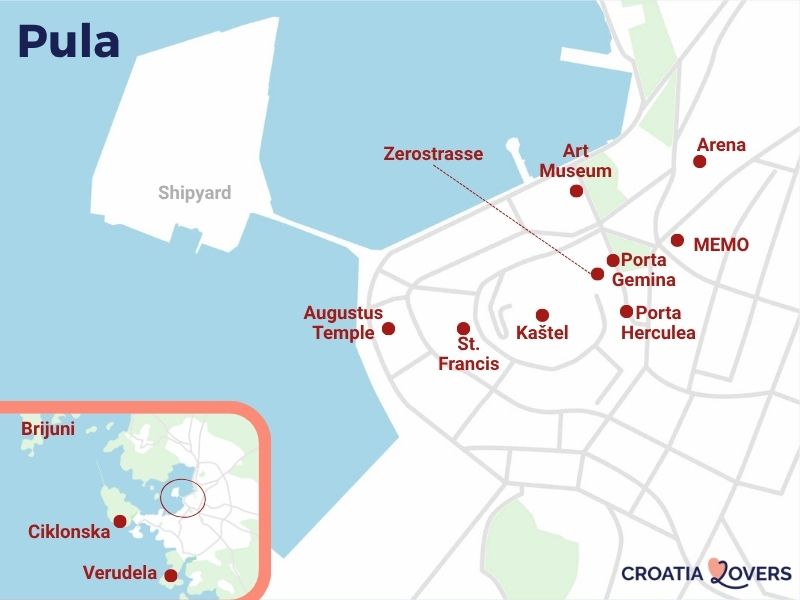
Where is the Pula Amphitheater located?
- In downtown Pula
- Flavijevska Street (Ulica Flavijevska)
- Just outside the old city walls, along the ancient Via Flavia
- Near the port of Pula and the Old Town
How to get there?
Pula’s historic center is easy to explore on foot, so we recommend taking a leisurely stroll from downtown to the Amphitheater. If you’re staying farther away, several bus lines stop right in front of the monument. We chose to walk, which allowed us to stroll through the old town before arriving in front of the amphitheater.
Parking
For visitors arriving by car, there is a parking lot about 50 meters from the amphitheater, near Titov Park. We recommend parking there rather than trying to find a spot in the narrow streets of the old town, where parking is more limited.

OUR ADVICE FOR RENTING YOUR CAR AT Croatia
- Compare prices on our preferred platform: DiscoverCars – one of the best rated sites.
- Choose a car that is powerful enough (the roads are steep) but compact (some passages are narrow).
- There is a lot of demand, book it early.


See our tips (coming soon)
Useful tips: duration, schedules, eating…
Best time to visit
During peak season, the site can get quite crowded around midday. We recommend visiting early in the morning or late in the day, when the light is also softer for taking photos. That way, you’ll be able to enjoy the site in a more peaceful setting.
>> Book your admission ticket to save time!
Length of visit and main difficulties
Allow between 45 minutes and 1 hour and 30 minutes to visit the Pula Amphitheater, depending on whether you just want to walk around the arena or also take the time to explore the underground exhibition.
The ground is uneven and there are steps in some areas, so we strongly recommend that you wear closed-toe shoes. Some parts of the site are wheelchair accessible, but the entire amphitheater is not.

Advice on how to visit
We recommend that you start by looking at the exterior façade before entering the arena. Then head down into the underground galleries to explore the exhibition, and return to the bleachers to take in the panoramic view before leaving the site. Following this route allows you to end your visit with the site’s most beautiful view.

Visiting with children
The Pula Amphitheater is a great place to visit with the family. Children generally enjoy the spectacular setting and the stories about gladiators. However, we recommend that you keep a close eye on young children because of the uneven ground and steps found in several areas of the site.
Schedules and rates
- Hours: 9 a.m. to 5 p.m. from November through March, 8 a.m. to 8 p.m./9 p.m. from April through September, and until 10 p.m. in June–August; last admission 1 hour before closing
- Price: €10 per adult; discounted rates for children
- Visit the official website for more info here.
- Buy your ticket to save time!

Guided tours
Audio guides are available in several languages, including French and English, allowing you to explore the site at your own pace. You can also opt for a guided tour if you’d like to learn more about the monument’s history. In the evenings during the summer, don’t miss the Spectacula Antiqua show, a reenactment inspired by gladiator games.

A LITTLE MORE patience
All the photos, maps, information and addresses you need to make your stay in Croatia a success will soon be available in a single ebook!

Architecture emblematic of the Roman Empire
Exterior walls
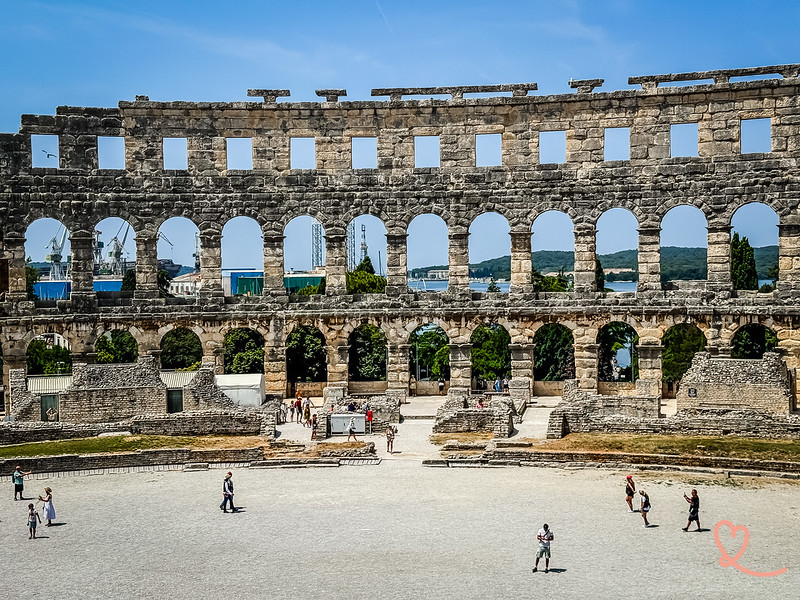
The exterior walls are made of limestone; the side facing the sea has three tiers, while the other sides have only two, as the amphitheater was built on sloping ground. We found this asymmetry particularly interesting to observe. The monument is 132.5 meters long, 105.1 meters wide, and rises to a height of over 32 meters, which gives an idea of the scale of the project undertaken by the Romans.

The view from the arena
Once in the center of the arena, we were struck by the sheer scale of the place. From this vantage point, the view takes in the entire ring of stands rising all around, as well as the outer limestone walls pierced by numerous arches. It was from this exact spot that gladiatorial combats once took place, watched by thousands of spectators seated high above.

We recommend that you take the time to stop at the center to appreciate the structure’s impressive dimensions, which are much larger than one might imagine from the outside. If you look up, you’ll also notice the difference in height between the side facing the sea—which has three levels—and the other facades, which have only two. In our opinion, this view from the arena floor remains one of the most striking highlights of the tour.

The view from the bleachers
After exploring the arena, we recommend heading up to the stands to get a completely different perspective. From up there, the view takes in the entire amphitheater, but also extends beyond its walls to the rooftops of Pula’s old town and the nearby harbor. We appreciated this contrast between the ancient monument and the modern city that surrounds it today—a testament to how deeply it is woven into the urban fabric.
It is also from the stands that one can best understand the original seating arrangement of the Roman audience, which was divided according to social class. During our visit, the late-afternoon light on the limestone gave the site a special atmosphere. Depending on where you stand, you’ll have the opportunity to enjoy very different views of the arena and the sea.
>> Book your admission ticket to save time!

An Underground Journey to Discover Antiquity
The basement of the amphitheater once consisted of a network of tunnels and chambers used to store the cages for the animals and to house the gladiators before their fights. We found the tour of these underground spaces just as interesting as the tour of the arena itself.
The exhibition area featuring antique jars and machines
These underground galleries now house a permanent exhibition dedicated to viticulture and olive oil production in Istria during the Roman era. We were surprised by the richness of this collection, which includes reconstructed tools, oil and wine presses, as well as numerous jars and amphorae used for storing and transporting these products.

The contrast between the somber atmosphere of the underground passages and these everyday Roman objects lends a more intimate feel to the visit—quite different from the experience in the open-air arena. You’ll be able to take a close look at the shape of these amphorae, which were designed to be stacked in the holds of merchant ships. We recommend that you don’t overlook this part of the site, which is often less crowded than the arena itself but just as rich in insights into daily life in Roman times.
>> Book your admission ticket to save time!


Enjoy a free view of the arena from the outside
You can also admire the Colosseum from the city. Here are a few vantage points.
Simply from the square in front:

From the pier, for a panoramic view:

From the small garden near Scalierova Street:

From the citadel:

Legends Surrounding the Pula Amphitheater
A local legend has it that the amphitheater was built by fairies, who carried stones from Mount Učka at night to construct their city. We really love this folk tale, which illustrates just how deeply this monument has captured the imagination of the people of Istria over the centuries.
According to this legend, however, the fairies were never able to finish the building’s roof, which explains why it’s currently open to the sky. You may hear this story told by a local guide during your visit.

A Place That’s Always Alive: Shows and Festivals
Today, the amphitheater has been transformed into a vibrant cultural venue, hosting numerous events such as the Pula Film Festival, concerts, and opera performances. We find it remarkable that an ancient monument can still host these kinds of events more than 2,000 years after it was built.
If you visit Pula in the summer, you may have the opportunity to attend one of these evening events in a truly unique setting. We’ll always have fond memories of the special atmosphere that fills the place after dark, when the spotlights illuminate the ancient limestone walls.

History in brief
Here are the key dates that have shaped the history of the Pula Amphitheater:
- During the reign of Emperor Augustus (27 B.C.–14 A.D.), the first wooden structure was built on the site.
- Under Emperor Claudius, this wooden structure was replaced by a stone building of more modest dimensions.
- Between 79 and 81 A.D., under Emperors Vespasian and Titus, the amphitheater was significantly expanded to accommodate gladiatorial combat.
- In the early 5th century, gladiatorial games were officially banned by Emperor Honorius, but fights involving prisoners and animals continued until 681.
- As early as the 5th century, many of the building’s stones were reused in other local structures.
- In 1583, a Venetian plan to dismantle the amphitheater and rebuild it in Venice was halted by Senator Gabriele Emo, an event now commemorated by a plaque on the northwest tower.
- Systematic efforts to preserve the monument began in the 19th century.
- Today, the site hosts the Pula Film Festival, concerts, and opera performances.

Frequently asked questions
How long does it take to visit the Pula Amphitheater?
Allow between 45 minutes and 1 hour and 30 minutes, depending on whether you want to visit just the arena or also the underground exhibition on viticulture and olive oil production.
Is the Pula Amphitheater accessible to people with limited mobility?
Some parts of the site are wheelchair-accessible, but the entire amphitheater is not, due to uneven ground and steps in some areas.
DISCOVER Istria