Zadar, on Croatia’s Dalmatian coast, is best explored on foot, amid Roman ruins, cobblestone streets, and contemporary art installations along the Adriatic coast. Two days give you time to go beyond the must-see attractions: the historic old town, its museums, its beaches, and an excursion to the surrounding area. We’ve put together two complementary itineraries for you that cover the highlights of what the city has to offer.
With our itineraries, we’ll guide you through Zadar. Make the most of your stay and form your own opinion of this destination with our practical tips and plenty of photos!
This opinion is completely independent, based on our experiences. We made our own choices, visited the area anonymously, and paid our bills in full.
Practical Tips for Visiting Zadar in 2 Days
What can you see in Zadar in 2 days? Is that enough time?
Two days in Zadar are enough to see the highlights of the old town—the Roman Forum, St. Donatus Church, St. Anastasia Cathedral, and the Organ of the Sea—and to explore further: museums, beaches, and a day trip to the surrounding area. Check out all our suggestions in our article on things to do in Zadar.
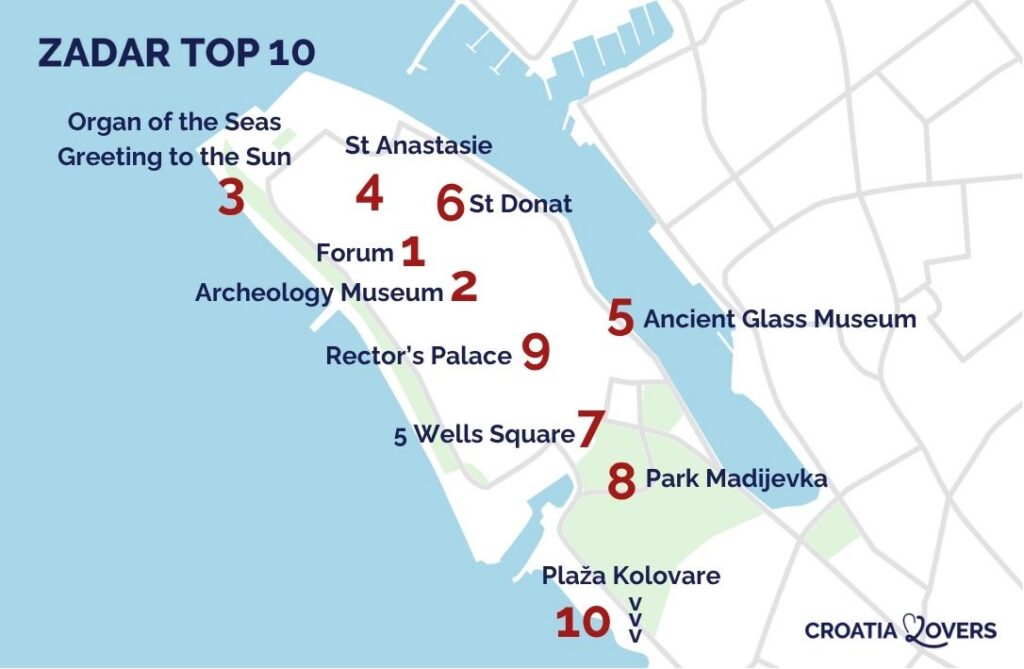
Map of must-see attractions
To help you follow along as you read our itinerary below, here is our map of Zadar’s main tourist attractions:
Getting around Zadar
Zadar’s Old Town is situated on a peninsula. You can reach most of the sights on foot in just a few minutes. The streets are generally flat and the distances short, making for pleasant days even with a busy schedule. A city bus network serves the outlying neighborhoods and more distant beaches such as Borik or Diklo. If you’d like to explore the surrounding area, the coast, or the islands on your second day, we recommend renting a car for greater flexibility. You can also opt for day trips.
OUR ADVICE FOR RENTING YOUR CAR AT Croatia
- Compare prices on our preferred platform: DiscoverCars – one of the best rated sites.
- Choose a car that is powerful enough (the roads are steep) but compact (some passages are narrow).
- There is a lot of demand, book it early.


See our tips (coming soon)
Where to Stay in Zadar
Here are our three favorite hotels in Zadar:
- Bastion Heritage Hotel – Our top pick in the historic center, a member of the Relais & Châteaux collection, featuring a gourmet restaurant and spa. View rates and availability
- Falkensteiner Hotel & Spa Iadera – The best beach resort 12 km from Zadar, featuring a private beach, spa, and pools. Check prices and availability
- Almayer Art & Heritage Hotel – An adults-only boutique hotel in the Old Town, featuring contemporary decor and a peaceful atmosphere. View rates and availability
WHERE TO STAY IN Zadar
Our favorites: neighborhoods and hotels
Historic Center –
Hôtel Bastion Heritage – check photos and availability
Borik Marina –
Hyatt Regency Zadar Hotel – check photos and availability
On the coast –
Falkensteiner Hotel & Spa Iadera – check photos and availability

Our Ideal Itinerary: 2 Days in Zadar
Ready for a two-day trip to Zadar? Between the Roman Forum, the museums, the Adriatic beaches, and a day trip to the surrounding area, you’re sure to enjoy the variety this Dalmatian city has to offer.

Day 1 — The Old Town and its Surroundings
Day 1, 9 a.m.: Roman Forum and St. Donatus Church
Start your first day in the historic heart of the city with the Roman Forum. Built between the 1st century BCE and the 3rd century CE, the forum stretched over 90 meters long and 45 meters wide: its remaining columns and the Column of Shame, which still stands today, bear witness to Zadar’s importance during the Roman era. We were struck by the sheer scale of the site, which was all the more striking at that early hour before the crowds arrived. Admission is free.
Just a few meters away,St. Donatus Church is Zadar’s architectural symbol. This 9th-century pre-Romanesque structure, built by Bishop Donatus, features a rare cylindrical shape: 27 meters in diameter, 27 meters high, with three levels and a circular gallery on the first floor. You’ll notice that its walls incorporate stone blocks salvaged from the nearby forum, including fragments of columns and ancient inscriptions. We appreciated the building’s remarkable acoustics; it hosts classical and medieval music concerts during the summer.

Day 1, 10:30 a.m.: Archaeological Museum
The Zadar Archaeological Museum, one of the oldest in Croatia (founded in 1830), is worth a visit after touring the Forum. Its collections span several millennia, from prehistory to the early centuries of Christianity, with a strong focus on Roman artifacts: statues, mosaics, ceramics, jewelry, and everyday objects. We appreciated the logical and well-structured layout, which serves as a natural extension of the nearby Forum. You can also see collections from the medieval period and the early days of Christianity in Dalmatia.

Day 1, 12:00 p.m.: Lunch in the Old Town
The old town offers a fine selection of restaurants, ranging from traditional konobas to more contemporary eateries. We particularly enjoyed Restaurant Pet Bunara, tucked away near the Square of the Five Wells, and Restaurant Fosa, facing the harbor, which serves exquisitely prepared fresh fish dishes. Take advantage of lunch to sample local specialties: pašticada (beef stew simmered in red wine), Pag cheese produced on the neighboring island, or grilled fish served with local olive oil. We recommend making reservations in advance during peak season.

A LITTLE MORE patience
All the photos, maps, information and addresses you need to make your stay in Croatia a success will soon be available in a single ebook!

Day 1, 2:00 p.m.: St. Anastasia Cathedral
St. Anastasia Cathedral has stood on the forum since the 12th century. Its Romanesque façade is adorned with three carved portals and a central rose window; the building, constructed between 1105 and 1324, combines Romanesque and Gothic styles. The interior features three naves separated by marble columns, finely carved 15th-century wooden choir stalls, and a crypt housing the relics of Saint Anastasia in a 9th-century early Christian sarcophagus. We recommend climbing the 56-meter bell tower: 180 steps for a panoramic view of the old town and the archipelago.

Day 1, 3:30 p.m.: Place des 5 Puits and Queen Madijevka Park
The Square of the Five Wells is a testament to the ingenuity of Zadar’s residents in the 16th century. These five stone wellheads, built in 1574 to supply the city with water during the Ottoman sieges, formed a collective cistern system connected by underground pipes to rainwater collected from the rooftops. We found this complex to be harmonious and well-preserved. Just a few steps away lies Queen Madijevka Park, a green space running along the old Venetian ramparts with an unobstructed view of the sea. Shaded paths, benches, and the coolness of the greenery make it a welcome break between sightseeing stops.

Day 1, 4:30 p.m.: Swimming at Kolovare Beach
Located just a few minutes’ walk from the Old Town, Kolovare Beach is the most accessible urban beach from the city center. It features both pebble areas and concrete platforms designed for swimming, with showers, changing rooms, and beach chair rentals available on site. We enjoyed the crystal-clear water and the view of Ugljan Island from the shore. It’s a pleasant mid-afternoon break before heading to the Sea Organ and the Riva to watch the sunset.

Day 1, 6:30 p.m.: Orgue des Mers & Salut au Soleil
The Organ of the Seas is a one-of-a-kind installation created by architect Nikola Bašić in 2005. Thirty-five tubes of varying lengths are placed beneath the stone steps along the waterfront: seawater flowing through them produces harmonious sounds that vary depending on the intensity of the waves. We found the concept ingenious and the experience surprising. A few meters away, the Salut au Soleil, also designed by Bašić, is a circle 22 meters in diameter that, after capturing solar energy during the day, lights up at dusk in a rhythm synchronized with the sounds of the sea organ.

Day 1, 8:00 p.m.: Dinner in the Old Town
To round out this first day, the Old Town offers several great places to visit. For an elegant meal, Restaurant Kastel, located in the Bastion Heritage Hotel, serves Mediterranean cuisine in a sophisticated setting. Be sure to finish your meal with a glass of marasquin, a local liqueur made from maraschino cherries that have been grown in the region for centuries.

Subscribe to our Newsletter
- Get away from it all with Region Lovers’ beautiful destinations!
- Once a month
- Advertising-free

Day 2 — Museums, Islands, and an Excursion
Day 2, 9 a.m.: Museum of Ancient Glass
The Museum of Ancient Glass, housed in the Cosmacendi Palace, is one of Zadar’s most unique institutions. We were captivated by the exhibits, which showcase the excellence of Roman glassmakers: more than 5,000 objects dating from the Roman era, including delicate goblets, perfume bottles, jewelry, and remarkably well-preserved everyday items. A section dedicated to manufacturing techniques features demonstrations of traditional glassblowing using Roman methods. Open daily from 9 a.m. to 9 p.m. in the summer and from 9 a.m. to 4 p.m. in the winter. Visit the official website for more information here.

Day 2, 10:30 a.m.: Gold and Silver Museum
Just a short walk away, the Museum of Gold and Silver is housed in the former Benedictine monastery of St. Mary, founded in the 11th century. Its collections of medieval religious metalwork are among the most remarkable in Croatia: reliquaries, processional crosses, chalices, and liturgical vestments in gold and silver, some of which date back to the 11th century. We found the thoughtful presentation and the setting of the monastery itself well worth seeing. Allow between 1 hour and 1 hour and 30 minutes for a leisurely visit.

Day 2, 12:00 p.m.: Lunch
Take advantage of this second lunch to explore a different spot than the one you visited yesterday. Restaurant Kornat, in the old town, serves authentic Dalmatian cuisine in a traditional setting. For something lighter, the cafés and bars along the Riva offer light bites with a view of the sea. No matter where you go, the local specialties remain the same: grilled fish, fresh seafood, and regional produce.

Day 2, 2:00 p.m.: Excursion to Nin or the island of Ugljan
The afternoon of the second day is a chance to leave the old town and explore the immediate surroundings. There are two options available, depending on your preferences.
Option A – Nin (15 km, 20 min by car): one of Croatia’s oldest towns.The Church of the Holy Cross, considered the world’s smallest cathedral, dates back to the 9th century and is notable for its astronomical precision. Nearby, the ruins of a Roman temple and the surrounding salt marshes round out the visit. The Queen’s Sandy Beach, a rarity in Dalmatia, stretches nearby. Book your ATV adventure to Nin.
Option B – Ugljan Island (20 min by ferry): Nicknamed “Zadar’s garden,” this island lies across from the old town, separated by a canal just a few kilometers wide. We enjoy this excursion for its accessibility and local charm. The Dalmatian stone villages of Preko, Kali, and Kukljica, along with the olive groves and beaches—which are less crowded than those in the city—make for a pleasant half-day trip. The ferry departs from the port of Zadar and takes about 20 minutes.

Day 2, 5:00 p.m.: Walk along the Riva
Back in town, head to the Riva to enjoy the sunset over the Adriatic. This wide, pedestrian-only seaside promenade, lined with palm trees and outdoor cafés, really comes alive at the end of the day. Take a seat on a bench or at a sidewalk café to watch the ferries and pleasure boats go by. The sunset from the Riva is considered by many to be one of the most beautiful on the Adriatic. It’s also the best time to sit on the steps of the “Organ of the Sea” and listen to the melodies created by the waves, then wait for the “Salut au Soleil” to light up at dusk.

Day 2, 8:00 p.m.: Dinner
To round out the weekend, we recommend The Well Restaurant. Tucked away in a wooded park just a few minutes from downtown Zadar, it’s a well-known spot for its traditional Balkan cuisine and peaceful setting, slightly removed from the hustle and bustle of the city. The restaurant offers an elegant setting, a pleasant terrace, and a menu centered on local specialties and healthy dishes.

It’s time to book!
Compare everything: companies, prices, schedules and availability.
Alternative 1: with more museums
If you’d like to explore the city’s cultural offerings further, Zadar has other museums and monuments to discover. The Rector’s Palace is a fine example of 15th-century Venetian Gothic architecture: its elegant façade, adorned with pointed arches, and its inner courtyard featuring a Renaissance loggia are well worth a visit, although access to the interior depends on the current exhibitions. In addition, the National Museum of Zadar features collections of sacred art and ethnographic exhibits that trace traditional Dalmatian life. For fans of contemporary art, the Museum of Contemporary Art showcases works by 20th-century Croatian artists. Find more ideas in our article on things to do in Zadar.

Option 2: with a long excursion
Zadar is an excellent starting point for exploring the region. Plitvice Lakes National Park (130 km, about a 1.5-hour drive) is Croatia’s most visited natural site and a UNESCO World Heritage Site: its 16 cascading lakes, connected by waterfalls, create a breathtaking landscape. Plan to spend a full day there. Closer by, Paklenica National Park (45 km, about a 45-minute drive) delights hiking and rock-climbing enthusiasts with its spectacular gorges. For a maritime experience, take a boat trip to the Kornati—an archipelago of 89 deserted islands with crystal-clear waters—makes for a memorable day.
Check out all our ideas in our article on the best day trips from Zadar.

Option 3: With children
Zadar is a great destination for a family visit. Vladimir Nazor Park, which runs along the peninsula’s waterfront, features shaded paths lined with maritime pines and palm trees, well-equipped playgrounds, and open spaces where children can run freely. The beaches at Kolovare and Borik feature calm, shallow waters, ideal for young children. The Museum of Ancient Glass organizes glassblowing workshops tailored for children during the summer—a unique way to discover Roman techniques in a different light. For a different kind of experience, a semi-submarine excursion lets you observe the seabed of the Adriatic from a boat with a glass bottom—without getting wet. Additionally, a boat trip through the archipelago is enjoyed by people of all ages.

What You Need to Know for Your Weekend in Zadar
The Weather in Zadar
Zadar has a Mediterranean climate: summers are hot and dry, with temperatures that can exceed 30°C in July and August. This is the busiest and sunniest time of year—ideal for enjoying the beaches—but also the time when the city is most crowded with tourists. Spring (April–May) and fall (September–October) offer pleasant conditions for visiting the old town, with fewer crowds and temperatures ranging from 18 to 25°C. In winter, the city takes on a calmer atmosphere: temperatures remain mild, generally between 10 and 15°C, and the main attractions remain open, although some may have reduced hours.
The Crowds in Zadar
Zadar is a popular summer destination, especially between June and September. The Old Town can get very crowded during the middle of the day. We recommend starting your sightseeing early in the morning to enjoy the sights without the crowds, particularly at the Roman Forum and St. Donatus Church. The Riva and the Sea Organ are especially lively in the evening—this is also the best time to visit them. Outside of peak season, the atmosphere is calmer and accommodations are significantly cheaper.

Adapt your itinerary when it rains
On rainy days, Zadar’s museums offer great alternatives. The Archaeological Museum, the Museum of Ancient Glass, and the Museum of Gold and Silver are perfect for spending several hours indoors. The many historic churches in the old town, including St. Anastasia Cathedral andSt. Donatus Church, are also open to visitors. The cafés and konobas in the city center are happy to welcome you for a leisurely break featuring local specialties.
To help you plan your trip as smoothly as possible, check out all our suggestions in our guide to things to do in Zadar, our guide to the best day trips from Zadar, and our selection of the best hotels in Zadar.