Located in the heart of the historic center, Zadar’s Archaeological Museum is one of the oldest in Croatia. Founded in 1832, it houses an impressive collection tracing the evolution of the region from prehistoric to medieval times. We loved this museum, which gives us a better understanding of how Zadar was built over the course of civilizations.
In this article, you’ll find some useful tips to help you prepare for your visit and have a wonderful time!
This opinion is completely independent, based on our experiences. We made our own choices, visited the area anonymously, and paid our bills in full.
Why visit Zadar’s Archaeological Museum?
Is Zadar’s Archaeological Museum worth a visit? Our opinion:
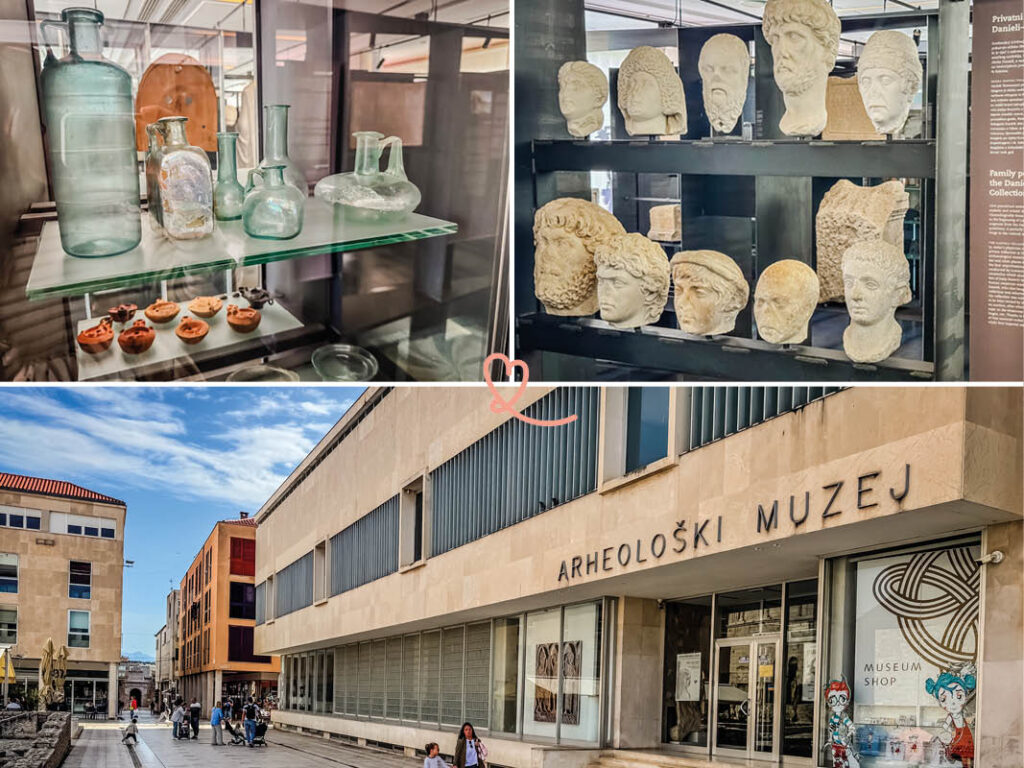
Yes, the Archaeological Museum of Zadar is clearly worth a visit, especially if you want to understand the history and evolution of the city. We appreciated the breadth of its collection, which spans several millennia, from the prehistoric period to the first centuries of Christianity. Roman artefacts are particularly prominent, shedding valuable light on Zadar’s importance at the time. These include
It’s one of Zadar’s best museums and one of the city’s best activities!

Our favorite moments
- Discover the floor devoted to the Roman period, particularly rich in everyday objects that give a very concrete idea of life in Zadar during Antiquity.
- Observe the jewels and small objects from the Middle Ages, superbly preserved and showcased.
- The location of the museum itself: step outside and you’re directly opposite Saint-Donat and the Forum, immediately making the connection between the objects seen inside and the remains on site.

WHERE TO STAY IN Zadar
Our favorites: neighborhoods and hotels
Historic Center –
Hôtel Bastion Heritage – check photos and availability
Borik Marina –
Hyatt Regency Zadar Hotel – check photos and availability
On the coast –
Falkensteiner Hotel & Spa Iadera – check photos and availability

History in brief
Zadar’s Archaeological Museum is one of the oldest in Croatia: it was founded in 1832, initially as part of a general museum of natural history and antiquities. By the end of the XIXᵉ century, it had become an institution in its own right, housing its first permanent collections inSt. Donatus Church. In 1974, the museum moved to its current building in the heart of the historic center. For almost 2 centuries, its mission has been to preserve and pass on the heritage of North Dalmatia. Its collections trace the life of the region from prehistoric times to the end of the Middle Ages, testifying to Zadar’s historical importance as a cultural crossroads between the Adriatic and Central Europe.

Access: Archaeological Museum, Zadar
Where is Zadar’s Archaeological Museum?
- The museum is located in the historic center of Zadar (on the peninsula),
- On the Place du Forum, next to the Church of St. Donatus and the Cathedral of St. Anastasia.
- Close to Zadar’s main attractions.

Access by car and parking
Located in the heart of the city, it’s easiest to get here on foot.
If you’re coming by car, be aware that parking can be difficult in Zadar’s historic center. We recommend the nearest parking lot, ideally located near the picturesque Port of
OUR ADVICE FOR RENTING YOUR CAR AT Croatia
- Compare prices on our preferred platform: DiscoverCars – one of the best rated sites.
- Choose a car that is powerful enough (the roads are steep) but compact (some passages are narrow).
- There is a lot of demand, book it early.


See our tips (coming soon)
Public transport access
If you take public transport, the nearest stop is “Poluotok”, part of the city’s transport network. It’s less than 5 minutes’ walk away.
To plan your itinerary, we invite you to consult the route maps, timetables and fares here.
A LITTLE MORE patience
All the photos, maps, information and addresses you need to make your stay in Croatia a success will soon be available in a single ebook!



Useful tips: duration, schedules, eating…
Best time to visit
We recommend visiting the museum in the morning, before the heat or the crowds. It remains pleasant in all seasons: in summer to take advantage of the air-conditioning and in winter for a quiet, enriching visit.
Length of visit and main difficulties
Allow around 1h30 to cover the entire museum at a leisurely pace. The tour covers several floors, but the staircases are easy to reach and well signposted. Signage is clear, in both Croatian and English, and the spaces are airy.

Advice on how to visit
The tour begins on the 1st floor with antiquity, then moves on to prehistory on the 2nd floor, before ending on the first floor, devoted to the Middle Ages. We found this progression quite fluid.

Visiting with children
In our opinion, the Zadar Archaeological Museum is the perfect place for a family visit. The itinerary is clear, the spaces are vast, and several sections include elements designed to arouse the curiosity of the youngest visitors. A small museography is dedicated to the young public, with some key information to help them better understand the exhibits.

Schedules and rates
- Schedules:
- January to March & November to December: Monday to Friday, 9 a.m. to 2 p.m. and Saturday, 9 a.m. to 1 p.m.
- April and May: Monday to Saturday, 9 a.m. to 3 p.m.
- June to September: daily, 9 a.m. to 8 p.m.
- July & August: daily from 9am to 9pm
- October: Monday to Saturday, 9 a.m. to 5 p.m.
- Price: €7
See the latest information on the official website, here.

Catering
With the church right in the center of town, you can easily take a gourmet break in one of Zadar’s best restaurants.
Tour begins: Zadar in Roman times
Iadera, a Roman city of temples and imperial statues

The tour begins on the 1st floor, in the heart of antiquity. Here we discover the grandeur of Zadar in Roman times, when it was known as

We were particularly impressed by the famous “Nin Group”, made up of statues of emperors such as Caesar, Augustus and Tiberius. Their presence testifies to the city’s political importance in Dalmatia.

Around them, mosaics, blown-glass objects and ceramic fragments tell of the daily lives ofIadera‘s inhabitants, between urban life, rituals and worship of the gods. You too will be struck by the timeless beauty of these 2,000-year-old testimonies.
Everyday life under the Empire: arts, crafts and urban life

In the following showcases, we immersed ourselves in the daily life of Zadar’s Romans. The museum presents a varied collection of everyday objects – tools, oil lamps, fibulae, jewelry and amphora fragments – that reveal the commercial vitality of the ancient port.

We enjoyed looking at the fine glassware, bronze kitchen utensils and coins bearing the effigies of the emperors. These modest objects bring to life the great stones you’ll have seen in the Roman forum, right next door to the museum.

You’ll discover how craftsmanship, maritime trade and religion structured Roman society, and how the elegance of everyday life matched the monumental grandeur of the city.
Continuation of the tour: back to the origins of Dalmatia
From Paleolithic hunters to Bronze Age craftsmen

On our way up to the 2nd floor, we left Rome for a real journey back in time. This part of the museum fascinated us with its rich prehistoric collection, one of the largest in Croatia!

The showcases, organized by period, retrace over 40,000 years of history, from the Palaeolithic to the early Iron Age. You can admire flint tools, finely decorated pottery, bronze weapons and even small animal figurines.

These objects, found in northern Dalmatia, bear witness to the ingenuity and creativity of prehistoric peoples. You may be amazed at the artistic and symbolic power of these ancient objects, reminiscent of mankind’s earliest gestures on the Adriatic coast.
The Liburnians, founding people of the Dalmatian coast

The section devoted to the Liburnians, the emblematic people of northern Dalmatia, was one of our favorite moments. We discovered their bronze and amber jewelry, weapons and funerary objects, testimony to a refined culture open to the sea.

This seafaring people, settled long before the Romans, had a profound impact on the region’s identity. By observing their decorated ornaments and ceramics, we realized the extent to which their art reflected a strong link between nature, spirituality and navigation.

You’ll see how the Liburnians, through their aesthetics and know-how, laid the foundations for what would later become historic Dalmatia.
Subscribe to our Newsletter
- Get away from it all with Region Lovers’ beautiful destinations!
- Once a month
- Advertising-free

End of tour: Medieval Croatia and the birth of a national art form
From the beginnings of Christianity to the first Croatian churches

The tour concludes on the first floor, in an area devoted entirely to the Croatian Middle Ages. We were struck by the sober beauty of these fragments of church, ciboria and carved stone.

Some bear the names of princes and donors, such as Prince Branimir or Zupan Godecaj, recalling the birth of Croatian identity in the 9th century. These remains illustrate the rise of Christianity in the region and the fusion of ancient heritage and new faith.

Here you’ll discover the first artistic expressions of the Croatian kingdom, a simple and powerful art, deeply spiritual, born on the ruins of the Roman Empire.
11th-century sculptural masterpieces

Finally, we admired the sculpted plutei and portals from the churches of St. Laurent and St. Nediljica, masterpieces of the 11th century. Their meticulous reliefs, depicting biblical and symbolic scenes, herald the birth of the Romanesque style in Croatia.

We found these sculptures fascinating for their balance between strength and delicacy: every detail, every motif, allows us to appreciate the techniques of the period. Like us, you’re sure to appreciate the conservation work that brings the different eras into dialogue.

A fitting conclusion to a visit that retraces, floor by floor, almost 40,000 years of human history.