Istria takes on a different pace in winter: the coastal towns welcome back their residents, mist sometimes settles on the hills, and Istrian cuisine shifts to seasonal dishes. We love this time of year for the tranquility of its narrow streets and for truffle season. The coastal climate also remains milder than in much of Central Europe.
Here are all our tips for visiting Istria in winter: activities, weather, temperatures… Plus, information on spending Christmas or New Year’s on this peninsula full of surprises!
This opinion is completely independent, based on our experiences. We made our own choices, visited the area anonymously, and paid our bills in full.
Visiting Istria in Winter: Is It Worth It?
Our take
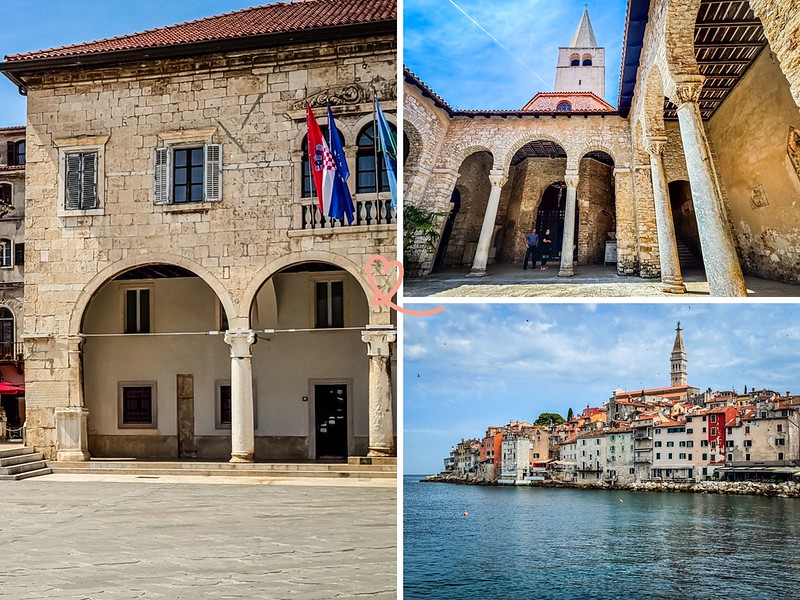
Yes, visiting Istria in winter is worth it, if you’re okay with the peninsula being a bit quieter than in summer. We enjoyed strolling through the narrow streets of Rovinj and along the ramparts of Motovun without the July crowds. The Pula Arena and the Euphrasian Basilica in Poreč can be explored in peace, and you’ll find yourself sharing the cafés mostly with locals.

Keep in mind, however, that some of the hotels and restaurants along the coast are closed until spring. We therefore recommend choosing a town that’s lively year-round, such as Pula. Our article on where to stay in Istria will help you make your choice.
Benefits
- You can explore the old towns of Rovinj, Poreč, and Pula without the crowds.
- Accommodation rates drop significantly compared to the summer.
- The coastal climate remains mild: it rarely freezes by the sea.
- Advent markets bring the towns to life from late November through early January.
- It’s the season for black truffles and seasonal dishes in the konobas.
- Major attractions, such as the Pula Arena and the Euphrasian Basilica, remain accessible.

Disadvantages
- Many hotels, campgrounds, and seaside restaurants close during the off-season.
- The bura, a cold northeasterly wind, can blow strongly from December through February.
- The sea, at around 11 to 12°C, is no longer suitable for swimming.
- Buses run on a reduced schedule.
- Ferries from Venice do not operate in winter.
- The days are short, and inland areas are colder and sometimes foggy.

WHERE TO SLEEP IN Istria
Our favorites: cities and hotels
Rovinj, for its undeniable charm
Grand Park Hotel – Check photos and availability
Porec, for a well-balanced holiday combining nature, beach and history
Valamar Riviera Hotel – Check photos and availability
Pula, for easy exploring and fine dining
Boutique Hotel Velsabbion – Check photos and availability

See our complete selection of the best destinations in Istria
Weather, Temperatures, and Conditions
On the coast, Istrian winters remain mild. In December and January, daytime highs range from 7 to 10°C, and nighttime lows drop to around 2°C. Frost is rare along the coast. Expect about 5 to 6 rainy days per month; December is the wettest month of the season. We recommend dressing in layers, as humidity makes it feel colder. We also suggest a raincoat rather than an umbrella, which doesn’t hold up well against gusts of wind.

The bura, a cold, dry wind from the northeast, sometimes blows strongly from December through February. It cools the air but often clears the sky. Inland, elevation changes the picture: in Pazin, at 280 meters, the average January temperature is around 4°C, nights drop below freezing, and fog sets in during periods of stable weather. We recommend checking the weather forecast before heading out to the hilltop villages. We also enjoy those misty mornings over the Mirna Valley, which give Green Istria a whole new look.
OUR ADVICE FOR RENTING YOUR CAR AT Croatia
- Compare prices on our preferred platform: DiscoverCars – one of the best rated sites.
- Choose a car that’s compact enough (some passages are narrow).
- There is a lot of demand, book it early.


What to Do in Istria in Winter?
Even in the off-season, Istria offers plenty to keep you busy for several days. With swimming off the table, winter highlights the region’s heritage, cuisine, and inland villages. Here are our suggestions:
- Visit thePula Arena and the ancient city center
- Admire the mosaics at the Euphrasian Basilica in Poreč
- Walk up to St. Euphemia’s Church in Rovinj
- Explore the hilltop villages: Motovun, Grožnjan, Hum
- Taste Istrian truffles, olive oil, and wines
- Take a walk at Cape Kamenjak or along the Opatija promenade
- Enjoy the Advent markets during the holidays
- For more ideas, check out our article on things to do in Istria!

Historic sites, without the crowds. Winter is a great time to explore the major attractions. In Pula, the 1st-century Arena, the Temple of Augustus, and the Arch of the Sergii are all just a few minutes’ walk from one another. We recommend adding Kaštel to your itinerary; it houses the Istrian Historical and Maritime Museum and overlooks the city. In Poreč, the Euphrasian Basilica, a UNESCO World Heritage Site since 1997, preserves 6th-century Byzantine mosaics that we find just as striking on a gray day. Finally, in Rovinj, the 60-meter bell tower of St. Euphemia’s Church watches over the peninsula.
- Discover the history of Pula with a local guide— book your guided tour
- Explore Rovinj’s Old Town on foot— learn more and book

Truffles and Istrian Cuisine. Winter is the season for black truffles, which are harvested in the forests around Motovun and Buzet. In the konobas, you’ll enjoy them served with fuži, a local fresh pasta, paired with a glass of white Malvazija or red Teran. We also recommend the olive oil mills around Vodnjan, which produce some of Croatia’s finest olive oils. We find that these seasonal meals perfectly capture the spirit of Istria outside the summer months.

When it rains, there are several indoor attractions to visit. In Pula, the Museum of Contemporary Art is a great place to take shelter. In Labin, the National Museum has recreated a coal mine in its basement, reflecting the town’s mining history. We also love the Lapidarium Museum in Novigrad, dedicated to stone sculpture from antiquity through the Middle Ages. Finally, the wellness centers in Opatija and Rovinj offer a chance to relax in the warmth. We recommend checking each location’s winter hours before you go.
Walking and biking in the great outdoors. On dry days, Cape Kamenjak, at the southern tip of the peninsula, is perfect for strolls along deserted coves. The Parenzana, a former railroad line converted into a bike path and hiking trail, crosses Istria from east to west. On the Kvarner coast, we enjoy the Lungomare in Opatija, a 12-km promenade between Volosko and Lovran, followed by a break at Angiolina Park. For a more ambitious day trip, we’ll save the Plitvice Lakes, about a 3-hour drive from Pula: book your excursion.


How do you get to Istria?
In winter, driving is still the easiest way to explore Istria. Public transportation is limited in inland villages, and buses run less frequently during the off-season. The distances are short: it takes about 1 hour and 15 minutes from Pula to Umag, or 40 minutes from Pula to Rovinj. We recommend renting a car as soon as you arrive.
Pula Airport has fewer flights during the winter. We therefore recommend also considering Trieste, Italy—about 50 minutes from Umag—or Venice. From Zagreb, the Croatian capital, it takes about 3 hours to drive to Pula.

In the summer, we like to take the ferry from Venice to Istria. However, these ferry routes to Pula, Rovinj, Poreč, and Umag are seasonal and do not operate in the winter. If you’re arriving via Venice, you’ll need to plan to drive instead.
Christmas in Istria
From late November to early January, Istria comes alive with the spirit of Advent. In Pula, the festivities take place at several locations in the city center, from the Forum to the Giardini. During the 2025 edition, an ice rink was set up in the Arena, and a 28-meter-tall Ferris wheel towered over the illuminated city. We also love the tradition of seafood risotto, served for free on Sundays at the market.
In Rovinj, Advent celebrates local culture: the batanas, traditional fishing boats, are decorated in the harbor, and the British daily *The Times* has ranked this market among the most beautiful in Europe. We recommend taking a stroll along the waterfront at dusk.

Poreč sets up its market around Matija Gupca Square, where you’ll find a free ice rink, live nativity scenes, and numerous concerts. Opatija, on the Kvarner Riviera, bills itself as “the most beautiful Advent by the sea,” and its ice rink is set up in the open-air theater. Motovun, Novigrad, Umag, and Pazin also offer their own programs. Dates vary each year. Visit the official website for more information here.
New Year’s in Istria
On the evening of December 31, Istrian cities host free outdoor concerts. In Pula, the festivities take place at both the Forum and Portarata Square, with multiple stages keeping the city lively until dawn. Rovinj celebrates the New Year on its waterfront, while Poreč hosts concerts at Freedom Square (Trg Slobode) and Matija Gupca Square.
We love the tradition in Novigrad, where they celebrate the New Year starting at noon—a great option if you’re traveling with your family. We’d also like to point out that, for New Year’s Eve 2024, several cities have replaced fireworks with light displays out of consideration for animals.

For New Year’s Eve dinner, we recommend that you make a reservation in advance, as fewer restaurants are open during the winter. And if you’re staying in the Kvarner region, Korzo—Rijeka’s main street—will also be hosting a big concert.
DISCOVER Istria