With more than 2, 300 years of history, Trogir is one of the best-preserved medieval towns in Central Europe. As you stroll through its cobblestone streets, you’ll discover an authentic Mediterranean atmosphere, blending Greek, Roman, Byzantine, and Venetian influences. Here are our reasons to visit this city steeped in history and charm.
This opinion is completely independent, based on our experiences. We made our own choices, visited the area anonymously, and paid our bills in full.
Is Trogir worth visiting?
Trogir is worth visiting for its medieval center, a UNESCO World Heritage Site that offers an exceptional example of medieval architecture and urban planning. The city is easy to explore on foot, and a half-day to full-day visit is usually enough to enjoy its narrow streets, historic monuments, and authentic atmosphere along the Adriatic Sea .
It is one of the most beautiful cities in Croatia.

Located just 30 minutes from Split, Trogir is also an ideal base for day trips to the neighboring islands or Krka National Park. Its lively waterfront is perfect for a leisurely stroll, while its proximity to other major attractions in Dalmatia makes it a convenient stop to enhance a trip to the region.
Reason 1 – A medieval town listed as a UNESCO World Heritage Site
An exceptionally well-preserved medieval town on an island
The historic center of Trogir, situated on a small island between the mainland and the island of Čiovo, is a rare example of well-preserved medieval urban planning. Its dense urban fabric and pedestrian-only narrow streets bear witness to remarkable historical continuity, where every stone tells a story. This island setting gives the town a unique atmosphere, blending the charm of a fishing village with a rich architectural heritage.

Internationally recognized since 1997
The historic center of Trogir has been listed as a UNESCO World Heritage Site since 1997, highlighting the universal value of its heritage. This designation protects an architectural complex that features some of the best-preserved Romanesque-Gothic elements in Central Europe. The presence of iconic monuments, such as St. Lawrence Cathedral and the Kamerlengo Fortress, illustrates the city’s artistic and defensive richness throughout the centuries.

WHERE TO STAY IN Trogir
Our favorites: neighborhoods and hotels
In the Old Town –
Hotel Monika – check photos and availability
On the island of Ciovo –
Brown Beach House Hotel – check photos and availability
On the mainland, a modern city—
, Bellevue Hotel— check photos and availability

See our selection of the best hotels in Trogir
Reason 2 – St. Lawrence Cathedral and Radovan’s Portal
St. Lawrence Cathedral , located in the heart of Trogir’s historic center , is a remarkable example of medieval architecture that blends Romanesque and Gothic styles. Its massive structure is characteristic of the Romanesque style, while its slender vaults and Gothic bell tower illustrate the stylistic evolution up through the 17th century.

The western portal, known as the Radovan Portal , is a masterpiece of Romanesque sculpture in Croatia, completed around 1240. This portal is distinguished by its finely carved biblical scenes and animal motifs, which reflect the city’s artistic richness at that time.
See more photos of the cathedral.

The climb up the cathedral’s bell tower, which rises to 47 meters, is an experience not to be missed. It offers a unique view of the rooftops of Trogir and the Adriatic Sea , rewarding the effort with a breathtaking panorama. We particularly enjoyed this perspective, which provides a better understanding of the urban layout of this island city.
OUR ADVICE FOR RENTING YOUR CAR AT Croatia
- Compare prices on our preferred platform: DiscoverCars – one of the best rated sites.
- Choose a car that’s compact enough (some passages are narrow).
- There is a lot of demand, book it early.


Reason 3 – An architectural heritage with diverse influences
Trogir’s architectural heritage reflects a rich and varied history, evident in its Hellenistic-era street layout. As you explore the city, you’ll discover Romanesque and Gothic buildings that bear witness to the Middle Ages, as well as Renaissance palaces that illustrate the city’s prosperity under Venetian rule.

Baroque additions and medieval fortifications round out this panorama, offering a vivid glimpse into the different eras that have shaped this island city.
Trogir, founded around 380 B.C. by Greek settlers from the island of Vis under the name Tragurion, developed into an important port during the Roman era. In the 12th and 13th centuries, the city gained autonomy and prosperity by becoming an independent municipality under Croatian-Hungarian sovereignty.

This period marked a significant expansion of the city’s urban and commercial structure. In 1420, Trogir came under Venetian rule, which lasted nearly 400 years; during this time, the Kamerlengo Fortress was built to protect the city and its harbor.

Reason 4 – Narrow streets to explore on foot
A stroll through the pedestrian-only streets of the historic district
Trogir’s Old Town is entirely pedestrian-only, which makes it much easier to explore on foot. Its narrow, cobblestone streets, lined with historic buildings, invite you to stroll and offer many surprises around every corner. You’ll often come across lively little squares featuring café terraces, artisan shops, and traditional restaurants. This urban layout creates an intimate and authentic atmosphere unique to ancient Mediterranean cities.

A walking tour of the historic center can be completed in 1 to 2 hours, but we recommend taking your time to fully enjoy the atmosphere and stop for some culinary delights. Please note that the cobblestone streets and a few old staircases may make access difficult for people with limited mobility, although adapted tours by vehicle are available to explore Trogir and its surroundings.
The main square, the heart of local life
In the heart of Trogir, Trg Ivana Pavla II Square is a lively spot where history blends with modern-day bustle. Surrounded by historic buildings, it’s home to numerous café terraces where you can sit back and watch the comings and goings of locals and visitors. It’s an ideal starting point for soaking up the local atmosphere and getting a feel for the city’s rhythm.

Reason 5 – a pleasant walk along the waterfront
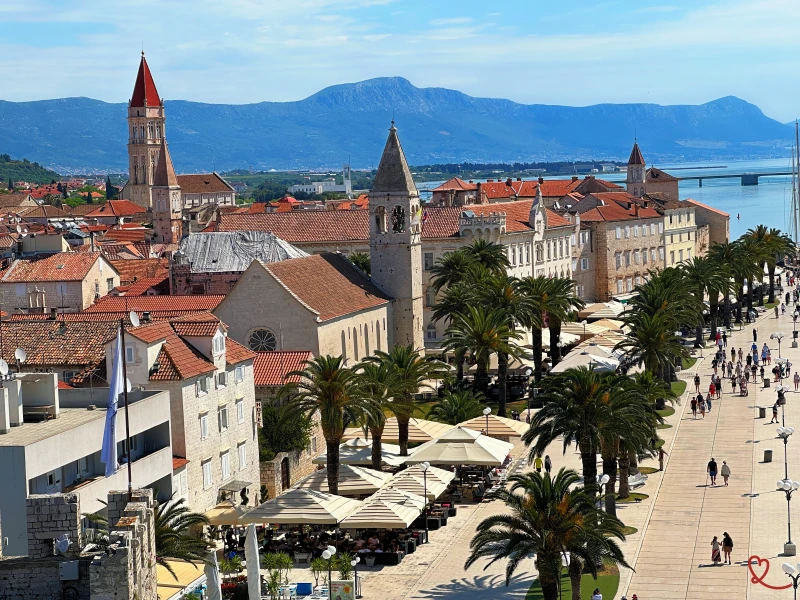
Trogir’s waterfront promenade connects the harbor to the Old Town and is notable for its palm trees, moored boats, and numerous restaurants and taverns. This stroll offers a quintessential Mediterranean atmosphere, with views of the city walls and the comings and goings of fishermen. It’s the perfect spot for a culinary break or a stroll at the end of the day, when the light softens the facades and you can feel the sea breeze.

A LITTLE MORE patience
All the photos, maps, information and addresses you need to make your stay in Croatia a success will soon be available in a single ebook!
Reason 6 – Dalmatian Culture and Traditions
Trogir is also known for its vibrant cultural scene, which brings the city to life during the summer. In July,the Trogir Cultural Summer offers a varied program of concerts, traditional dance performances, and exhibitions, often held in the streets and at historic landmarks. This event highlights local traditions, particularly through performances of klapa—the polyphonic a cappella singing recognized as part of UNESCO’s Intangible Cultural Heritage—which symbolizes the musical soul of Dalmatia.

In August, the Kula Kula Festival brings the Kamerlengo Fortress to life with contemporary music concerts, attracting Croatian and international artists. In addition, the Opera Selecta Festival celebrates opera and classical music at iconic venues such as the Monastery of St. Dominic.

It’s time to book!
Compare everything: companies, prices, schedules and availability.
Reason 7 – A starting point for Čiovo and the Blue Lagoon
Trogir is connected to the island of Čiovo by a pedestrian bridge, making it easy to reach its beaches and villages from the historic center. This proximity makes it easy to combine exploring the city’s heritage with relaxing by the sea, particularly in Okrug Gornji, a beach just a few minutes away on foot, by bike, or by car.

From the port of Trogir, you can take a boat trip to the Blue Lagoon, located between the islands of Drvenik Veli and Krknjaši. This lagoon is renowned for its turquoise waters, which are ideal for swimming and snorkeling. Trogir is therefore a convenient starting point for exploring the neighboring islands and fully enjoying the Adriatic Sea. See options and availability.
EXPLORE Trogir
- Attractions in Trogir
- Best Hotels in Trogir
- St. Lawrence Cathedral
- Fortress

A Few Drawbacks of a Trip to Trogir
Tourist Crowds and Traffic in the Old Town
Trogir’s old town sees a large influx of tourists in July and August, which can make the narrow streets quite crowded. These streets are entirely pedestrian-only and inaccessible by car, which preserves the authenticity of the historic center but means you can only get around on foot.

Paid parking is available outside the Old Town, within a short walking distance. We recommend that you allow enough time to fully enjoy your walking tour, keeping in mind that foot traffic can be heavy at times during the high season.
Prices and Heat During Peak Season
In Trogir, prices for lodging and restaurants rise significantly in July and August, which is the peak tourist season. This period is also marked by intense heat, with temperatures often exceeding 30°C at midday, which can make outdoor sightseeing more tiring.

For a more comfortable and economical trip, the months of May, June, September, and October are the best times to visit. During these periods, there are fewer tourists and accommodation rates are generally more affordable, while the weather remains pleasant for exploring the city.
May be closed during the off-season
Outside of the high season—particularly between November and March—many restaurants and cafés in Trogir’s historic center close or reduce their hours of operation. This quieter period also means that several travel agencies and boat rental companies suspend or limit their operations; they often operate by reservation only.
How to Get to Trogir
Main Entrances
Trogir is located on the central Dalmatian coast , about 27 km west of Split, making it easily accessible from that major city. Split-Kaštela International Airport , located just 5 km away, is one of the closest airports in the region, making Trogir particularly accessible to air travelers. Trogir’s historic center, situated on a small island, is connected to the mainland by a bridge, allowing direct access by car or on foot.
A second bridge connects the old town to the island of Čiovo, providing a convenient link between the two areas. The old town itself is entirely pedestrian-only, with cobblestone streets that invite you to take a stroll. As for public transportation, regular buses run between Trogir and Split, while ferries serve the neighboring islands. This setup makes it easy to explore Trogir while preserving the charm of its historic center.
PLAN YOUR TRIP TO Croatia
- Best of
Top Destinations
; Most Beautiful Cities
; Most Beautiful Islands
; National Parks

- Practical advice
When to go?
How to rent a car in Croatia
Driving tips
Itineraries: Road Trip—10 Days, 2 Weeks, 3 Weeks

- The must-dos
Attractions in Dubrovnik
Attractions in Zadar
Attractions in Split
Attractions in Zagreb
Attractions in Istria
The Plitvice Lakes