Immerse yourself in local traditions at Split’s Ethnographic Museum, a place where the cultural richness of Dalmatia comes to life through its unique collections. Housed in a historic building in the heart of Diocletian’s Palace, this museum seduced us with the diversity of traditional costumes on display, antique jewelry and handicrafts that tell an authentic story.
In this article, you’ll find some useful tips to help you prepare for your visit and have a great time.
This opinion is completely independent, based on our experiences. We made our own choices, visited the area anonymously, and paid our bills in full.
Why visit Split’s Ethnographic Museum?
Is Split’s Ethnographic Museum worth a visit? Our opinion:
Yes, the Ethnographic Museum in Split is definitely worth a visit. Its historic building, located right in the heart of Split, offers an authentic and pleasant setting for exploring the local culture. We enjoyed the richness of its permanent collection, which features traditional Dalmatian costumes, antique jewelry, and handicrafts. In our opinion, it’s one of the best attractions in Split!
The atmosphere there is calm and conducive to exploration, with a classic layout and easy navigation.

Why is Split’s Ethnographic Museum famous?
The Split Ethnographic Museum is renowned for its unique collection, which showcases Dalmatian traditions and local crafts. Located in the heart of Diocletian’s Palace, it offers a glimpse into the daily lives of the region’s inhabitants throughout the centuries, featuring traditional clothing, jewelry, weapons, and objects from rural life.
What makes it particularly famous is its role as a guardian of the region’s intangible cultural heritage, offering a true journey through ancestral customs and craftsmanship. Finally, its prime location within a UNESCO-listed site further enhances its reputation and attracts many curious visitors. More info here.

Our favorite moments
During our visit, 3 moments particularly struck us:
- The Vestibule Terrace of Diocletian’s Palace: contemplating the bell tower of Split’s St. Domnius Cathedral while listening to the voices of traditional Croatian singers echoing through the vestibule was a very moving experience.
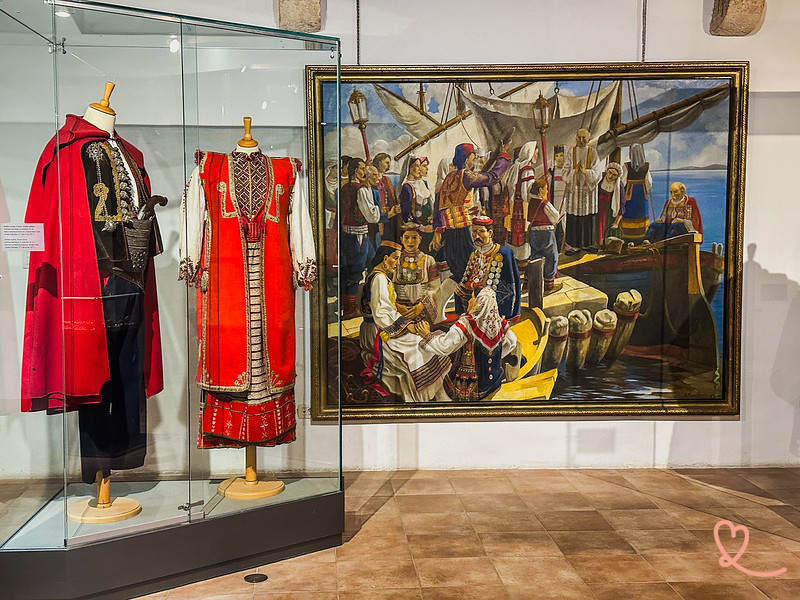
- Traditional Dalmatian costumes: admiring these richly decorated garments immersed us in local history. Their finesse and authenticity left a lasting impression.
- The reconstitution of a period bedroom: enter into the intimacy of the premises and project yourself into their daily lives with a gentle touch.

WHERE TO STAY IN Split
Our favorites: neighborhoods and hotels
Marina –
Hotel Ambasador – check photos and availability
Old Town –
Piazza Heritage Hotels – check photos and availability
Bacvice, on the coast –
Hotel Park Split – check photos and availability

Access: Ethnographic Museum (Split)
Where is the museum?
The Ethnographic Museum is located at 4, rue Iza Vestibula in Split (Croatia).
- In the heart of Split
- Inside Diocletian’s Palace
- Next to the Vestibule and Cellars of Diocletian’s Palace
- 5min walk from Split’s St. Domnius Cathedral
How to get there?
Visiting Split’s Ethnographic Museum is easy, as it’s right in the city center. It is located in a pedestrian zone, or one with very limited traffic. To get there, cross the Vestibule of Diocletian’s Palace. You’ll then see an arched passageway indicating the museum entrance. The entrance is on the left after the passage.
For public transport, the nearest bus stop is PAZAR 1 or 2, a 5-minute walk away. Find out about available routes here. If you have a car, you’ll need to park outside the city center, which is car-free.

Parking
The museum has no parking facilities, as it is located in the Diocletian’s Palace, an entirely pedestrian zone. We do not recommend parking in the parking lots at the entrance to the historic area, as they are very expensive. Instead, opt for the parking lot at Istarska ul. 4, a 7-minute walk away.
OUR ADVICE FOR RENTING YOUR CAR AT Croatia
- Compare prices on our preferred platform: DiscoverCars – one of the best rated sites.
- Choose a car that’s compact enough (some passages are narrow).
- There is a lot of demand, book it early.


Useful tips: duration, schedules, eating…
Best time to visit
In summer, when Split attracts many travellers, the museum offers a refreshing and cultural break from the hustle and bustle of the streets and the heat, but prefer an early-morning or late-day visit. Spring and autumn are ideal if you wish to enjoy a quieter atmosphere, with fewer visitors and pleasant weather to combine a visit to the museum with a stroll around Diocletian’s Palace. Winter, though quieter, will appeal to history buffs who appreciate the intimate atmosphere and the opportunity to take their time in the halls. Whatever the time of year, the visit remains enriching, but it takes on a special flavor out of season, when the pace is more relaxed.

Length of visit and main difficulties
Allow between 45min and 1h30 depending on your interest in the permanent collection and temporary exhibitions.
Most of the tour takes place indoors and continues outdoors. The museum is housed in a historic building, so visitors should be prepared to use stairs, though it is also equipped with elevators. Access to the observation deck is not wheelchair-accessible, as it requires navigating a very narrow stone staircase equipped with a handrail. Restrooms are available on site. The lighting is adequate, though sometimes a bit dim for the exhibit labels.

Advice on how to visit
We recommend you start your visit with the temporary exhibitions on the first floor, which, at the time of our visit, showcased the traditional clothing of Croatian women through the ages. On the same floor, you’ll discover the interior of the Church of St. Andrew of Fenestris, as the museum is located within Diocletian’s Palace. Then climb to the upper levels to explore the permanent collection. Before you leave, don’t forget to go back down to the first floor and use the door to the right of reception. An unassuming path leads to a hidden terrace above the palace vestibule, where you can admire the silhouette of the bell tower of St. Domnius Cathedral and, with a little luck, hear traditional Croatian songs in this unique setting!

Visiting the museum with children
The museum is hosting an exhibition entitled “A Child in Dalmatian Folk Culture”. Here, we discover the customs that once marked childhood, the traditional outfits worn on a daily basis, and the games and toys that accompanied the youngest children. The exhibition also looks at beliefs linked to birth and upbringing, shedding light on how Dalmatian society perceived the role of the child. It’s a great way to help your children compare their lives today with a more traditional reality, and better understand the contrast between past and present.

Schedules and rates
The museum adapts its opening hours according to the season:
- November to May Monday to Friday, 9 a.m. to 4 p.m. and Saturday, 10 a.m. to 2 p.m.
- June to August Monday to Friday, 9 a.m. to 7 p.m., Saturday 10 a.m. to 5 p.m. and Sunday 10 a.m. to 2 p.m.
- in September, Monday to Friday, 9 a.m. to 6 p.m., Saturday 10 a.m. to 5 p.m. and Sunday 10 a.m. to 2 p.m.
- in October, Monday to Friday, 9 a.m. to 5 p.m. and Saturday, 10 a.m. to 2 p.m.
- closed on public holidays
Prices are as follows:
- Adult: €5
- Discount (schoolchildren, students, seniors): €3.50
- Family pass: €10
Visit the official website here for the latest updates.

Catering
The museum does not have an on-site dining area.

Walk through a historic building
The remains of Diocletian’s Palace
The Ethnographic Museum of Split is located in a place steeped in history, on the site of the former triclinium and residential part of Diocletian’s Palace. This historic building housed a convent from the 15th century until 1884, bearing witness to a rich monastic heritage. Inside, we observed relics from that era, making the experience all the more authentic. A visit to the museum is also a journey through these strata of time, a unique experience for lovers of architecture and history.

Saint-André de Fenestris Church and its architectural fragments
While visiting the first floor, you can enter the Church of St. Andrew of Fenestris, located in the heart of the former Imperial Residence of Diocletian’s Palace. This preserved site is home to several architectural fragments that bear witness to the history of the area. Natural light subtly highlights these remains, creating a peaceful yet solemn atmosphere that we greatly appreciated. This stopover in a sacred building adds a special depth to the visit and reinforces the link between religious heritage and ancient heritage.

Discover local crafts and know-how
From woodcarving to refined lacemaking
Immerse yourself in a world rich in local craftsmanship. The permanent collection showcases unique objects, from wood carvings to delicate handmade lace, testimony to skills handed down for generations. We also saw weapons, jewelry, wooden furniture and other accessories from the local landscape. As you wander through the rooms, you sense the passion and expertise of the local craftsmen.

Sea fishing, traditions and ancient tools
The museum also highlights the deep roots of sea fishing in local life. We discovered the ancient tools used by Dalmatian fishermen. These items illustrate an essential activity, intimately linked to the region’s culture and economy. Observing these artifacts allowed us to visualize the daily life of coastal communities, between sea and tradition. This immersion in ancestral fishing practices complements the discovery of other local skills.

A LITTLE MORE patience
All the photos, maps, information and addresses you need to make your stay in Croatia a success will soon be available in a single ebook!

Immersion in Dalmatian folk culture
Traditional Adriatic costumes and jewelry
At Split’s Ethnographic Museum, the wealth of traditional Dalmatian costumes is revealed with authenticity. We were captivated by the finesse of the fabrics and the variety of silver and gold ornaments, testimony to ancestral know-how. Each piece, carefully displayed, reveals a local history, between elegance and artisan heritage. The soft lighting enhances the details of the jewelry and embroidery, creating an intimate atmosphere respectful of Adriatic culture.

Children in popular culture: rites, beliefs and games
The museum offers a touching exhibition dedicated to children in local culture, illustrated by black-and-white photographs and vintage everyday objects. We were struck by the emotional dimension of these images, revealing young children in traditional costumes. This visual immersion invites us to feel the simplicity and depth of intergenerational ties in Dalmatia.

A complete tour and unexpected spaces
The reconstruction of a popular late 19th-century bedroom
The reconstruction of a popular late 19th-century bedroom offers a striking immersion in the daily life of yesteryear. We were struck by the simplicity and authenticity of the objects on display, which tell an intimate, human story. Every detail, from furniture to textiles, invites us to take a visual plunge into the past, awakening a subtle emotion and a connection with the inhabitants of that era. This immersive experience allowed us to feel the warmth and modesty of a traditional Dalmatian home.

The secret terrace above the Vestibule of Diocletian’s Palace
One of the museum’s hidden treasures is its secret terrace, perched above the Vestibule of Diocletian’s Palace. Accessing this unique space, we discovered a breathtaking view of the bell tower of St. Dominius Cathedral, the city’s landmark. The atmosphere is almost mystical, reinforced by the gentle resonance of traditional Croatian songs floating in the air. This unexpected place offered us a suspended moment, where sights and sounds mingle for a powerful emotional experience.

History in brief
- 1910: Kamilo Tončić, a noble collector from Zadar, founds the Regional Museum of Folk Arts and Crafts.
- World War I: the works are protected and hidden to prevent their transfer to Austria.
- 1923: the museum becomes regional with the enrichment of the collection.
- 1927: official founding and regulation of the museum.
- 1946: the museum is renamed the Ethnographic Museum of Split.
- Before 2005: several successive locations (including the former Hôtel de Ville on Place Nationale in 1924)
- 2005: definitive move to current premises in the heart of Diocletian’s Palace.