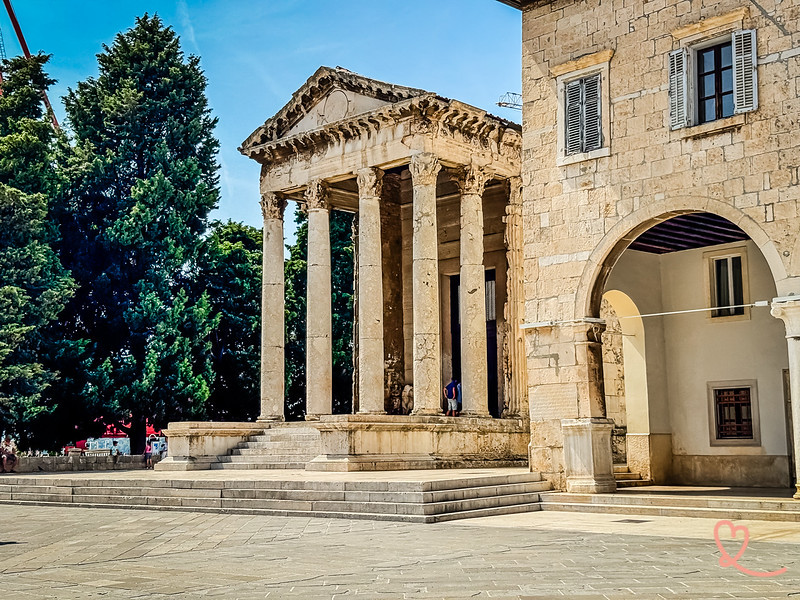
In the historic center of Pula, don’t miss the Temple of Augustus, one of the city’s best-preserved Roman monuments. We were particularly impressed by its façade with Corinthian columns, which still dominates the Forum Square today.
In this article, check out our photos and all our tips for making the most of your visit to the Temple of Augustus.
This opinion is completely independent, based on our experiences. We made our own choices, visited the area anonymously, and paid our bills in full.
Why Visit the Temple of Augustus
Is the Temple of Augustus worth a visit? Our take:
Yes, the Temple of Augustus is worth a visit. We admired its façade with Corinthian columns—one of the best-preserved on the Adriatic—as well as the small collection of Roman sculptures it houses. Its central location on Forum Square makes it a quick and rewarding stop during a stroll through Pula.
It’s one of Pula’s best attractions.

Why is the Temple of Augustus famous?
The Temple of Augustus is one of the best-preserved Roman temples outside of Italy. It was part of a complex of three temples that once lined the Forum of Pula, including the one dedicated to the Capitoline Triad (Jupiter, Juno, and Minerva), which no longer exists.
Only the Temple of Augustus remains intact, while the rear wall of the Temple of Diana—which was identical to it—has been incorporated into the neighboring Town Hall. Its architrave bears an inscription dedicating the building to the goddess Roma and to Emperor Augustus, son of the divine Caesar and father of the fatherland, which allows us to date its construction to between 2 B.C. and 14 A.D.

History in brief
The Temple of Augustus has stood the test of time, changing its function several times over the centuries. Here are the key dates to remember:
- 2 B.C. – April 14, A.D.: Construction of the temple, dedicated to the goddess Roma and Emperor Augustus
- Late Antiquity: Conversion of the Building into a Christian Church
- Middle Ages: Use of the building as a grain storage facility
- 19th century: converted into a museum of Roman sculptures (lapidary museum)
- World War II: The temple was almost completely destroyed during the bombings
- 1945–1947: Reconstruction of the temple to its original design
- Today: The temple features a collection of Roman sculptures

WHERE TO STAY IN Pula
Our favorites: neighborhoods and hotels
In the city center, near attractions:
Hôtel Mondival – check photos and availability
Verudela Peninsula, cliffs, and squares:
Hotel Brioni – check photos and availability
Stoja neighborhood, between the Old Town and the beaches
Hotel Milan – check photos and availability

Directions: Temple of Augustus, Pula
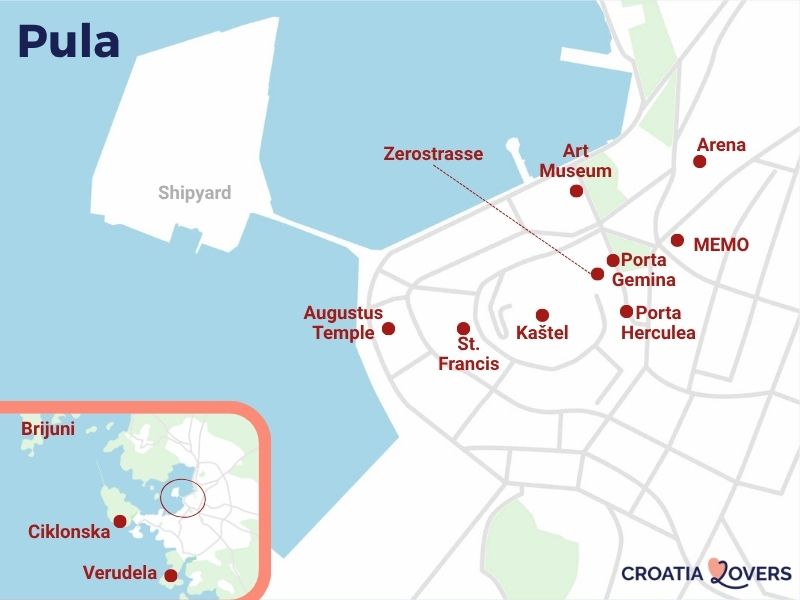
Where is the Temple of Augustus located?
- In downtown Pula, on Forum Square
- Address: Forum, Pula
- Near City Hall and Pula Cathedral
How to get there?
The Temple of Augustus is located right in the heart of downtown Pula, on Forum Square, and is therefore easily accessible on foot from anywhere in the historic center. The ground level of the square is flat, and there are no particular difficulties in accessing it from the outside. There are only a few steps to climb to enter the temple.
Parking
Since the historic center of Pula is largely pedestrian-only around the Forum, we recommend parking in one of the parking lots located on the outskirts of the old town, then walking to the temple—it’s just a few minutes away.
OUR ADVICE FOR RENTING YOUR CAR AT Croatia
- Compare prices on our preferred platform: DiscoverCars – one of the best rated sites.
- Choose a car that is powerful enough (the roads are steep) but compact (some passages are narrow).
- There is a lot of demand, book it early.


See our tips (coming soon)
Useful tips: duration, schedules, eating…
Best time to visit
We recommend visiting the temple early in the morning or late in the day, when the Forum is quieter and the light highlights the details of the facade. Since the interior is only open to visitors from April through October, plan your visit during this period if you’d also like to explore the museum.
Length of visit and main difficulties
Allow 10 to 15 minutes to admire the exterior details of the Temple of Augustus, and 15 minutes for the interior.
The Forum square has a flat surface, making the exterior easily accessible. However, there are a few steps to climb to enter the temple.

Visiting with children
The short duration of the visit—between 10 and 15 minutes—makes it a great stop for families. We recommend combining this stop with a stroll through the Place du Forum, where the kids can stretch their legs.
Schedules and rates
- Visible at all times from the outside; the interior is generally not open to visitors
: at least from 9 a.m. to 7 p.m. from April through October - Prices: €2
- Latest news on the official website here

A LITTLE MORE patience
All the photos, maps, information and addresses you need to make your stay in Croatia a success will soon be available in a single ebook!

Remarkable Roman architecture
A facade with Corinthian columns
We were struck by the elegance of the façade of the Temple of Augustus. The building stands on a podium, and its portico is supported by four Corinthian columns adorned with finely carved capitals. Above, the architrave features a frieze decorated with acanthus scrolls, fruit, and birds—a motif you can see if you look up before entering. On the triangular pediment, a circular medallion completes the ensemble.
On the front facade, an engraved inscription recalls that the building was dedicated to the goddess Roma and to Emperor Augustus, son of the divine Caesar and father of the fatherland. Built between 2 B.C. and A.D. 14 during the reign of Augustus, the temple reflects the late Hellenistic influence characteristic of that period.

The Forum, a gem in the heart of the city
The Temple of Augustus stands on the Forum Square, the historic and administrative heart of ancient Pula. Originally, the square was home to three temples, including one dedicated to the Capitoline Triad (Jupiter, Juno, and Minerva), which no longer exists.
Only the Temple of Augustus remains intact, while the rear facade of the Temple of Diana—which was identical to it—has been incorporated into the neighboring City Hall. We love this blend of antiquity and everyday city life: today, the square is lined with lively café terraces.
Take a moment to sit down and admire the temple from different angles, especially at the end of the day when the low-angled light highlights the contours of its facade.

A lapidary museum worth exploring inside
The cella and its collection of Roman sculptures
Inside, the cella of the Temple of Augustus now houses a tiny museum of stone sculptures. There, we discovered a collection of Roman sculptures in bronze, marble, and stone, including busts of emperors and depictions of various deities.

Explanatory panels provide context for each room and highlight the role of imperial worship in Roman society. The space is modest compared to the grandeur of the exterior façade, but you’ll still find enough here to understand the site’s religious and political significance during the time of Augustus. Allow a few extra minutes to explore all the display cases.

From Church to Granary: An Eventful History
The Temple of Augustus did not always retain its original function. After the fall of the Roman Empire, the building was converted into a Christian church, before serving as a grain storehouse for part of the Middle Ages. In the 19th century, it became a museum of Roman sculptures, a function it still serves today.

We find this succession of uses particularly revealing of the ability of ancient monuments to endure through the centuries by adapting to the needs of each era. However, the building you are currently visiting is not the original: it was almost entirely destroyed during the bombings of World War II and then rebuilt exactly as it was between 1945 and 1947.


Frequently asked questions
Is there an admission fee to visit the Temple of Augustus?
The exterior facade can be viewed for free from the Place du Forum. A tour of the interior, however, costs €2.
DISCOVER Istria