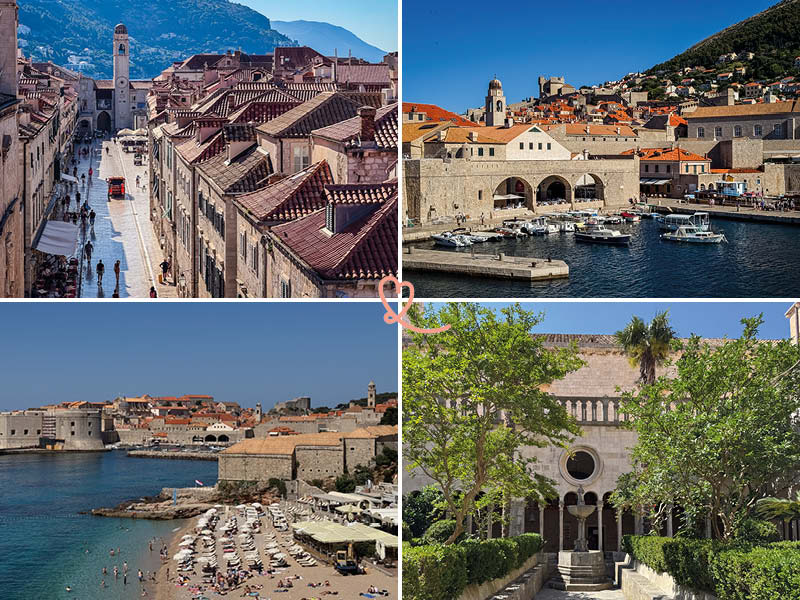
Perched on the shores of the Adriatic, Dubrovnik is one of the best preserved cities on the Mediterranean. Its medieval ramparts, UNESCO World Heritage-listed old town and deep-blue waters make it an extraordinary destination. We were won over by its rich architectural heritage and the raw beauty of its Dalmatian coastline.
Discover our ideas for what to do in Dubrovnik, illustrated with photos that will make you want to go. Bonus: useful tips and additional activities.
This opinion is completely independent, based on our experiences. We made our own choices, visited the area anonymously, and paid our bills in full.
1. Walking the ramparts

Why visit?
Walking on Dubrovnik’s ramparts is perhaps the most iconic experience the city has to offer. These medieval fortifications, whose construction dates back to the 14th century, encircle the entire old town over a length of almost 2km. From the top of the walls, you can enjoy breathtaking panoramic views of the orange-tiled roofs, the Adriatic Sea and the surrounding islands. The looped route allows you to observe the old town from all angles, both on the seaward and inland sides.
Find out more in our dedicated article!

Practical advice
- Length of visit: 2 hours for the entire circuit
- Opening hours: open daily from 9am to 5pm in high season and until 3pm in low season.
- Difficulties and access for disabled people: many stairs and ascents, not accessible to disabled people; bring good walking shoes; avoid the hottest times of the day in summer.
- Prices: ticket included in the Dubrovnik Pass at €40. Find out more on the official website here.
- Access: several entrances in the old town, notably near the Porte Pile (west entrance) and near Fort Revelin (east entrance).
- Parking: There’s no dedicated parking lot, but you’ll find a few spaces just below the ramparts, at the Buza Gate. Obviously, this parking lot is crowded, so plan to arrive early.
- Eating and drinking: a number of cafés and bars are located along the ramparts.
Visit the official website for more info here.
2. Admire the treasures of Assumption Cathedral

Why visit?
Assumption Cathedral, also known as Velika Gospa Cathedral, stands in the heart of the Old Town on the remains of a former Romanesque basilica. Built between the 17th and 18th centuries in Baroque style, the building houses a treasure trove of exceptional value. We were impressed by the richness of this collection: gold and silver reliquaries, altarpieces and the famous polyptych attributed to Titian. Among the treasure’s highlights is the reliquary of the skull of St. Blaise, the city’s patron saint, whose history is intimately linked to that of Dubrovnik. A must-see to understand the past of the Republic of Ragusa.

Practical advice
- Tour duration: 30min to 1h
- Opening hours: Monday to Saturday 9am to 5pm, Sunday 11am to 5pm
- Difficulties and PRM access: a few steps to reach the church
- Admission: While admission to the cathedral is free, a visit to the treasure trove requires a supplement of €4 (payment in cash only) and a shoulder-wrap.
- Access: in the heart of the old town, Ulica Pred Dvorom, within walking distance of the Pile Gate
- Parking: no parking available in the pedestrianized Old Town; park in the Ilijina Glavica parking lot and come on foot.
- Eating and drinking: numerous restaurants and cafés in the adjacent lanes
3. Stroll through the narrow streets of the old town

Why visit?
Listed as a UNESCO World Heritage Site since 1979, Dubrovnik’s Old Town is a labyrinth of white limestone cobbled streets, lively squares and Baroque facades of remarkable architectural coherence. Stroll through and you’ll discover Renaissance palaces, historic fountains such as the 15th-century Grande Fontaine d’Onofrio, and a multitude of small chapels. We enjoyed getting lost in the alleys that run up the hillside, away from the hustle and bustle of the Stradun. The old town, entirely pedestrianized, reveals itself differently at every hour of the day: calm in the morning, lively during the day, atmospheric at nightfall.

Practical advice
- Length of visit: 2 hours if you don’t stop at the museums
- Opening hours: free access at all times
- Difficulties and access for disabled people: many cobbled and sloping streets, not suitable for wheelchairs and baby carriages; limestone cobblestones can be slippery in wet weather.
- Rates: free access to the old town
- Access: main entrance via Porte Pile to the west or Porte Ploče to the east; bus lines 1A, 1B, 3 stop Pile
- Parking: Ilijina Glavica and Gruz parking lots outside the old town
- Catering: numerous options on site, from café terraces to gourmet restaurants
A LITTLE MORE patience
All the photos, maps, information, good addresses to make your stay in Provence a success, will soon be gathered in a single ebook!
If you’d like to be notified when our Madeira guide is published, please subscribe:
4. Visit the Rector’s Palace

Why visit?
The Rector’s Palace is one of Dubrovnik’s most representative monuments of Gothic-Renaissance architecture. This palace was the seat of government of the Republic of Ragusa, and was home to the elected rector, whose term of office lasted only one month. We were fascinated by the loggia with its elaborate columns adorning the façade and the sculpted details of the capitals. Inside, the building now houses Dubrovnik’s Cultural-Historical Museum, whose collections trace the history and splendor of the Republic of Ragusa: period furniture, official portraits, weapons and ancient coins.

Practical advice
- Length of visit: Allow 1 hour for a classic visit, and up to 2 hours for enthusiasts.
- Opening hours: open daily from 9 a.m. to 6 p.m. (variable hours in low season)
- Difficulties and PRM access: partial access for people with reduced mobility; some rooms on the second floor accessible by staircase only
- Prices: €15 for adults, €8 for schoolchildren and students – included in the Dubrovnik Pass
- Access: Pred Dvorom 3, in the Old Town, 2min walk from Assumption Cathedral
- Parking: none
- Eating and drinking: several restaurants and terraces in the adjacent streets
- Book your ticket here Book your ticket now to save time!
5. Discover Fort Lovrijenac (the Game of Thrones fortress)

Why visit?
Perched on a 37m-high rock to the west of the old town, Fort Lovrijenac is one of the most impressive fortresses on the Dalmatian coast. Built in the 11th century to defend the town against Venetian attempts to seize the bay, it bears the Latin inscription “Non bene pro toto libertas venditur auro” – “Freedom cannot be sold for all the gold in the world”. Fans of the Game of Thrones series will recognize it immediately: the fort was used as the setting for King’s Landing’s Red Fortress in several seasons. We were blown away by the 180° view of the sea and ramparts from its terraces. In addition, the Dubrovnik Summer Festival organizes open-air theatrical performances here every year.

Practical advice
- Tour duration: 30min to 1h
- Opening hours: open daily from 8 a.m. to 6:30 p.m. in season; shorter opening hours in winter
- Difficulties and PRM access: access via staircases cut into the rock; not accessible to people with reduced mobility; uneven floor inside.
- Rates: included in Dubrovnik Pass
- Access: 5min walk from Porte Pile, just outside the western ramparts
- Parking: nearby Ilijina Glavica parking lot
- Eating out: a few cafés outside the fort near the Pile Gate
6. Escape to the Elaphite Islands by boat

Why visit?
Just a few nautical miles northwest of Dubrovnik, the Elaphite archipelago comprises thirteen islands, of which only three are inhabited: Koločep, Lopud and Šipan. This boat trip is a great way to get away from the hustle and bustle of the old town and discover a wild coastline, secluded coves and villages with deserted alleyways. We were seduced by the tranquility of Lopud, whose sandy beaches – rare in Dalmatia – offer a welcome contrast to the ubiquitous pebbles. The archipelago can be explored by scheduled ferry or organized excursion departing from Dubrovnik harbor, with stopovers on several islands in one day.

Practical advice
- Length of visit: a full day to visit 2 or 3 islands
- Timetable: regular ferries from the port of Gruz, several departures a day
- Difficulties and PRM access: the mainline ferries are accessible, but getting around on the islands (cobbled streets, paths) can be difficult for people with reduced mobility.
- Prices: scheduled ferry approx. EUR 5 to 10 per trip; organized excursion EUR 50 to 90 per person, depending on service provider
- Access: departures from the port of Gruz, accessible by bus from the old town (lines 1A, 1B).
- Parking: at the port of Gruz
- Eating and drinking: a few restaurants and konobas (taverns) on each inhabited island, especially Lopud and Šipan.
- Book your tour now to save time!
7. Enjoy the tranquillity of the Franciscan Monastery

Why visit?
Nestled just inside the Pile Gate, Dubrovnik’s Franciscan Monastery is one of the old town’s little-known gems. Founded in the 14th century, it houses one of the oldest Romanesque-Gothic cloisters in Croatia. The finely sculpted double columns surrounding the interior garden create a serene setting. We also discovered one of Europe’s oldest surviving pharmacies, open since 1317. The adjoining museum houses a fine collection of liturgical objects, illuminated manuscripts and religious paintings. Outside high season, the cloister offers a welcome moment of calm away from the hustle and bustle of the nearby Stradun.

Practical advice
- Visit duration: between 30min and 1h
- Opening hours: open daily from 9am to 6pm (shorter hours in winter)
- Difficulties and PRM access: limited access for people with reduced mobility due to steps and uneven cobbled surface
- Rates: Admission is €6 per person, but if you opt for the Dubrovnik Pass, admission is free.
- How to get there: Placa 2, a few metres from Porte Pile, in the old town
- Parking: outside town
- Eating and drinking: numerous cafés and restaurants on the Stradun, 30m away
Subscribe to our Newsletter
- Get away from it all with Region Lovers’ beautiful destinations!
- Once a month
- Advertising-free

8. Admire the sunset at Mount Srd

Why visit?
If you want to see Dubrovnik in all its splendour, Mount Srd, at 412m, is the ideal vantage point. A cable car links the old town to the summit in just a few minutes, offering spectacular views of the orange roofs, the Adriatic Sea and the island of Lokrum. We particularly recommend the climb at the end of the day: at sunset, the golden light on the ramparts and the water is simply remarkable. At the top, the Imperial Fort – built by Napoleon in the 19th century and heroically defended during the 1991-1992 siege – houses a museum dedicated to the city’s recent history, including the Croatian War of Independence.

Practical advice
- Length of visit: depends on the time you go up to watch the sunset.
- Opening hours: cable car open from 9 a.m. to midnight in summer; reduced opening hours in winter (ask for details); the fort is open at the same time.
- Difficulties and access for disabled people: the cable car is accessible for disabled people; the summit is flat but the fort has a few steps.
- Price: €25 return for adults; the fort is included in the ticket
- Access: bottom station of the cable car at Petra Krešimira IV, 10min walk from the Ploče Gate; it is also possible to walk up in about 1h30.
- Parking: a few spaces near the bottom station of the cable car
- Catering: panoramic bar and restaurant on the summit
- Visit the official website for more info here.
9. Enjoy the Stradun’s evening entertainment

Why visit?
The Stradun – also known as the Placa – is the main pedestrian thoroughfare that crosses the old town from east to west for around 300m. Paved with limestone polished by centuries, this avenue is the beating heart of Dubrovnik. We enjoyed the lively atmosphere of the evening stroll, when locals join travelers for a Dalmatian-style passeggiata, café terraces come alive and baroque facades are illuminated.
10. Explore the garden island of Lokrum

Why visit?
Just 600m off the coast of the old town, the island of Lokrum is a natural refuge classified as a nature reserve. It can be reached in ten minutes by the regular shuttle service from the old town harbour. Covered in lush vegetation – pines, century-old olive trees and rare Mediterranean plants – the island is also home to a botanical garden founded in the 19th century by Archduke Maximilian of Austria. We were charmed by the peacocks that roam freely between the ruins of the Benedictine monastery and visitors, without the slightest shyness. There’s also an inland sea lake where you can swim in calm, uncrowded waters. The island is an ideal nature break, just a stone’s throw from the hustle and bustle of the old town.

Practical advice
- Length of visit: allow half a day to get the most out of your visit
- Times: shuttles from Dubrovnik’s old port from 9am to around 7pm in season; the island closes to visitors after the last boat; closed in winter.
- Difficulties and PRM access: natural paths sometimes uneven; limited access for people with reduced mobility in certain areas of the island.
- Prices: round-trip shuttle approx. 5-8 EUR; island entrance included in shuttle ticket
- Access: shuttles from Dubrovnik’s old port, in the old town.
- Parking: no cars on the island
- Catering: only one restaurant on the island, in the monastery ruins; bring a picnic for greater flexibility
Other things to do in Dubrovnik
Lounging on one of the beaches
Dubrovnik is not a beach destination in the strict sense, but the city does have several accessible swimming spots. Banje Beach, just outside the Ploče Gate, is the most popular with its stunning views over the old town and the island of Lokrum. We also enjoyed the landscaped rocks of Buža Beach, accessible via a passage cut into the seaward ramparts. The wilder Sveti Jakov Beach, a 20-minute walk from the old town, offers a more authentic setting. Please note that most of Dubrovnik’s beaches are pebbled.

Shopping
The old town is packed with souvenir stores, local craft workshops and shops selling regional produce. For more authentic shopping, choose the side streets rather than the Stradun, where prices are higher. Specialties to bring back include myrtle liqueur (mirtovina), local fruit jams and syrups, and Dalmatian embroidery and lace. We also found some very nice jewelry shops! The market on the square (Place Ivan Gundulic) also sells local produce and fresh fruit.

Other museums
Dubrovnik boasts a varied network of museums. We loved it:
- The Maritime Museum traces the history of the Republic of Ragusa’s powerful merchant fleet, with ship models, navigational instruments and archival documents.
- The Red History Museum retraces the history of communism in Croatia through an interactive scenography featuring documents, photos, multimedia and the striking reconstruction of a period house. An immersive and surprising visit!
- MOMAD exhibits works by Croatian artists of the 19th and 20th centuries in the Villa Banac.

Taste Dalmatian cuisine in one of our charming restaurants
Dalmatian cuisine focuses on quality products: fish and seafood from the Adriatic, local olive oil, wines from the Pelješac vineyards and cheeses from the hinterland. We recommend you try the konobas (family-run taverns) rather than the more touristy restaurants of the Stradun. Specialties include peka (meat or octopus cooked under a bell), brudet (fish stew), seafood pasta and crni rižot (squid ink risotto). Rue Prijeko, which runs parallel to the Stradun, is home to a large number of addresses, as is the Lapad district for a more local atmosphere.

Excursions around Dubrovnik
The Dubrovnik region is an excellent base for exploring the surrounding area, both inland and to the islands. Here are our suggestions for day or half-day excursions from the city.
Sea kayaking is one of Dubrovnik’s most popular activities. Several providers offer guided trips along the seaward side of the ramparts, then on to the sea caves carved into the rock at the foot of the fortifications, or to the island of Lokrum. We were blown away by the view of the walls and cliffs from the water. Outings are usually in the morning to take advantage of the calm sea, with small groups. Allow 3 to 4 hours for a complete excursion, including a swim stop.

Explore the charming town of Cavtat
Located 18km south of Dubrovnik, Cavtat is a gentle Dalmatian town often overshadowed by its more famous neighbor. Its tree-lined waterfront, Venetian palaces and tranquil atmosphere make it an ideal excursion away from the tourist crowds. The best way to reach the city is by a 20-minute boat ride from Dubrovnik! We particularly enjoyed the promenade along the seafront and the Bukovac Museum.

Explore the peaceful Lapad district
The Lapad peninsula, 4km west of the center of Dubrovnik, is the city’s residential and seaside district. Far from the hustle and bustle of the old town, its shady lanes, family-friendly beaches and more affordable restaurants make it a welcome alternative, especially for families. The Promenade de Lapad, which comes alive in the evening, is ideal for a stroll along the water’s edge before dinner. We found the atmosphere much more relaxed than in the inner city. The district is accessible by bus from the Old Town, with several lines connecting it to the center. We also enjoyed Parc Velika and Mala Petka.

Useful tips for visiting Dubrovnik
Where is Dubrovnik?
- Dubrovnik is located in the far south of Croatia, on the Dalmatian coast of the Adriatic Sea, on the border with Bosnia-Herzegovina and Montenegro.
- Dubrovnik to Split: approx. 3h30 drive (225km)
- Dubrovnik to Zagreb: approx. 5h30 to 6h drive (600km)
- Dubrovnik to Kotor (Montenegro): approx. 1h30 drive (85km)

How to get to Dubrovnik
Dubrovnik is served by an international airport (Dubrovnik-Čilipi Airport), 22km from the city center, linked to many European capitals by direct seasonal and regular flights. Airport-city center shuttles (Atlas buses) run every time a flight arrives. The city is also accessible by road from Croatia and neighboring countries, and by ferry from Split, Rijeka and the Dalmatian islands.

Parking in Dubrovnik
The Old Town is entirely pedestrianized: it’s impossible to enter by car. The main parking lots nearby are the Ilijina Glavica parking lot (closest to the Pile Gate, approx. 5 EUR/h), the Gruz parking lot near the ferry port, and the Lapad parking lot. In high season, parking spaces are scarce: it’s advisable to arrive early in the morning, or to park on the outskirts and take the bus to the center.

Getting around Dubrovnik
Dubrovnik’s city bus network is efficient and inexpensive. Routes 1A and 1B connect the old town (Pile stop) with the port of Gruz and Lapad. Tickets can be purchased from the driver (approx. EUR 2) or at a reduced rate from the kiosk. The Old Town itself can be visited entirely on foot. For island excursions, water shuttles leave from the old port. In high season, water cabs also serve the surrounding beaches and coves.
Where to eat in Dubrovnik
Dalmatian gastronomy takes pride of place in the many konobas in the old town and Lapad district. We particularly enjoyed the Taj Mahal Restaurant for its value for money and authentic cuisine. For a more refined meal with a view of the sea, the terraces overlooking the ramparts on the eastern side are ideal. Avoid restaurants directly on the Stradun, which are often more touristy and expensive.

Dubrovnik in winter
Outside the high season, Dubrovnik has a more local and serene atmosphere. We particularly like the old town in winter: the city walls, the Stradun and the museums are much less crowded, and accommodation prices drop significantly. Note that some museums and attractions reduce their opening hours between November and March, and ferries to the islands are less frequent.

It’s time to book!
Compare everything: companies, prices, schedules and availability.
Frequently asked questions about Dubrovnik
Where are the best views of Dubrovnik?
Dubrovnik lends itself particularly well to photography and panoramic views. The most famous viewpoint is from the top of Mount Srd, accessible by cable car, where the view of the city walls, the old town and the island of Lokrum is complete. On the ramparts themselves, the section along the sea offers breathtaking views. The Srđ Road viewpoint, accessible by car or on foot from the Bosanka district, is a less crowded alternative. Finally, from the island of Lokrum, the view of the golden ramparts on the seaward side is particularly stunning at the end of the day.

Is the Dubrovnik Pass worth it?
The Dubrovnik Pass is a tourist card that includes access to the city walls, Fort Lovrijenac, several municipal museums (including the Rector’s Palace, the Maritime Museum and MOMAD) and unlimited use of city buses for 1, 3 or 7 days. If you’re planning to visit several sites in a short space of time, the card pays for itself after 2 or 3 visits. On the other hand, if your stay is short or focused on walking and beaches, an à la carte purchase may suffice. Visit the official website for more info here.
Is Dubrovnik expensive?
Dubrovnik is one of the most expensive destinations in Croatia and the Adriatic region. In the high season (July-August), accommodation in and around the old town is very expensive, and restaurants on the main tourist routes are significantly more expensive than the national average. Entrance fees to major sites such as the city walls (EUR 35) or the cable car (EUR 25) also represent a considerable expense. To keep expenses under control, we recommend staying in the Lapad district, eating in the konobas in the side streets, and visiting outside the months of July and August.