Behind its appearance as a former municipal hospital, Split’s Museum of Fine Arts offers a rich and surprising artistic adventure. Ideally located just a few steps from the Golden Gate of Diocletian’s Palace, it harmoniously blends history and modernity in a unique setting. We were particularly impressed by the diversity and quality of the collections, which range from the 14th century to the present day. We were as fascinated by the masterpieces ofModern and Contemporary Art as we were by the peaceful inner courtyard, a veritable haven for contemplation.
In this article, we share with you our impressions and practical advice, illustrated with images, to make the most of this experience.
This opinion is completely independent, based on our experiences. We made our own choices, visited the area anonymously, and paid our bills in full.
Why visit Split’s Fine Arts Gallery?
Is Split’s Museum of Fine Arts worth it? Our opinion:
Yes, the Split Fine Arts Gallery is definitely worth a visit. Its historic building—a renovated former municipal hospital—offers an authentic and light-filled setting. The extensive permanent collection, featuring over 5,200 works, spans a wide range from the 14th century to contemporary art, including major works from the Croatian art scene. The museum is primarily aimed at art lovers, as well as those curious about local culture. It is one of Split’s top attractions.

Why is Split’s Museum of Fine Arts famous?
Split’s Museum of Fine Arts is renowned for its exceptional national collection, which traces the region’s artistic history from the 14th century to the present day. Its varied collection of paintings, sculptures, photographs, multimedia installations and digital works testifies to the region’s rich cultural heritage.
Its collection highlights major Croatian artists such as Vlaho Bukovac, Ivan Meštrović and Mladen Stilinović, offering a comprehensive panorama of local Modern and Contemporary Art. You’ll be enchanted by this museum of contemporary art, which reflects both tradition and artistic innovation.

Our favorite moments
During our visit, we particularly appreciated:
- The inner courtyard and its galleries: strolling under these arches offered us a moment of calm and wonder at the works on display. The atmosphere is authentic and contemplative.
- The Modern Art rooms: we were captivated by the wealth of artistic movements on display, with paintings and sculptures that tell the story of the evolution of local art before 1950.
- The Contemporary Art collection: discovering the works of the young Croatian generation surprised us with their originality and diversity, especially the multimedia installations which add a dynamic touch.

WHERE TO STAY IN Split
Our favorites: neighborhoods and hotels
Marina –
Hotel Ambasador – check photos and availability
Old Town –
Piazza Heritage Hotels – check photos and availability
Bacvice, on the coast –
Hotel Park Split – check photos and availability

Access: Museum of Fine Arts, Split
Where is the museum?
- In Split, Croatia
- Next to Josipa Jurja Strossmayera Park
- Facing the Golden Gate of Diocletian’s Palace
- At 15 Ulica kralja Tomislava
- 5min walk from Split’s St. Domnius Cathedral
- 5min walk from Riva Split
How to get there?
The museum is within walking distance of the historic center. It faces the Golden Gate of Diocletian’s Palace and borders Josipa Jurja Strossmayera Park. It’s located on a wide, concreted tourist street, making it easy to get to without difficulty. The area is busy but pleasant.
If you’re driving, you’ll need to park in a parking lot outside the Diocletian’s Palace, as the area is entirely pedestrian-only. If you’re using public transportation, the nearest bus stop, “HNK,” is a 3-minute walk away. Find out about possible routes here.

Parking
The museum has no parking facilities. It is located in a very busy tourist area. We do not recommend parking in the parking lots at the entrance to the historic center, as they are very expensive. Instead, use the parking lot at Istarska ul. 4, a 5-minute walk away.
OUR ADVICE FOR RENTING YOUR CAR AT Croatia
- Compare prices on our preferred platform: DiscoverCars – one of the best rated sites.
- Choose a car that’s compact enough (some passages are narrow).
- There is a lot of demand, book it early.


Useful tips: duration, schedules, eating…
Best time to visit
The Split Museum of Fine Arts is not very crowded, which guarantees a quiet visit at all times. However, avoid Saturdays and Sundays, especially in July and August, when the museum is more crowded. Prefer a weekday visit, preferably in the morning or early afternoon, to take full advantage of the Modern and Contemporary Art collections. Alternatively, a visit in the late afternoon guarantees a nice light under the galleries.

Length of visit and main difficulties
Allow between 1h and 2h for a full tour of the museum, with the possibility of extending to half a day for art enthusiasts.
Wheelchair-accessible toilets are located near the entrance on the first floor. The museum’s accessibility is generally good, with elevators and platform lifts, but the entrance requires climbing a staircase fitted with a handrail.

Advice on how to visit
Visiting the museum is free, with no set itinerary, allowing you to explore at your own pace. If you wish to follow a chronological thread, we recommend you start with the Old Masters Collection (14th to 18th centuries), before moving on to the rooms devoted to Modern Art. Then finish on the first floor, where Contemporary Art reveals its most current and daring forms. The museum also features temporary exhibitions that regularly enrich the experience. Don’t forget to take advantage of the interior courtyard and its galleries, a peaceful, luminous place that rounds off your visit perfectly.

Visiting with children
The museum is not specially designed for children, with few activities or mediation adapted to them. However, curious young visitors will appreciate the diversity of the works, particularly the multimedia installations and sculptures. Spaces are large and airy, making it easy for the whole family to visit. Keep your visit short, so as not to lose your children’s attention.

Schedules and rates
The museum is open Tuesday to Friday from 10am to 6pm and weekends from 10am to 2pm. Closed on Mondays and public holidays.
Admission to the permanent collections is €5 for adults and free for children under 7. Add €5 per adult and €3 per child for access to temporary exhibitions. Find out more about current temporary exhibitions on the official website here.
Catering
The museum has its own restaurant. The Art Gallery Cafe Music Bar Split boasts a pleasant terrace directly facing the ramparts of Diocletian’s Palace. The setting is ideal for sipping a cocktail at the end of the day, or sharing an aperitif. It also offers bowls for a more balanced meal. Otherwise, you’ll be in the immediate vicinity of a host of good addresses. Our selection of the best places to eat in Split will soon be available to help you make the right choice!


The classic masters collection
Between Italian paintings and Sacred Art
Split’s Museum of Fine Arts offers a fascinating dive into art history, particularly through its Italian paintings and works of Sacred Art. We were drawn to the golden hues of the polyptych by Paolo Veneziano, the most eminent Venetian painter of the 14th century. The museum’s classical scenography highlights these luminous pieces, bathing the rooms in a pleasant halo that sublimates details and colors.

We were particularly struck by The Four Seasons by Peter Brandl – a forgotten painter of the late Baroque period – a work with an almost mystical atmosphere. In this painting, the milky-skinned figures stand out against a dark background, seeming to unite in a dance imbued with poetry and spirituality. This immersion in the world of the great classical masters was essential to our understanding of the evolution of art, both locally and across Europe. To visit the Split Museum of Fine Arts is to experience a moment suspended between history and beauty, where each canvas reveals a unique emotional intensity.

The museum’s iconographic treasures
The icon collection at the Museum of Fine Arts in Split is one of the richest in Croatia. It brings together works from Crete and Venice, from the Ionian school and the workshops of Boka Kotorska, as well as from Russia and continental Greece, offering a broad panorama of iconographic art. Most of these icons, in small or medium format, were intended for private devotion. Some can be attributed to specific artists or workshops, while others are signed by Madonnari, the popular painters who specialized in religious representations.

A LITTLE MORE patience
All the photos, maps, information and addresses you need to make your stay in Croatia a success will soon be available in a single ebook!

Plunging into the heart of Modern Art before 1950
Masterpieces of Modern Art
A significant part of the collection is devoted to the great masters of Croatian modernism, among whom Vlaho Bukovac and Mato Medović stand out. Bukovac’s creations, produced in Split between 1884 and 1885, mark a major turning point, heralding the beginnings of Modern Art in Croatia. These works offer a fascinating glimpse into local artistic evolution and testify to the dynamism of the Croatian art scene at the end of the XIXᵉ century. We were called by a canvas by Medović depicting a wild landscape of the Island of Korčula in a thousand and one hues.

Polymorphous works: between sculpture and painting
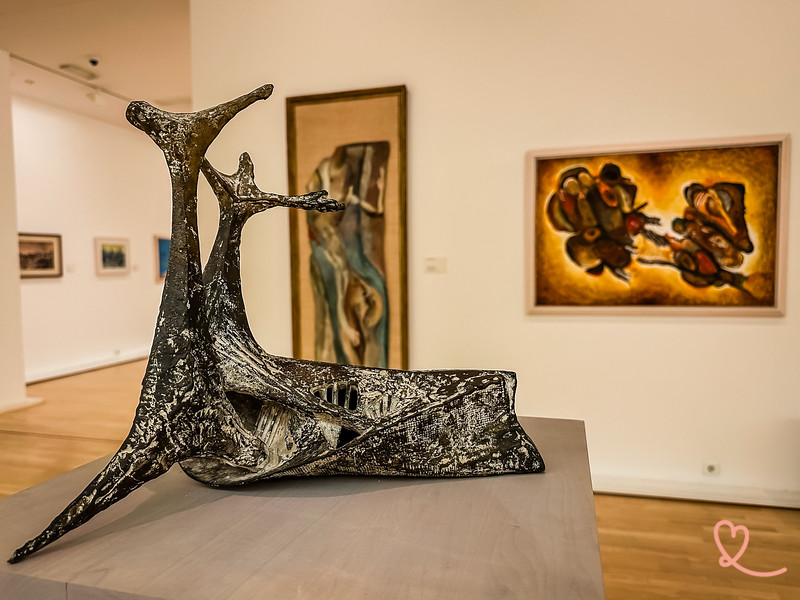
The museum’s Modern Art collection perfectly illustrates the richness and variety of Croatian art. We noticed the refined portraits by Juraj Pavlović and Ivan Skvarčina, as well as the remarkable sculptures byIvan Rendić. We also liked the caricatures, drawings and paintings byEmanuel Vidović, who was instrumental in introducing modern art ideas to Split. Sculptures byIvan Meštrović, the most famous Yugoslav sculptor of the 20th century, complete the panorama, offering a fine balance between painting and sculpture and testifying to the vitality of the Croatian art scene through the ages.

Immersion in Croatian contemporary art after 1950
Creations that shake up codes
As we wandered through the rooms dedicated to Contemporary Art, we were surprised by the creativity and boldness of Croatian artists after 1950. The works explore varied and sometimes unexpected forms, materials and approaches, challenging traditional codes. Multimedia installations, paintings, live performances and sculptures interact with one another, inviting reflection as much as wonder. This part of the museum particularly appealed to us for its energy and originality, offering a striking contrast with the more classical collections. Here you’ll discover striking works by Mladen Stilinović, Goran Petercol and Ivan Faktor, major figures on the local scene. These creations are surprising in their diversity and modernity.

Artists of the younger generation
A visit to Split’s Museum of Fine Arts is also a chance to immerse yourself in the visual diversity of the young generation of Croatian artists. The Contemporary Art collection exhibits a variety of works that testify to an abundant creativity and a plurality of mediums. We were delighted to observe the contrasts between forms, colors and techniques, reflecting a lively dialogue between tradition and innovation. Through works by Miroslav Šutej, Juraj Dobrović and Julije Knifer, we were able to trace the major trends that marked this period. The museum places particular emphasis on recent artistic practices, highlighting the work of the younger generation, such as Vlasta Žanić ‘s performance, which raised a number of questions for us.

Subscribe to our Newsletter
- Get away from it all with Region Lovers’ beautiful destinations!
- Once a month
- Advertising-free

Frequently asked questions
Does the Split Museum of Fine Arts host temporary exhibitions?
Yes, the Split Museum of Fine Arts regularly organizes temporary exhibitions. These events often feature contemporary artworks and multimedia installations, enriching the visitor experience. These temporary exhibitions complement the museum’s rich permanent collection and give it a new coloring.

Does the Split Museum of Fine Arts have a souvenir store?
Yes, the museum has a store where you’ll find a wide selection of items related to art and culture. These include exhibition catalogs, as well as specialized books on art, design, architecture, photography, theory and aesthetics. You can also take away art posters published by the museum, postcards and greeting cards, as well as original and unique objects, perfect as souvenirs or gifts.

History in brief
- 1792: construction of Split’s first municipal hospital, the museum’s historic building.
- 1872: Expansion of the hospital complex, preserving its fine architecture.
- 1931: official opening of the museum in the former hospital.
- Late 1970s: the site becomes a Museum of the Revolution.
- Today: the museum houses over 5,200 works of art from the 14th century to the present day, reflecting local cultural history.