A Croatian peninsula bathed by the Adriatic, Istria is a remarkably diverse destination. We were won over by the richness of this region, with its mix of historic towns, turquoise coves, hilltop villages and unique gastronomic experiences.
In this article, we share 10 reasons to visit Istria.
This opinion is completely independent, based on our experiences. We made our own choices, visited the area anonymously, and paid our bills in full.
Is Istria worth a visit?
Absolutely. Istria brings together in a single peninsula all that is best about Croatia: a remarkable ancient heritage, lively coastal towns, preserved medieval villages, renowned gastronomy and natural beauty. We’ve visited it and come away convinced that it deserves a place on any itinerary of Central Europe and the Mediterranean.
We list the reasons in more detail below, or you can check out our selection of the region’s top attractions.

Reason 1 – Pula’s exceptional Roman and medieval heritage
Pula is Istria’s most emblematic city and a must for anyone interested in history and culture. Its Roman amphitheatre, built in the 1st century BC, is one of the best preserved in the world and remains the symbol of the city. We were struck by its imposing size: capable of accommodating up to 20,000 spectators at the time, it was used for gladiatorial combat and public spectacles. A tour of the stands makes it easy to understand why it attracts visitors from all over the world. The city center is also well worth a visit. The Arch of Sergius, the Roman Forum and the Hercules Gate are reminders that Pula was one of the most important colonies of the Roman Empire. In addition, the bustling port and quayside offer a pleasant atmosphere of local life, with cafés and markets where you can sample local produce.
Book your guided tour of Pula now

WHERE TO SLEEP IN Istria
Our favorites: cities and hotels
Rovinj, for its undeniable charm
Grand Park Hotel – Check photos and availability
Porec, for a well-balanced holiday combining nature, beach and history
Valamar Riviera Hotel – Check photos and availability
Pula, for easy exploring and fine dining
Boutique Hotel Velsabbion – Check photos and availability

See our complete selection of the best destinations in Istria
Reason 2 – UNESCO-listed architectural gems in Poreč
Poreč offers a very different face from Pula, with an intimate atmosphere deeply marked by Venetian influence. The town is famous for its Euphrasian Basilica, a UNESCO World Heritage Site, an early Christian architectural ensemble that bears exceptional witness to Byzantine art in the Adriatic. We were impressed by the richness of its mosaics and the coherence of this monumental ensemble. Around the basilica, the old town is easily explored on foot, with its cobbled streets and small squares where you can stop for a coffee. The promenade along the waterfront offers panoramic views of the sea and nearby islands. The surrounding area is also well worth a visit: the beaches of Zelena Laguna and Funtana are within easy reach, and dolphins and cetaceans can be spotted on sea excursions.

Reason 3 – Lively, authentic coastal towns
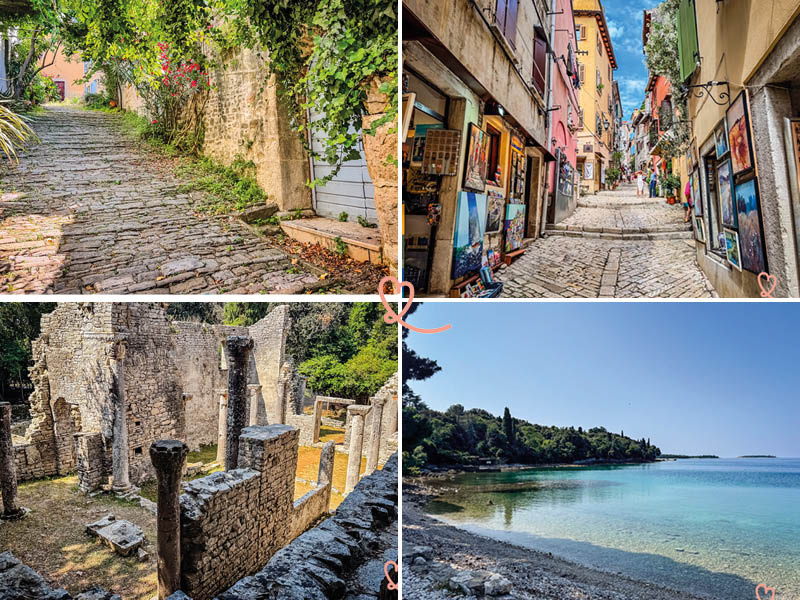
Beyond Pula and Poreč, Istria has several coastal towns that are well worth your time. Rovinj is undoubtedly the most emblematic. Perched on a peninsula, its old town is a maze of cobbled streets, staircases and lively squares. At the top, the church dominates the town, offering a panoramic view of the colorful rooftops, the harbor and the neighboring islands. Rovinj’s lively yet intimate atmosphere won us over. Further north, Novigrad combines a fishing port with medieval streets, while Umag, close to the Slovenian border, is appreciated for its beaches and lively atmosphere in summer. Vrsar, a small town of discreet charm, will charm you with its narrow streets and sheltered harbour. Here you can enjoy a leisurely stroll before exploring the surrounding coves.

OUR ADVICE FOR RENTING YOUR CAR AT Croatia
- Compare prices on our preferred platform: DiscoverCars – one of the best rated sites.
- Choose a car that is powerful enough (the roads are steep) but compact (some passages are narrow).
- There is a lot of demand, book it early.


See our tips (coming soon)
Reason 4 – The Brijuni Islands, an extraordinary national park
Just a few kilometers from Pula, the Brijuni islands form a unique archipelago classified as a national park, and are a must-see excursion in the region. We fell in love with this excursion. You’ll discover an unspoilt landscape of Mediterranean forests and secluded coves. Roman and Venetian remains stand alongside buildings dating from the time when Tito, former president of the Socialist Federal Republic of Yugoslavia, made it his presidential residence. Part of the island is also home to a small animal park, with zebras, deer and other exotic species. The paths are ideal for walking or cycling, away from the crowds of the coast. If you have the opportunity, we recommend spending a night here to fully appreciate the special atmosphere.
Take a boat trip through the Brijuni archipelago with dolphin watching – Find out more and book

Reason 5 – Green Istria and its hilltop villages
Behind the coast, Istria reveals a greener, more undulating face. The village of Motovun is one of the most beautiful in the region, recognizable by its silhouette overlooking green valleys, vineyards and truffle forests. We were impressed by its medieval atmosphere, with ramparts, cobbled streets and stone houses. Arriving at the village offers one of the most emblematic panoramas of Green Istria. Further afield, Grožnjan captivates visitors with its art galleries and lively alleyways, while Hum, nicknamed the world’s smallest village, is a stopover as unusual as it is endearing. Bale and Oprtalj complete the picture of authentic, rural Istria, far from the hustle and bustle of seaside resorts. These villages are well worth a visit!
If you don’t have a car, you can discover Motovun on an organized tour:

A LITTLE MORE patience
All the photos, maps, information and addresses you need to make your stay in Croatia a success will soon be available in a single ebook!
Reason 6 – A unique gastronomy with multiple influences
Gastronomy is an essential pillar for understanding Istria and immersing oneself in its cultural identity. The region is world-famous for its truffles, particularly around the villages of Motovun and Buzet. Enjoy typical dishes, such as fuži pasta topped with truffles, accompanied by local wines such as white malvasia or red teran. We understand that Istrian gastronomy is as much about discovering the products as it is about the setting in which you enjoy them. A meal on a terrace overlooking the sea or in a medieval village is an experience in itself. The konobas, traditional tavernas, offer an immersion in local culinary culture. You can also sample cheeses, charcuterie, award-winning olive oil and fresh seafood. Local markets complete the gourmet offer.
Here are a few activities we recommend to take you further:
- Embark on a truffle-hunting adventure with a local family, including a 3-course brunch – See availability and make reservations
- Savor the flavors of Istria with a tasting of olive oil, local cheese and artisanal charcuterie – See availabilities and make reservations

Reason 7 – Turquoise beaches and coves
Istria is lined with beautiful pebble beaches and rocky coves with clear turquoise waters. Cape Kamenjak, at the southernmost tip of the peninsula, near Pula, is a veritable natural sanctuary in our opinion. Here you can walk or cycle, discover secluded coves and enjoy the almost untamed nature. The beaches around Rovinj are also very popular, yet still close to the towns and their infrastructure. We also discovered some beautiful beaches near Fazana, Kavran, Umag and Premantura, the latter offering a particularly unspoilt natural setting. Some of the beaches are well developed, with family-friendly areas and restaurants, while the more remote coves guarantee peace and authenticity. The diversity of beach profiles is one of the major assets of the Istrian coast.

Reason 8 – An ideal playground for nautical activities
Discovering Istria from the sea gives you access to landscapes you’ll never see from land. Limestone cliffs, sea caves, pine-covered islets and wild coves make up a spectacular coastline, ideal for exploring by kayak or boat. Around Rovinj, the archipelago of islands offers calm, translucent waters, perfect for paddling and swimming breaks. Around Pula and Cape Kamenjak, caves and cliffs create a wilder atmosphere. Dolphins can also be spotted on certain excursions, particularly at the end of the day.
- Best excursions from Pula – Find out more and book
- Best excursions from Poreč – Find out more and book
- Best excursions from Rovinj – Find out more and book
- Best excursions from Opatija – Find out more and book

Subscribe to our Newsletter
- Get away from it all with Region Lovers’ beautiful destinations!
- Once a month
- Advertising-free

Reason 9 – A paradise for cyclists and hikers
Istria lends itself perfectly to outdoor activities, and we met many cyclists here. The Parenzana, a former railroad line transformed into a cycle path and hiking trail, crosses the peninsula from east to west and is one of the region’s most emblematic itineraries. It links several of Green Istria’s villages and offers a wide variety of landscapes. Forests, vineyards, hills and coastal panoramas follow one another along the way. The coastal paths, especially around Cape Kamenjak, also offer great walks and, in our opinion, spectacular views of the Adriatic. Whether you’re an experienced sportsman or simply looking for a peaceful stroll, you’ll find a playground in Istria to suit your pace.

Reason 10 – An ideal base for exploring the entire region
Istria is ideally situated for exploring other destinations. Opatija, about 1 hour’s drive from the southern tip of the peninsula, is the historic seaside resort on the Gulf of Kvarner, nicknamed the “Croatian Riviera”. We fell in love with its Belle Époque villas, its Angiolina Park and its 12km-long Lungomare promenade. Rijeka, a large port city, completes the picture with its historic center rich in Austro-Hungarian buildings. The island of Krk, accessible by bridge from the mainland, combines beaches, villages and varied landscapes. Further afield, the Plitvice Lakes, 3 hours from Pula, are one of Croatia’s natural wonders. Finally, from several towns in the region, ferries take you to Venice, offering a unique cultural getaway on the other side of the Adriatic.

DISCOVER Istria

Some disadvantages of a trip to Istria
High season tourist numbers
Istria attracts many visitors, especially between July and August, when coastal towns such as Rovinj, Poreč and Pula can be very busy. Queues at iconic sites, such as the Pula amphitheatre or the Euphrasian Basilica, grow significantly longer. We advise you to visit in mid-season, from April to June or September to October, to enjoy the sites in the best possible conditions. If you visit in summer, arrive early in the morning at the main sites and book your tickets in advance. It’s also advisable to book your accommodation several weeks in advance, as availability quickly dwindles in the most popular cities.

The need to rent a car
While the main towns are served by public transport, most of Istria’s isolated beaches, villages and natural sites can only be reached by car. We strongly recommend that you rent a car to enjoy the region to the full and get around at your own pace. It’s also the most practical way to get to Opatija, Rijeka or the Plitvice Lakes.


Summer heat and in-season prices
July and August can be hot months in Istria, with temperatures regularly reaching 30-35°C on the coast. If you’re sensitive to the heat, plan your visits for the morning or late afternoon, and protect yourself from the sun, as UV indexes are high. Prices for accommodation, restaurants and activities also rise sharply in high season. We advise you to compare accommodation offers in advance and to consider a mid-season stay to benefit from better value for money, while enjoying more reasonable visitor numbers and a very pleasant climate.


It’s time to book!
Compare everything: companies, prices, schedules and availability.
How to get to Istria
Istria is located in north-western Croatia, on the border with Slovenia and Italy. There are several options for getting there:
- By plane: Pula airport (Pulska Županija) is served by several European airlines, notably from Paris, London and Amsterdam. It’s the most convenient point of entry for exploring the peninsula.
- Ferry from Venice: Regular ferry services connect Venice with Pula, Rovinj, Poreč and Umag. This is an original option for combining the two destinations. See available routes here.
- By car: Istria is easily accessible from Slovenia or Italy by freeway. From France, allow around 10h to 12h depending on your point of departure.