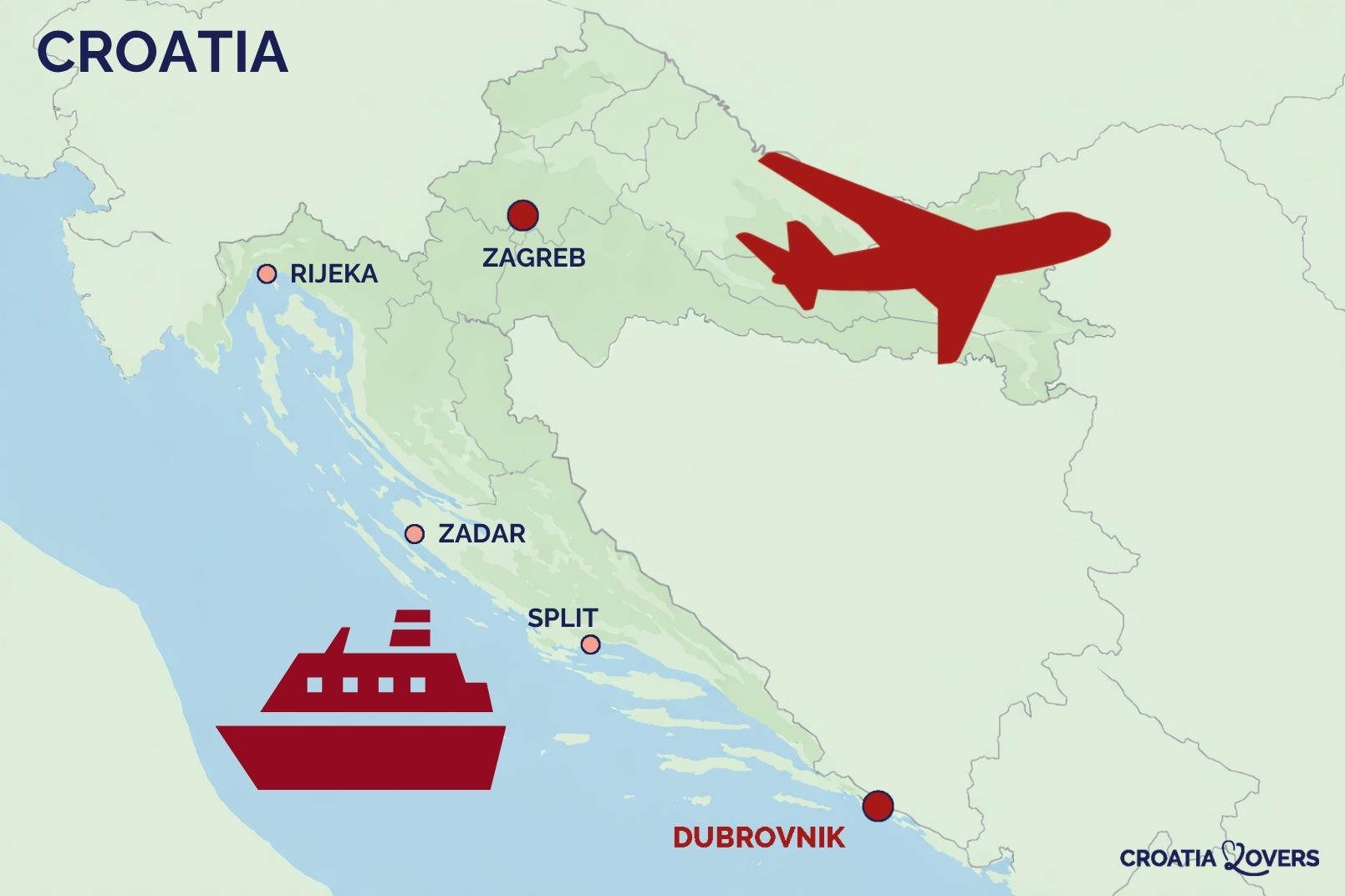
Dubrovnik lies at the southernmost tip of Croatia, on the Dalmatian coast of the Adriatic Sea. Sandwiched between Bosnia-Herzegovina and Montenegro, the city’s unique geographical position makes it a destination in a class of its own. Its historic center, a UNESCO World Heritage Site, attracts millions of visitors from all over the world every year.
Here we’ve put together all the practical options for getting to Dubrovnik, whether you’re arriving by air, road, ferry or from Split.
Summary: How to get to Dubrovnik
If you don’t want to read the whole article:
- At the southernmost tip of Croatia’s Dalmatian coast, on the border with Montenegro
- ~20min from Dubrovnik International Airport – Čilipi (direct flights from all over Europe in season)
- ~4h30-5h by bus or car from Split
- Seasonal ferry service from Split, the Dalmatian Islands and Bari (Italy)
- ~6h drive from Zagreb via A1 and Pelješac bridge (avoids Bosnian border)
It’s time to book!
Compare everything: companies, prices, schedules and availability.

Dubrovnik location and map
Dubrovnik occupies the southern tip of Croatia, on a narrow coastal strip bordered by Bosnia-Herzegovina to the east and Montenegro to the south. The city stretches along the Adriatic Sea, facing the Elaphite Islands and the island of Lokrum, visible from the city walls.
This particular geographical position deserves a mention: until June 2022, any road journey between northern Croatia and Dubrovnik had to pass through the Neum corridor, a Bosnian enclave just a few kilometers long. The opening of the Pelješac bridge put an end to this constraint. We’ll come back to this in the section on roads.
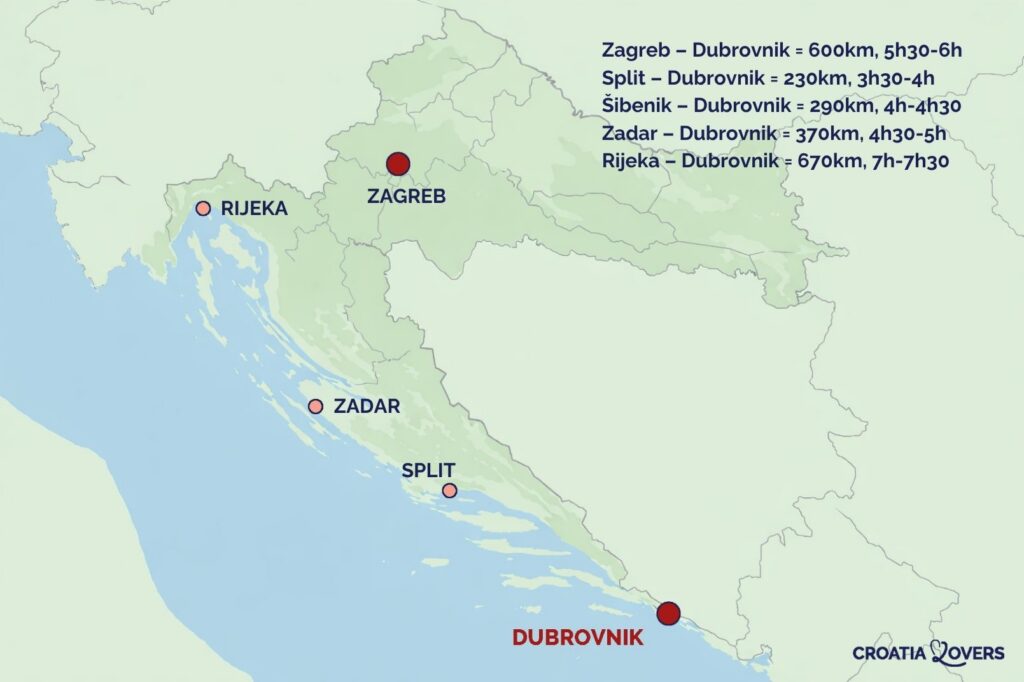
Good to know: Dubrovnik is around 600km south of Zagreb, 230km south of Split and 50km north of the Montenegrin border.
By plane – Dubrovnik International Airport (DBV)
Dubrovnik by plane
Dubrovnik International Airport, located in Čilipi, is about 20km southeast of the city center. It is the main gateway to the city, especially for European travelers. The airport is modern, well-organized and has car rental counters, shuttle buses and cab services at the arrivals exit.
Seasonal flights are plentiful from April to October from most major European cities. Outside this period, the offer is concentrated on internal Croatian routes via Zagreb or Split, as well as on a few European services maintained year-round.
Main air links to DBV
- From France: seasonal flights from Paris (CDG and Orly), Lyon, Nantes, Bordeaux, Marseille and Toulouse (Transavia, easyJet, Volotea, Air France).
- From Switzerland: Geneva and Zurich (Swiss, easyJet, Edelweiss)
- From Belgium: Brussels-Charleroi (Ryanair), Brussels-Zaventem (Brussels Airlines, TUI fly)
- From Germany: Frankfurt, Munich, Berlin, Düsseldorf (Lufthansa, Eurowings, Ryanair)
- From the UK: London (Gatwick, Luton, Stansted), Manchester, Bristol, Edinburgh (easyJet, Ryanair, Jet2)
- From Croatia: Zagreb and Split (Croatia Airlines) – flights available all year round
In low season, it may be easier to travel via Zagreb or Split to Dubrovnik.

Access options from Dubrovnik Airport (DBV)
The airport is about 20km from the center. There are several ways to reach the city, depending on your preferences and budget.
By rental car
The main rental agencies have counters in the arrivals hall. The journey to the city center takes around 25-30 minutes, depending on traffic conditions. In July and August, we advise you to book in advance: available vehicles are scarce and rates increase significantly.
An important word of warning: Dubrovnik is a difficult city to get around by car. The old town is pedestrianized, and parking in the surrounding area is limited and expensive in high season. A car is useful for exploring the region (Pelješac peninsula, Kotor in Montenegro, islands by ferry), but less essential for visiting Dubrovnik itself, whose center can only be visited on foot.
Compare available rental cars.

Private transfer
In our opinion, a private transfer is a practical option, especially for families or groups. A driver will meet you at the terminal exit and take you directly to your accommodation. The price is fixed per vehicle, making it competitive for two or three passengers.
See available airport transfers.
By public bus
Line 11 of the Atlas network links the airport with Dubrovnik’s bus terminal (Pile Gate), located at the entrance to the old town. Buses run in partial coordination with flight arrivals in high season.
Duration: ~45min
Cost: approx. €6-8 per person
We recommend checking the latest timetables directly at the airport or with your accommodation, as frequencies vary according to the season.

By cab
Cabs are available in front of the arrivals terminal. Check that the meter is on when you leave. VTC apps also operate in Dubrovnik, allowing you to estimate the fare in advance.
Duration: ~25-30min
Cost: €35-50 depending on time and destination
By ferry
The ferry is a pleasant way to reach Dubrovnik, particularly from the Dalmatian islands or Italy. The port of Dubrovnik (Luka Dubrovnik) hosts several types of ferry service, depending on the season.

From the Dalmatian Islands
Regular connections link Dubrovnik to Hvar, Korčula and Mljet (Jadrolinija). These connections are seasonal and particularly frequent from June to September. Korčula, in particular, can be easily reached from Dubrovnik by catamaran in just one hour.
From Italy
A seasonal service links Bari to Dubrovnik (Jadrolinija). The crossing takes around 9-10 hours at night, which saves you a night in a hotel. Cabin comfort is decent, but you’ll need to bring something to cover up, as the air-conditioning on board can be quite strong.
Good to know: ferries sell out quickly in July and August, especially on routes from Italy. We recommend booking several weeks in advance.
By car
From Zagreb, northern Croatia or Split
From Zagreb, the quickest route is along the A1 freeway to Ploče, then south along the coastal road. The journey takes around 5h30-6h in normal conditions.
Distance: about 600km
- Zagreb – Dubrovnik – approx. 600km, 5h30-6h via A1 and Pelješac bridge
- Split – Dubrovnik – approx. 230km, 3h30-4h via coastal road E65
- Šibenik – Dubrovnik – about 290km, 4h-4h30
- Zadar – Dubrovnik – approx. 370km, 4h30-5h
- Rijeka – Dubrovnik – about 670km, 7h-7h30

Pelješac Bridge: a major new feature
Before July 2022, all road journeys from northern Croatia to Dubrovnik had to pass through the Neum corridor, a Bosnian enclave some twenty kilometers long. This involved two border crossings, with long queues in summer.
The opening of the Pelješac Bridge in July 2022 has changed all that. This 2.4km bridge now links the Pelješac peninsula directly to the rest of Croatia, bypassing Bosnian territory. This makes for a smoother journey, and eliminates the need for customs checks on this section. We recommend this route, especially in high season.
Day trip from Split
Split is Croatia’s second-largest city and a major transit hub for Dubrovnik. A number of excursions offer day trips from Split to Dubrovnik. In our opinion, this formula is ideal for travellers staying in Split who want to discover Dubrovnik without worrying about logistics. See options from Split.

And once in Dubrovnik…
Dubrovnik’s old town is entirely pedestrianized. The nearest parking lots (Pile and just below the ramparts, at Buza Gate) are subject to a charge and often overcrowded in summer. If you’re coming by car, check with your accommodation to find out what parking options are available nearby.
Compare available rental cars.

Once you’ve arrived, the city has a lot to offer. Here are just a few of the things we think you shouldn’t miss:
- Tour of the medieval ramparts of the old town
- Dubrovnik cable car and view from Mount Srđ
- The Beaches of Banje and the Elaphite Islands
- The island of Lokrum, a 15-minute boat ride from the old port
- An excursion to Kotor (Montenegro) or the Pelješac peninsula
Read our article on what to do in Dubrovnik here.
Here’s our article on where to stay in Dubrovnik.