The Museum of Contemporary Art Zagreb, also known as MSU, is a major cultural space located in the Novi Zagreb-est district. Opened in 2009 in a modern building designed by Croatian architect Igor Franić, it houses a rich collection of contemporary art. In addition to its permanent collections, it hosts a series of often engaging temporary exhibitions.
In this article, you’ll find our useful tips in pictures to help you prepare for your visit to the Museum of Contemporary Art in Zagreb and enjoy a memorable experience.
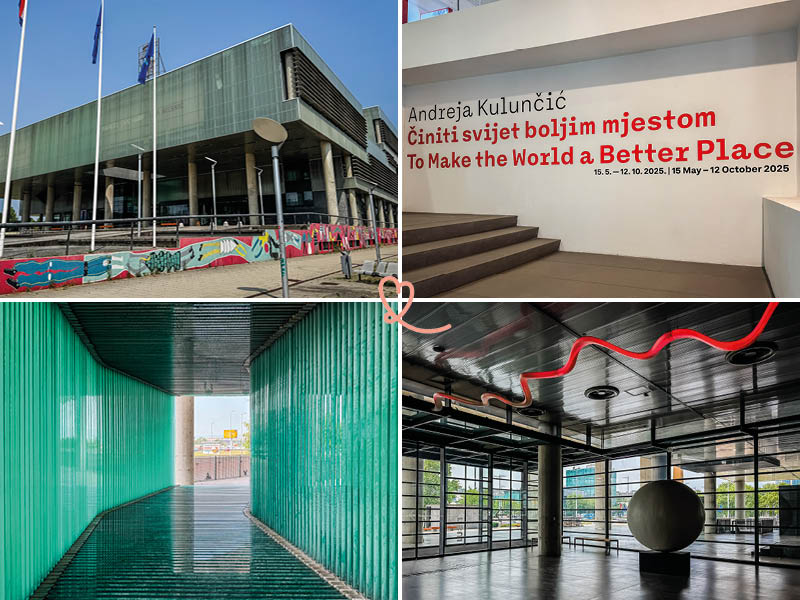
This opinion is completely independent, based on our experiences. We made our own choices, visited the area anonymously, and paid our bills in full.
Why visit the Museum of Contemporary Art in Zagreb
Is the Museum of Contemporary Art worth it? Our opinion:
Yes, we really enjoyed the Museum of Contemporary Art in Zagreb. There are several reasons for this:
- Firstly, its modern architecture offers a bright, spacious setting.
- Secondly, its rich collections cover painting, sculpture and photography, as well as multimedia works.
- The experience is fluid, with an accessible course and a surprisingly artistic slide to descend between floors.
- The museum caters to art enthusiasts and families alike, with workshops and areas dedicated to children.
In our opinion, it’s one of Zagreb’s best attractions.

Why is Zagreb’s Museum of Contemporary Art famous?
The Museum of Contemporary Art Zagreb is recognized as Croatia’s largest and most modern museum of contemporary art. Its outstanding national collection includes works by Jossip Seissel, Carsten Höller and Marina Abramović.
Opened in 2009 in an innovative building, it regularly hosts committed temporary exhibitions, such as the one by Andreja Kulunčić, which we were able to discover there, focusing on social responsibility. Its dynamic programming and commitment to education reinforce its reputation in the Croatian cultural landscape.

Our favorite moments
During our visit, we particularly appreciated :
- Carsten Höller’s toboggan: a playful and unexpected experience, offering a fast and fun descent from the second floor to the first floor.
- Outdoor installations: works exhibited outdoors on the museum forecourt carry the experience out into the street.
- Photographic collections: between documentary views, artistic experiments and conceptual works.

History in brief
- 2003-2009: Construction of the modern building designed by architect Igor Franić.
- December 11, 2009: Official opening of the museum in its new contemporary setting.
- The museum was moved from a former palace to this innovative building, reinforcing its cultural status.

Access: Museum of Contemporary Art (MSU), Zagreb
Where is the Museum of Contemporary Art?
The Museum of Contemporary Art, also known as MSU, is located at 17 Avenija Dubrovnik, Zagreb.
- It is located in the Novi Zagreb-est district, south of downtown Zagreb.
- It is set in a modern, contemporary environment.
OUR ADVICE FOR RENTING YOUR CAR AT Croatia
- Compare prices on our preferred platform: DiscoverCars – one of the best rated sites.
- Choose a car that is powerful enough (the roads are steep) but compact (some passages are narrow).
- There is a lot of demand, book it early.


See our tips (coming soon)
How to get there?
- The museum is a little way from downtown Zagreb. Allow about 1 hour’s walk.
- By car, it’s obviously quicker, taking around 17 minutes from the city center, with easy access via the A1, A2 and A3 freeways.
- The museum is well served by public transport: streetcars 6, 7 and 14, as well as numerous buses (166, 219, 220, 221, 229, 268, 310, 311, 313, 109, 222).
- Streetcar and bus stops are nearby.
- Access by bicycle is also possible, for those who prefer soft mobility.

Parking
- There is a parking lot under the museum, with access to the forecourt by elevator or staircase.
- There’s also plenty of parking all around.

Useful tips: duration, schedules, eating…
Best time to visit
The museum is busiest during vernissages and special events (concerts, screenings, etc.), but at other times its vast spaces make it easy to get around.

Length of visit and main difficulties
- Allow 1 to 2 hours for a quick visit, and up to half a day for a complete discovery.
- The museum is accessible to people with reduced mobility, with elevators and adapted toilets.
- The exhibition spaces are divided into two sections, all of which are accessible.

Advice on how to visit
- There is no set direction.
- We started with the temporary exhibition before exploring the museum’s permanent collections.
- It’s also great fun to lose yourself in the stunning architecture.
- Don’t forget to take advantage of the accessible roof.

A LITTLE MORE patience
All the photos, maps, information, good addresses to make your stay in Provence a success, will soon be gathered in a single ebook!
If you’d like to be notified when our Madeira guide is published, please subscribe:

Visiting with children
The museum is very family-friendly. It offers creative workshops for children aged 5 to 15. Strollers are allowed, and all areas are easily accessible.

Schedules and rates
- Opening hours: Tuesday to Friday, 11 a.m. to 7 p.m., Saturday and Sunday, 11 a.m. to 6 p.m.
- Closed: Mondays and public holidays
- Full adult price: €11
- More details on the official museum website here

Guided tours
- During our visit, we didn’t notice any audioguides or guided tours.
- However, the museum’s official website states that tours are available with a guide in English or Croatian.
Catering
The museum has an on-site café and restaurant, perfect for a gourmet break. It was very hot during our visit, and we really appreciated the breeze from the sun-sheltered terrace.

Start of the tour: discovering the building
Admire contemporary architecture and bold lines
Opened in 2009, the Museum of Contemporary Art Zagreb boasts modern architecture by Igor Franić. Its bold lines and meticulous design blend perfectly into the urban environment of Novi Zagreb East. The building is spacious and offers a fluid flow between its many exhibition rooms.

The innovative architecture creates a soothing yet stimulating atmosphere, ideal for enjoying Musée Art Contemporain exhibitions. The space is designed for everyone, with access adapted for people with reduced mobility and open spaces that encourage circulation.

Discover outdoor sculptures and installations
In front of the museum, the forecourt is dotted with immersive works. Among them, Ivana Franke’s glass pavilion and Miroslaw Balka’s cubic sculpture evoking purification. These outdoor installations extend the visit, inviting visitors to discover the museum from another angle.

The outdoor setting, with its flat, accessible surfaces, makes it easy to stroll around and contemplate the works. This dialogue between architecture and contemporary art seemed to us to constitute a lively and surprising itinerary. Whether you’re an art lover or simply curious, these outdoor spaces will add an extra dimension to your discovery of the museum.

The tour continues: a journey between floors and terraces
Explore the temporary exhibition and its immersive spaces
During our visit, the temporary exhibition by Croatian artist Andreja Kulunčić questioned social and environmental responsibility. We enjoyed discovering his engaged works, which offered us a perspective on local contemporary creation, within a sensory and reflective experience.

The rooms are vast, bathed in a controlled light that brings out the best in each work. A minimal but effective scenography guided us naturally through the exhibition, encouraging us to see differently, to feel the current issues through creation.

Enjoying a terraced vegetable garden, between art and biodiversity
On the roof, we found a terraced vegetable garden combining art and biodiversity. This open-air space also invites relaxation and contemplation. We were able to observe a diversity of plants in dialogue with the artistic installations, creating a balance between culture and environment.

This verdant terrace is a lively space, where contemporary art also echoes current ecological concerns. It’s a questioning pause that extends the discovery of the indoor exhibitions.

End of visit: permanent collections and relaxation areas
Immerse yourself in the works in the permanent exhibition
To conclude the visit, we took time to explore the works then visible from the museum’s rich permanent collection. We admired works by Gerhard Richter and Jesús Rafael Soto. Between optical games, abstract explorations and sensory experiences, the panorama of modern and current creation seemed to us to be consequent.

Last but not least, the huge Carsten Höller toboggan, a symbol of the museum, invites visitors to experience art as a physical and playful experience. We didn’t jump in, but this interactive approach reflects the spirit of the place, where the visitor is not simply a spectator, but a player in a dialogue between art and space.

End your visit at the design and souvenir boutique
To round off the experience, a visit to the museum store offers a refined selection of objects related to contemporary art and local culture. You’ll find books, postcards, posters and decorative objects, perfect for prolonging the memory of your visit.

This boutique is also a design space where original creations combine with Croatian craftsmanship. It’s the ideal place to find a gift or souvenir, directly linked to the Musée Art Contemporain exhibitions you’ve just discovered.

Frequently asked questions
Can we touch certain installations?
As a rule, the works do not touch, but some installations, such as that by Jesús Rafael Soto, are designed to be walked through and experienced from the inside.

Which works are not to be missed?
Among the must-sees at Zagreb’s Museum of Contemporary Art are :
- Carsten Höller’s monumental slide, now the museum’s emblem.
- Jesús Rafael Soto’s kinetic and immersive installations, which you can walk through.
- Paintings by Gerhard Richter, a major figure in abstraction and contemporary painting.
- Great pieces of contemporary Croatian art, including those by Julije Knifer or Ivan Kožarić.