In the heart of Dubrovnik’s Old Town, the Cathedral of the Assumption is one of the Dalmatian city’s most emblematic monuments. Built between 1671 and 1713 after the earthquake of 1667, this cathedral stands out for its imposing Baroque dome, majestically dominating the roofs of the old town. With its richly sculpted façade, its chapels adorned with works of art and its extraordinary treasury, Dubrovnik Cathedral offers visitors a fascinating journey through fifteen centuries of Mediterranean history.
In this article, you’ll find some useful tips to help you prepare for your visit to Dubrovnik Cathedral.
This opinion is completely independent, based on our experiences. We made our own choices, visited the area anonymously, and paid our bills in full.
Why visit Dubrovnik Cathedral
Is Dubrovnik Cathedral worth it? Our opinion:
Yes! Dubrovnik Cathedral is well worth an in-depth visit for :
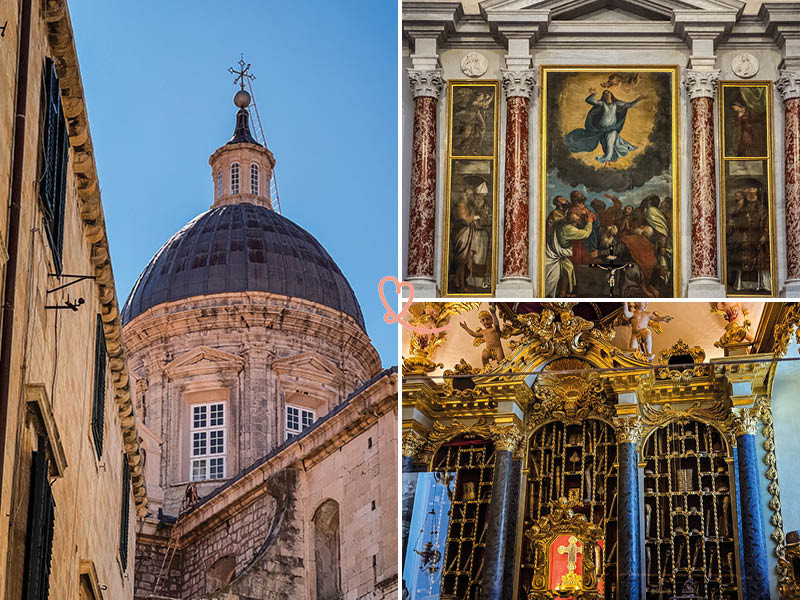
- Its Italian Baroque architecture makes it one of the finest examples of this style in the Adriatic, with its monumental façade adorned with Corinthian columns, its three finely profiled portals and its imposing dome .
- Its richly decorated side chapels and, above all, Titian’s masterpiece, the Assumption of the Virgin (1552), enthroned above the main altar.
- Its treasure trove. We were literally blown away by this richly Baroque room, which houses over 150 reliquaries and goldsmith’s objects dating from the 11th to the 17th century. The gilded reliquaries of the skull, arm and leg of St. Blaise, inlaid with precious stones, and the precious relic of the True Cross are among the most exceptional treasures of sacred art on the Adriatic.
It’s one of the city’s top attractions.

WHERE TO STAY IN Dubrovknik
Our favorites: neighborhoods and hotels
Old Town –
Hotel Villa 5DB – check photos and availability
Lapad and Babin Kuk –
Hotel Royal Neptune – check photos and availability
North Shore –
Hôtel Ninon Bed & Breakfast – check photos and availability
Ploče District –
Excelsior Hotel – check photos and availability

What is the Assumption Cathedral famous for?
Dubrovnik Cathedral owes its renown to several exceptional aspects. It is home to major artistic treasures, including Titian’s polyptych of the Assumption of the Virgin around 1552, considered one of Croatia’s greatest works of art. But it is above all its treasure trove that makes the building world-famous: this exceptional collection of sacred silverware includes unique Byzantine and Norman pieces, notably the 11th-century reliquaries of St. Blaise (the town’s patron saint), attributed to the royal workshops of Palermo. The 10th-century gold staurotheque containing a fragment of the True Cross is the most valuable Byzantine liturgical object in precious metals preserved in Croatia. William Shakespeare himself is said to have referred to Dubrovnik and its famous reliquaries in his comedy Twelfth Night.

Our favorite
Beyond the dazzling reliquaries and precious goldsmith’s objects, it was the décor of the treasure room itself that really captured our attention. Look up: the ceiling is covered with exceptionally rich Baroque gold stucco, creating a theatrical atmosphere.
The stucco ornaments unfurl like plant branches gilded with gold leaf, elegantly framing the allegorical painting created by Matejević in the 17th century.
Against a deep blue sky, angels seem to float in an upward motion.
Two medallions with biblical inscriptions in Latin reinforce the spiritual message, such as “The Lord guards all their bones” or “O death, where is your victory?”. This Baroque conception of the treasury, finalized during its renovation in 1721, transforms the space into a veritable spiritual center where art, architecture and relics interact to illustrate victory over death and the promise of eternal life.

History in brief
- 7th century: Construction of a Byzantine basilica, the remains of which were discovered during archaeological excavations beneath today’s cathedral.
- Medieval period: Construction of a Romanesque cathedral, whose funding legend attributes to the English king Richard the Lionheart, who was saved from a shipwreck near the island of Lokrum.
- 1667: A devastating earthquake destroys the Romanesque cathedral.
- 1671-1713: Construction of today’s Baroque cathedral under the direction of Italian architects from Rome and Venice, including Andrea Buffalini and Paolo Andreotti.
- 1721: Opening and renovation of the Cathedral Treasury, which receives its current Baroque presentation with ceiling paintings by Matejević.
- 1806: Enrichment of the Treasury with relics from the abolished monasteries of Dubrovnik.
- 1992: During the siege of Dubrovnik during the Croatian War of Independence, the cathedral suffered damage that was later restored.
- Today: The cathedral is one of Dubrovnik’s most visited monuments and houses one of Croatia’s most precious treasures of sacred art.

How to find us: Dubrovnik Cathedral
Where is Uznesenja Blažene Djevice Marije Cathedral?
The cathedral is located at 1, Ul. kneza Damjana Jude, in the heart of Dubrovnik, just a 3-minute walk from Dubrovnik’s Old Port.

How to get there?
From the city’s two main entrances (Ploce Gate and Porta Pile), the cathedral is just a 5-minute walk away. We therefore advise you to get to the old town by car or public transport and then do the rest on foot.
Access is easy from Rue Stradun, but there are several steps up to the cathedral entrance.
OUR ADVICE FOR RENTING YOUR CAR AT Croatia
- Compare prices on our preferred platform: DiscoverCars – one of the best rated sites.
- Choose a car that is powerful enough (the roads are steep) but compact (some passages are narrow).
- There is a lot of demand, book it early.


See our tips (coming soon)
Parking
As the cathedral is located in the pedestrian zone of the old town, there is no reserved parking for visitors. You’ll need to find out about the parking lots at the entrance to the town.
Useful tips: duration, schedules, eating…
Best moment
The cathedral is a must on Dubrovnik’s tourist circuit, so there will always be a few people in the building during your visit. To avoid the crowds, it’s best to visit early in the morning or at the end of the day.

Length of visit and main difficulties
Allow between 30min and 1h for an attentive tour of the cathedral. The route is free and the traffic flowing, making it easy to explore. Please note that the cathedral does not have an elevator, and several steps must be climbed at the entrance. Decent dress is recommended, with shoulders and knees covered.
A LITTLE MORE patience
All the photos, maps, information and addresses you need to make your stay in Croatia a success will soon be available in a single ebook!

Advice on how to visit
We recommend you start by exploring the richly decorated façade, then visit the chapels in the nave. Finish off in the treasure room, home to over 150 reliquaries and precious objects. A self-guided tour lets you admire the altars and Titian’s polyptych at your own pace.

Visiting the Cathedral with children
The site is not especially child-friendly, with no dedicated areas or specific activities. However, curious children will be fascinated by the baroque sculptures and colorful paintings.

Cathedral opening times and prices
Dubrovnik Cathedral is open from 8am to 7pm on weekdays, and from 11:30am on Sundays.
While access to the cathedral is free, a visit to the treasure trove requires a supplement of €4 (cash only) and shoulder coverings.
More information on the official website here.

Guided tours
You can visit the cathedral on a self-guided tour. Mediation booklets are available for a fee at the entrance to the treasure to enhance your discovery.
It’s best to contact the tourist office directly, as many organizations offer guided tours of the old town, including various historic sites.

Restaurants near Dubrovnik Cathedral
The cathedral is located in the heart of the historic center, surrounded by numerous cafés and restaurants. Just behind the cathedral, we recommend the excellent Taj Mahal Restaurant. For more choice, check out our selection of the best places to eat in Dubrovnik.

Understand the history and fascinating architecture of the Cathedral
A building in the center of Dubrovnik’s old town
The Cathedral of the Assumption of the Blessed Virgin Mary is located in the center of Dubrovnik’s old town. You won’t want to miss its baroque dome, which rises with great panache above the city’s rooftops. You’ll be able to see it as soon as you arrive at the port, but the best vantage point is undoubtedly from Dubrovnik’s ramparts, to admire the building in its entirety.

Admire the Cathedral from the outside
The cathedral’s exterior captivates with its Italian Baroque style, the work of architects from Rome and Venice. The cathedral rises majestically on a seven-step staircase. Its forecourt opens onto three finely profiled portals, framed by two rows of Corinthian columns and pilasters with carved capitals.
The richly decorated façade features remarkable stone statues: St. Blaise on the right, St. Joseph on the left, and Korčula-born sculptor Martin Radica.
Take the time to look around the building: its sober sides and side doors bear witness to an architecture designed to combine grandeur and balance.

Legends and archaeological discoveries beneath the Cathedral
Legend has it that the previous Romanesque cathedral was built thanks to a donation from the English king Richard the Lionheart. He is said to have made a vow after being rescued from a shipwreck on the island of Lokrum. This story adds a mysterious aura to the building, arousing the curiosity of visitors.
Beneath the present-day cathedral, excavations have revealed the remains of a 7th-century Byzantine basilica, a tetraconical memorial chapel and an ancient defensive wall. These historical strata bear witness to the multiple eras that overlap here, offering a veritable journey through time.

DISCOVER Dubrovnik

Explore the wonders of the Cathedral
Discover the works in the chapels
The cathedral’s interior reveals a succession of richly decorated side chapels. Each houses altars and paintings by Italian and Dalmatian masters, illustrating the cultural links between Dubrovnik and the great cities of the Mediterranean. Visitors can admire colorful altarpieces, frescoes and religious sculptures that enrich the spirituality and beauty of the site.
For our part, we particularly appreciated the high altar of St. John Nepomuk, considered one of Dubrovnik’s finest marble altars. It was commissioned in Vienna and completed in 1778. Take a look at its particularity: violet marble and, above all, its workmanship: between niches, statues and columns!

Titian’s masterpiece: The Assumption of the Virgin Mary
After exploring the various chapels, approach the church choir and take time to observe the work of art that sits above the main altar. This is the The Assumption of the Virginpainted by Titian around 1552. This polyptych, commissioned especially for Dubrovnik, is considered one of the city’s greatest artistic treasures. Its vibrant composition, intense light and Baroque dynamism captivate visitors and bear witness to the city’s artistic influence during the Renaissance.

The Cathedral treasure: a journey to the heart of the relics
Finally, we strongly urge you to pay the extra fee (€4) to discover the Cathedral’s treasure. We were blown away by the abundance of decoration in this room! In addition to the stucco decoration, the room houses over 150 reliquaries and goldsmith’s and silversmith’s objects dating from the 11th to 17th centuries.
Among the most remarkable pieces are the gilded arm, leg and skull of Saint Blaise, Dubrovnik’s patron saint, inlaid with precious stones. There is also a relic of the True Cross, as well as icons and liturgical vessels of exceptional finesse. These treasures bear witness to the spiritual importance of the city and its links with the great Christian centers of the Mediterranean.

Subscribe to our Newsletter
- Get away from it all with Region Lovers’ beautiful destinations!
- Once a month
- Advertising-free

Frequently asked questions
Can I attend a mass in Dubrovnik Cathedral?
Yes, the cathedral is still an active place of worship, with many celebrations.
We wondered how the magnificent organ above the entrance portal could sound.
The feast of Saint Blaise (Sveti Vlaho), on February 3, is undoubtedly the most important religious event in Dubrovnik. The city’s patron saint is celebrated with great solemnity, processions and a special mass where the relics are exhibited.
Find out more directly on the parish website here.

Where is the best place to admire Assumption Cathedral?
If you climb the ramparts of Dubrovnik, you’ll get a great low-angle view of the cathedral, but in our opinion, the best view is from the sea. If you’re lucky enough to go on an excursion, be sure to look back towards the port and see the imposing silhouette of the cathedral behind the walls.