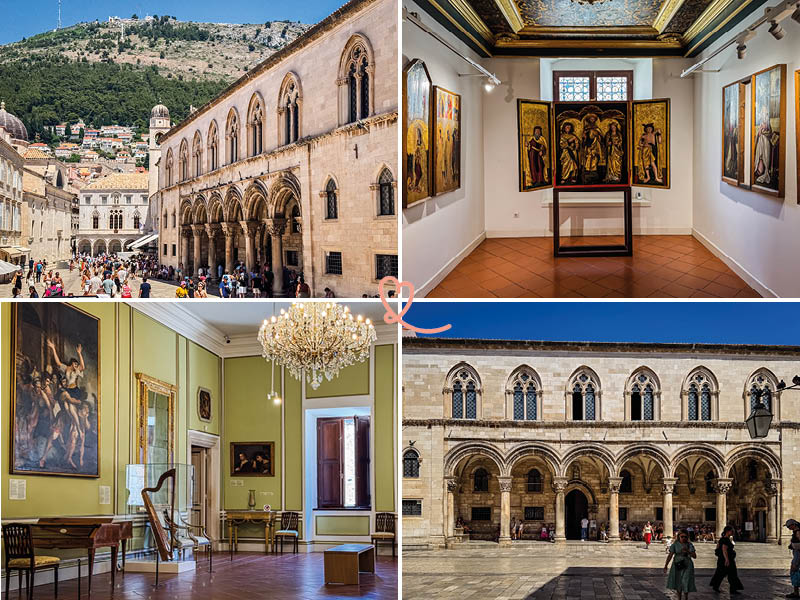
In the heart of Dubrovnik’s old town, the Rector’s Palace is one of the most emblematic monuments of the former Republic of Ragusa. Formerly the residence of the rectors who governed the city, it elegantly combines several architectural styles and today houses the Dubrovnik History Museum.
Behind the magnificent Renaissance façade lies a magnificent and varied collection of furniture, paintings and many other curiosities in a refined atmosphere.
In this article, you’ll find our useful tips in pictures to help you prepare for your visit to Dubrovnik’s Rector’s Palace and enjoy a memorable experience.
This opinion is completely independent, based on our experiences. We made our own choices, visited the area anonymously, and paid our bills in full.
Why visit Dubrovnik’s Rector’s Palace?
Is the Rector’s Palace worth it? Our opinion:
Absolutely! Dubrovnik’s Rector’s Palace is well worth a visit, not only for the beauty of its architecture, but also for its elegant atmosphere and rich collections. Religious art, period furniture, arms and armor, paintings, glassware and ceramics – there’s something for everyone. For us, it’s one of Dubrovnik’s must-sees!

Why is the Rector’s Palace famous?
Rector’s Palace Dubrovnik is famous for having been the seat of government of the Republic of Ragusa. Most of the administrative offices were located on the first floor for easy access. We were impressed by the room known as the “Raguzina”, the original cabinet of the period, with Rococo details and wood panels dating back to the 18th century.
We’re sure you’ll be equally charmed by this place of art and history!

Our favorite
During our visit, we appreciated the architecture of the palace and the fine collection of paintings, particularly the Italian series from the 17th and 18th centuries. But what most charmed us was the museum’s light. Filtered through the high Gothic windows with their hooped stained glass, we enjoyed its dancing reflections on the terracotta tiled floor!
This end-of-day sparkle really set the pace for our visit…

History in brief
- 14th century: initial construction of the Rector’s Palace, seat of the administration of the Republic of Ragusa (Dubrovnik).
- 1435: Partial destruction of the site following an explosion. Restoration by Onofrio della Cava in late Gothic style. Adoption of the definitive plan with central courtyard and portico.
- 1463: New explosion (arsenal) – west facade damaged. Restoration work carried out by Juraj Dalmatinac and Michelozzo of Florence.
- 1667: Earthquake – major damage. Addition of the Baroque grand staircase.

Access: Rector’s Palace, Dubrovnik
Where is the Rector’s Palace?
The Rector’s Palace is located at 3, Ul. Pred Dvorom, in the heart of Dubrovnik’s old town.

How to get there?
The easiest way to reach the Palace is on foot from the historic center, via Via Stradun.
The site is a 5-minute walk from Porta Pile, one of the city’s main gateways.
Parking
The Rector’s Palace has no dedicated parking facilities for visitors.
It is advisable to park in public parking lots outside the old town and to walk to the museum.
OUR ADVICE FOR RENTING YOUR CAR AT Croatia
- Compare prices on our preferred platform: DiscoverCars – one of the best rated sites.
- Choose a car that is powerful enough (the roads are steep) but compact (some passages are narrow).
- There is a lot of demand, book it early.


See our tips (coming soon)
Useful tips: duration, schedules, eating…
Best time to visit
The Dubrovnik Rector’s Palace can be visited all year round.
To avoid the crowds and make the most of the site, it’s best to arrive as soon as it opens or in the late afternoon. You can see the predicted number of visitors to the palace on the city’s website here.
Also note that the palace is not air-conditioned, so it’s best to visit in the morning during hot weather.
Length of visit and main difficulties
Allow 1 hour for a standard visit, and up to 2 hours for enthusiasts.
Toilets are available near the entrance.
With regard to the difficulties of visiting, note that there are several staircases to climb up and down, and that the rooms have little seating, which can be tiring for some people.

Advice on how to visit
We recommend that you follow the suggested itinerary.
After admiring the exterior façade, you start with the rooms containing the religious collection, the prison and the atrium.
You can then take a tour of the mezzanine floor, where small items from the collection are displayed (measuring tools, coins, medals, silver objects, weapons).
The second floor is the most beautiful part of your visit, with the ceremonial rooms and the painting collection.
Finally, the second floor houses the Clock Tower mechanism and sometimes temporary exhibitions. Don’t forget to take a look at the boutique at the end of your visit!

Visiting with children
The Rector’s Palace is not particularly suitable for young children. However, they’ll love the virtual reality dots.
Schedules and rates
- Open daily (closed Mondays) from 9:00 am to 6:00 pm from April to October, then from 9:00 am to 4:00 pm from November to March.
- Prices: €15 for adults, €8 for schoolchildren and students
- Access included with Dubrovnik Card.
We strongly advise you to book your ticket in advance.
Guided tours
We haven’t spotted any guided tours on offer, but you can download a free audioguide onto your phone. Each room is clearly and precisely explained, and the focus on certain works allows you to delve deeper into the richness of the collections.
In the galleries, you’ll also find additional mediation material.

Catering
You’ll find a few tables to relax at, and there’s a range of drinks and snacks on offer. However, we can’t recommend enough that you book a table at the TajMahal Restaurant, a veritable institution, just a 2-minute walk from the Palace!

Discover the fascinating architecture of the Rector’s Palace
Dive into Gothic, Renaissance and Baroque styles
Built in the 14th century, Dubrovnik’s Rector’s Palace is a perfect illustration of the evolution of architecture in Dalmatia. Both the seat of political power and the official residence of the Rectors of the Republic of Ragusa, it has stood the test of time.
Take time to observe the details of the façade! On the first floor, a series of Gothic arches resting on massive columns create an open gallery. Finely carved capitals already introduce Renaissance touches, visible in the delicate decorative motifs. Upstairs, the facade is adorned with geminated ogival windows, each framed by slender colonnettes and sculpted motifs. We appreciated this impression of lightness despite the sturdiness of the structure!

Admire the majesty of the atrium
Passing through the first rooms, you enter the inner courtyard, the true heart of the palace. Originally, access was not restricted: the atrium served as a public square, animated by daily life, as evidenced by the small fountain beneath the staircase. Today, this solemn space captivates with the elegance of its Gothic arcades and richly sculpted columns, which frame the whole harmoniously. Perfectly preserved, the courtyard retains a timeless atmosphere and remarkable acoustics, so much so that it still regularly hosts concerts and cultural events.

And discover the palace’s other sights…
Beyond its majestic halls, the Palais du Recteur holds many surprises in store. We discovered the former prison cells, a vivid reminder of the place’s judicial role, as well as some superb chests whose intricate mechanisms illustrate the ingenuity of the period.

The chapel, with its elegant vaulted ceilings and contemplative atmosphere, contrasts in intimacy with the large performance spaces. And then there are those little details that make all the difference, like the staircase handrails held in place by hands carved in stone!

Explore the interior of the Rector’s Palace and its rich collections
The secrets of state rooms and private apartments
A tour of the palace’s various rooms reveals the extent to which the building blended official functions with private life. The antechamber and audience room recall the political role of the rector, who received ambassadors and advisors here. Further on, the private apartments reveal a more intimate setting, elegantly furnished.
Our favorite is the rector’s bedroom, recreated with refined 18th-century furnishings: four-poster bed, elaborate chests of drawers and imposing mirrors. It’s easy to imagine the rector, whose term of office lasted just one month, regretting leaving the premises!

The Dubrovnik History Museum’s varied collections
Today, the Rector’s Palace houses the Dubrovnik History Museum, whose collections reflect the wealth and trade of the former Republic of Ragusa. Here we discover an astonishing variety of objects: Chinese porcelain and vases imported via the sea routes, coins minted in Dubrovnik, weapons and armor reminiscent of the city’s military might, and a series of paintings ranging from religious art to portraits of notables. While each room offers its share of discoveries, we particularly enjoyed the paintings by the Italian school of the 17th and 18th centuries!

An educational museum and a VR experience to take you further
Visits to the Rector’s Palace are accompanied by a meticulously-designed mediation service, with labels in Croatian and English that explain the provenance of objects and clarify the interpretation of certain paintings. For further information, there’s an audioguide available directly on your phone, offering clear, detailed commentary. We also tried out the 4D experience: by scanning the “AR” panels, characters from the past appear in augmented reality – the rector, his wife and the inhabitants of Ragusa – who recount fragments of their daily lives, bringing the history of the palace to life. While this addition is more playful than immersive, it does offer an original touch.

Subscribe to our Newsletter
- Get away from it all with Region Lovers’ beautiful destinations!
- Once a month
- Advertising-free

Frequently asked questions
Is the Rector’s Palace included in the Dubrovnik Pass?
Yes, the Rector’s Palace is included in the Dubrovnik card.
This card provides easy access to many of the city’s attractions.
Find out more on the official website here.
Which works are not to be missed?
Among the works of art to be discovered in the Palace, you can first take an interest in the statue of Miho Pracat in the atrium. Created by sculptor P. Giacometti in 1628, it is the only public monument that the Republic has erected for a deserving citizen.
In the apartments, you’ll see fine paintings by Pietro da Cortona dating from the 17th century. Finally, on the first floor, you won’t be able to miss twoRenaissance bronze statues, automata known as “the Greens”, which once struck the hours on the town’s bell tower. They were cast around 1478, most probably in the workshop of Michele di Giovanni from Fiesole in Dubrovnik.