Immerse yourself in the world of Dubrovnik’s Museum of Red History, a unique place dedicated to the complex history of the former Yugoslavia. This unique museum retraces the history of communism in Croatia through an interactive scenography featuring documents, photos, multimedia and the striking reconstruction of a period house.
An immersive and surprising visit not to be missed!
In this article, you’ll find some useful tips to help you prepare for your visit to Dubrovnik’s Red History Museum.
This opinion is completely independent, based on our experiences. We made our own choices, visited the area anonymously, and paid our bills in full.
Why visit the Red History Museum
Is the Red History Museum worth it? Our opinion:
Yes, the Red History Museum in Dubrovnik is well worth a visit. This private museum, housed in the former ‘TUP’ graphite factory, offers a unique immersion in the history of former Yugoslavia between 1945 and 1991. Its interactive and immersive scenography, with multimedia devices and a stunning reconstruction of a house, particularly appealed to us.

Why is the Red History Museum famous?
The Red History Museum is particularly renowned for shedding light on the history of communism in Croatia. Much more than a simple collection of photographs and period objects, it offers a real immersion in the atmosphere of the Communist years, with the reconstitution of a house.
A gripping experience that really gives you the impression of traveling back in time!

Our favorite moment
While we enjoyed the museum’s immersive tour as a whole, one feature in particular made a deep impression on us: the one devoted to Goli Otokthe infamous prison island of the Communist era. Built by Tito in 1949, this desert island served as a forced-labor camp for political opponents accused of pro-Soviet sympathies. Thousands of men were imprisoned in extreme conditions.

The museum’s scenography plunges visitors into a dark room, immediately reminiscent of the austerity of a cell. Two narratives confront each other: that of a former inmate, describing with emotion the violence he endured; and that of Jovo Kapicic, the camp’s first governor, who coldly defends the institution’s “reeducational” mission.
This striking confrontation, between real-life pain and official justification, leaves the visitor shaken.
History in brief
The museum is housed in the former ‘TUP’ graphite factory, founded in 1953 in Dubrovnik. This industrial site played a key role during the socialist period and the Croatian War of Independence.

Access: Red History Museum, Dubrovnik
Where is the Red History Museum?
- The museum is located at 3 Svetog Križa Street in Dubrovnik, Croatia.
- It is located in the Gruž district, close to the city’s main port.

How to get there?
The Red History Museum can be reached on foot in 30 minutes from Dubrovnik city center.
By car, the journey takes just 10mins, making access much easier.
Otherwise, several bus routes serve the museum, including routes 1A, 1B, 1C, 3, 3A, 7 and 8.
Parking
The museum doesn’t have reserved parking, but you can try parking in the adjacent streets or you’ll find spaces at the Srđ shopping center, a 2min walk from the museum.
OUR ADVICE FOR RENTING YOUR CAR AT Croatia
- Compare prices on our preferred platform: DiscoverCars – one of the best rated sites.
- Choose a car that is powerful enough (the roads are steep) but compact (some passages are narrow).
- There is a lot of demand, book it early.


See our tips (coming soon)
Useful tips: duration, schedules, eating…
Best time to visit
Dubrovnik’s Red History Museum can be visited all year round without any problems. As the museum is located away from the historic center, crowds are kept to a minimum and the visit is very quiet.
Extended opening hours from 9:30 am to 8:30 pm make for flexible visits, even at the end of the day.
Length of visit and main difficulties
Allow 1 to 2 hours for a complete visit of the Red History Museum, to allow time to read most of the explanatory panels. And don’t forget to visit the gift store for some original souvenirs! Most of the items are made by local producers.
With regard to PRM accessibility, please note that the toilets are located outside, on the first floor, and that some panels and manipulations are at a height, which can complicate the visit. There is no left-luggage or luggage-storage service on site.
Also note that it’s very hot in this museum, so bring a fan if you’re coming in summer.

Advice on how to visit
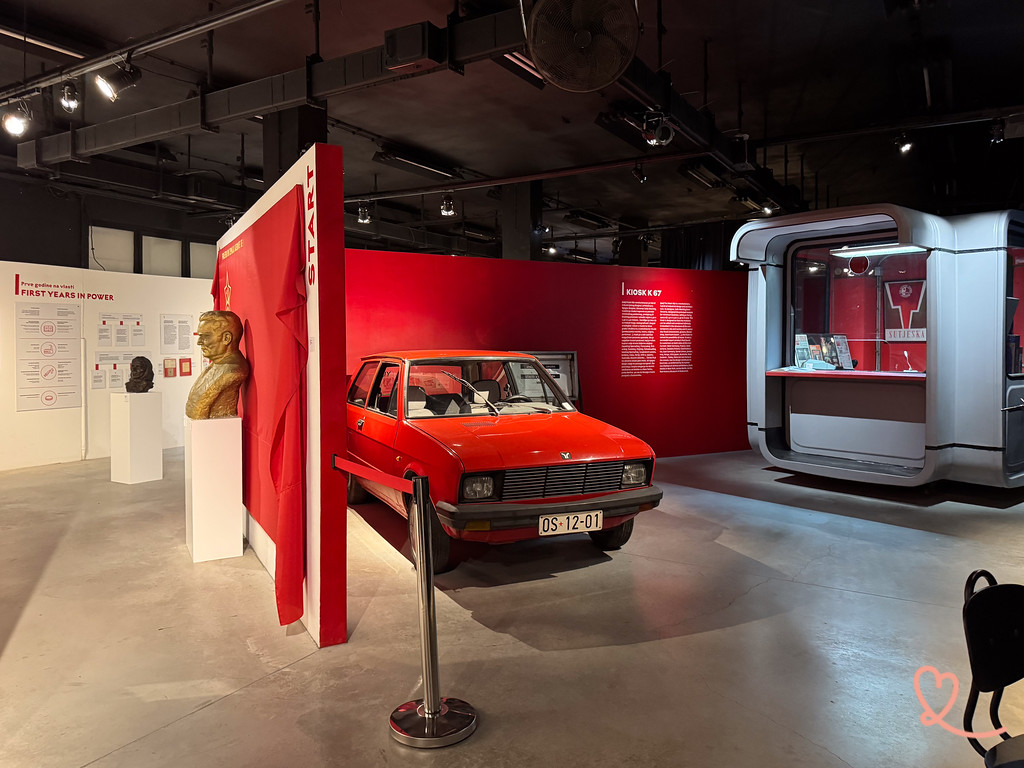
There’s only one way to visit! You’ll follow a well-marked itinerary. You’ll start in the history room, then explore a reconstructed period house, before moving on to darker areas devoted to conflict. Finish with the secret service room and the virtual reality experience in kiosk K67.
Finally, there’s a temporary exhibition room and other buildings where you can discover works by amateur artists.

Visiting with children
Your children are sure to love wandering around the reconstructed house! They’ll particularly enjoy handling certain objects and dipping into the bowl of sweets available to visitors. However, the density of the texts and the complexity of the themes can be complex for young visitors. You’ll need to accompany them as they explore the museum.

Schedules and rates
- Opening hours: open daily from 9:30 a.m. to 8:30 p.m., last entry at 7:45 p.m.
- Rates: €9.00 (full adult rate), €3.60 (students), free for children under 10 years of age.
Find all the latest information on the official website here
Guided tours
The museum does not yet offer guided tours, but you can use an audioguide application on your phone. This application translates all the panels into several languages, including French, and enriches the experience. Interactive features and videos round off the discovery perfectly.

Catering
After your visit, take a break at the Red Bar, which offers a wide range of drinks and snacks.

An edifying museum of Croatian history
Careful documentation of the advent of communism
Dubrovnik’s Red History Museum offers a richly documented immersion in the history of the Communist Party in Croatia. Photographs, everyday objects and period furniture give a concrete insight into life under the regime. The visit begins with a Claire room, organized as a chronological frieze, tracing the major stages of the country’s history.
But the museum doesn’t limit itself to this didactic approach, and the scenography is designed to take visitors on a journey through time. The museum also dares to show the dark side of Communism. An entire room is devoted to the secret services, where the scenography plunges visitors into a heavy atmosphere, to better grasp the violence and surveillance that marked daily life.

Period objects and furniture marking the history of Croatia
Note that the museum’s documentary approach is enriched by multimedia devices that make the visit both educational and immersive: video extracts from period advertisements, political speeches, music… You’ll also discover the Kiosk K67, an icon of socialist design imagined by Slovenian architect Saša Mächtig. Conceived as a 2.40m module that could be reused and combined ad infinitum, it served as a newsstand, a grocery store and a concierge’s lodge. You’ll have the pleasure of entering some of the specimens!

Immerse yourself in everyday life under Communism
Immersive scenography: the reconstruction of a period house
At the Red History Museum, the reconstruction of a typical Communist-era home immediately transports you to another time. Each room has been carefully decorated, and every object is brought to life to show the effects of communism on daily life at the time, from design to customs to decoration.

The immersion is such that you sometimes forget you’re in a museum. Objects become gateways to understanding the period: the role of women, the cult of Tito, social codes… Educational panels accompany the visit, sometimes hidden in cupboards, inviting visitors to actively explore the premises.

The little story in the big story: photos and intimate stories of Croatians
As well as immersing us in the atmosphere of the time, we also enjoyed the “memory tunnel”, a room dedicated to personal photographs donated by Croatian citizens who lived under the Communist regime. These visual and written testimonies bring a deeply human dimension to the history presented. The images capture simple moments of life, sometimes joyful, sometimes heavy, inviting sensitive reflection on this period.

Interactive features for a fun visit
Tactile devices and videos to relive history
Finally, the originality of the Musée de l’Histoire Rouge lies in its interactivity!
Here, visitors become actors in their own discovery: they can handle objects, open cupboards, listen to records on headphones or watch period videos.
We stayed for a long time listening to the hits of the time.
Another amusing wink: you’re offered Kraš Bronhi sweets, accompanied by the ironic slogan “Don’t be a greedy capitalist, have a sweet!

The VR experience to discover the building behind the museum
At the end of the tour, a virtual reality experience invites you to discover the former TUP factory, founded in 1953, which today houses the Red History Museum. This socialist industrial site played a key role in the Croatian War of Independence. The VR headset authentically recreates the atmosphere of this historic factory. You can visualize the buildings and understand their function, enriching your immersion in Dubrovnik’s socialist context and collective memory.

Subscribe to our Newsletter
- Get away from it all with Region Lovers’ beautiful destinations!
- Once a month
- Advertising-free

Frequently asked questions
Is the Red History Museum included in the Dubrovnik Pass?
Unfortunately, the Red History Museum is not included in the Dubrovnik Pass.
What other museums in Dubrovnik deal with Communism and the Croatian War?
In Dubrovnik, several museums deal with recent history, but each from a different angle. The Homeland War Museum, housed in the former imperial fortress overlooking the city, traces the siege of Dubrovnik (1991-1992) through weapons, uniforms and soldiers’ testimonies. While the War Photo Limited, located in the old town, takes a more artistic and universal approach: its photojournalism exhibitions show contemporary conflicts from all over the world, far beyond the Balkans. The Red History Museum stands out for its focus on everyday life and the legacy of communism in the former Yugoslavia.