Behind the elegance of Villa Banac, Dubrovnik’s Museum of Modern Art, nicknamed MOMAD, promises an immersion in Croatian art. Founded in 1945, the museum now houses almost 3,000 works tracing the country’s artistic development from the late 19th century to the present day. With its dynamic temporary exhibitions, rich permanent collections and romantic terrace offering a breathtaking view of the old town, this museum deserves a place on your itinerary.
In this article, discover our useful tips for visiting Dubrovnik’s Museum of Modern Art.
This opinion is completely independent, based on our experiences. We made our own choices, visited the area anonymously, and paid our bills in full.
Why visit Dubrovnik’s Momad?
Is Momad worth it? Our opinion:
Yes! With its immersive tour of Croatian art, the museum offers the perfect cultural counterpoint to the historic Old Town. With nearly 3,000 works spanning the late 19th century to the present day, the museum offers a comprehensive panorama of the Croatian art scene. You can also take advantage of the museum’s terraces and its incredible panorama of Dubrovnik’s ramparts.

Why is Dubrovnik’s Museum of Modern Art famous?
Dubrovnik’s Museum of Modern Art owes its renown to its collection of modern and contemporary Croatian art, built up since 1945. The museum is particularly famous for housing one of the most important collections (77 paintings) by Vlaho Bukovac (1855-1922), the founding father of modern Croatian painting.
The museum also holds works byIvan Meštrović, an internationally renowned Croatian sculptor considered one of the greatest artists of the 20th century. Beyond these major figures, MOMAD stands out for its remarkable documentation of Croatian artistic development over more than a century.

Our favorite
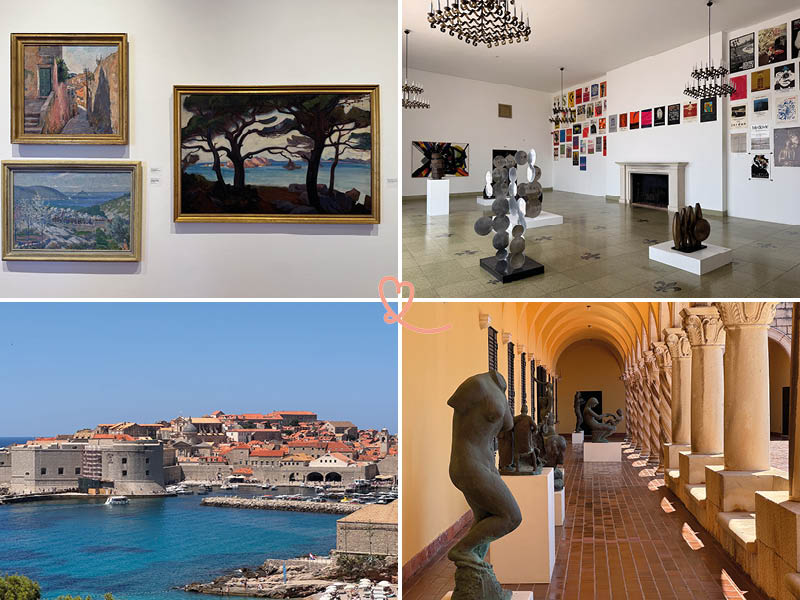
While we were won over by the diversity of the works on display at MOMAD – bucolic paintings, contemporary photographs, bold installations – we particularly appreciated the accessible, fluid nature of the visit. No overloaded explanations. This uncluttered approach allows us to concentrate on what’s essential: the creations themselves. But our real highlight was the unexpected discovery of the museum’s terrace. This enchanting outdoor space features ornate columns, a variety of sculptures and, above all, fragrant wisteria, offering a welcome romantic interlude after a visit to the collections.

History in brief
Here are the museum’s key dates:
- 1935: Construction of Villa Banac in neo-Renaissance style for an aristocratic Dubrovnik family
- 1945: Nationalization of the property after World War II and founding of the Umjetnička galerija Dubrovnik, initially located in the Cerva-Pozza palace.
- 1948: Official opening of the museum in the Villa Banac, dedicated to modern and contemporary art.
- 1991-1995: Damage suffered during the Croatian war of independence
- 2003: Reopening after major restorations

Access: Museum of Modern Art, Dubrovnik
Where is the Museum of Modern Art?
The Museum of Modern Art, or MOMAD, is located at 23 Put Frana Supila in Dubrovnik.
It’s a 10-minute walk from the historic center and just across from Banje Beach.

How to get there?
The easiest way to reach the museum is on foot. From Dubrovnik city center, it’s a 10-minute walk to the museum.
If you’re driving, you can park in the nearby parking lot. Access from a nearby parking lot takes around 11 minutes on foot.
Parking
The museum has no private parking facilities for visitors, and it is not possible to park in front of the museum. Public parking is available nearby, including Parking Dubrovnik at 12 Ul. Bruna Bušića.
OUR ADVICE FOR RENTING YOUR CAR AT Croatia
- Compare prices on our preferred platform: DiscoverCars – one of the best rated sites.
- Choose a car that is powerful enough (the roads are steep) but compact (some passages are narrow).
- There is a lot of demand, book it early.


See our tips (coming soon)
Useful tips: duration, schedules, eating…
Best time to visit
The Musée d’Art Moderne MOMAD is open all year round and is set back from the main tourist routes. So you’ll enjoy a calm, unhurried atmosphere.
If you can, make your visit on a sunny day, to take advantage of the terrace and the small, pleasant terraced garden.

Length of visit and main difficulties
Allow 1 hour for a complete tour of the museum.
PRM access is guaranteed in the exhibition areas, which are quite wide, but some parts of the terrace are difficult to access. Note, however, that several labels are a little high.

Advice on how to visit
The tour is open-ended. We recommend starting on the second floor to discover the permanent collection, then exploring the temporary exhibitions before taking a tour of the terrace, admiring the view of Dubrovnik and the sculpture collection.

Visiting with children
The museum is open to all ages, but does not offer specific activities for children.
Schedules and rates
- Opening hours: Open Tuesday to Sunday, 9am to 8pm (closed on Mondays).
- Price: €10 (full adult price)
- Combined family tickets available at EUR 25 for 3 people.
- Entrance included in Dubrovnik Pass
Find out more on the museum’s official website here.

Guided tours
Guided tours are available by appointment (telephone 020 426 590). We don’t know if they are available in French.
We regret that there is no audioguide service in the museum.
Catering
There are no restaurants in the museum. If you would like to eat, we recommend that you explore the restaurants in Dubrovnik city center, about 11 minutes’ walk away.
However, you will find tables and chairs for relaxing in the museum store.

Discover the historic architecture of Villa Banac
Villa Banac, built between 1932 and 1939, is the former home of Dubrovnik shipowner Božo Banac. This remarkable building, now a historic monument, was built according to the architectural plans of Lavoslav Horvat and Harold Bilinic.
We were captivated by the beauty of its facade, adorned with twisted columns and a variety of elements, combining modern architecture with Gothic or Renaissance details.
Contemplating the villa, one is struck by the masterly treatment of the stone, varying from rustic to completely polished surfaces.

Entering the villa, we discovered generously proportioned rooms that have retained their original character. We particularly liked the large windows in the living room overlooking the terrace, whose natural light sublimates the works of art on display.
The floor paved with fleur-de-lys and the fireplace attest to the power of the former owners. Look out, too, for the wrought-iron interior: metal railings, fireplace grates, decorative mesh frames for lamps and hanging chandeliers designed by sculptor Greta Turkovic (1896-1978).

Immersion in modern Croatian art
The variety of the Momad’s local collection makes for a captivating discovery. We began our tour with works from the academic period, testifying to the European influence on Croatian art. In particular, we were impressed by the romantic landscapes that magnify the beauty of the Adriatic coast with their dramatic skies and changing light.

The section devoted to the inter-war period is particularly striking for its liveliness and boldness. You’ll discover how Croatian artists assimilated Expressionist influences from Central Europe. Colors became more vivid, shapes more geometric, reflecting the questioning of an era of upheaval.
You’ll be intrigued by the formal experiments that anticipate developments in abstract art. And then you’ll have time to discover the contemporary section, which is more eclectic, radical and committed. We regret that there is not more mediation in this area, to better understand the context of the works and their meaning…

Finally, we’d like to mention the room where several paintings come to life thanks to 3D animation. It may seem a bit gimmicky, but we appreciated the museum’s choice to add an immersive touch to the visit! The tone is set to the rhythm of an enchanting song.

Enjoy the outdoors and the panoramic terrace
Finally, you’ll round off your visit to the Momad with a tour of the terraces, a veritable haven of peace. Take a look at the sculpted columns, each adorned with a sign of the zodiac, created by the famous Croatian sculptor Vanja Radaus (1906-1975).
The terrace also houses an exhibition of sculptures commissioned from various Croatian artists – Ivan Mestrovic, Robert Franges Mihanovic, Frano Krsinic, Ivan Lozica, Vanja Radaus, Branko Ruzic and others – between 1964 and 1970.
The sculpted busts and portraits exude a remarkable emotional intensity despite their apparent sobriety. Finally, the dialogue between the dark bronze of the statues, the whiteness of the columns and the yellow of the walls, and the mauve of the wisteria, creates a welcome contrast.

But the highlight is undoubtedly the panoramic view from the terrace. You’ll take in the whole of Dubrovnik’s old town, with its orange-tiled roofs and centuries-old ramparts. We spent a long time identifying the emblematic monuments that dot the skyline, from the bell tower of the cathedral to Fort Lovrijenac perched on its rocky promontory. If you can, plan your visit for late afternoon, when the fading sun gilds the facades and softens the contrasts.

Subscribe to our Newsletter
- Get away from it all with Region Lovers’ beautiful destinations!
- Once a month
- Advertising-free

Frequently asked questions
Does Dubrovnik’s Museum of Modern Art host temporary exhibitions?
Alongside its permanent collection, the museum regularly organizes retrospective, monographic and thematic temporary exhibitions, highlighting both the classics of Croatian modern art and major figures on the national contemporary scene.