Don’t miss a visit to the Zagreb Botanical Gardens. It’s a haven of peace and freshness right in the heart of the Croatian capital. Founded in 1889, this university garden covers more than 5,000m² and is home to over 6,000 plant species, including endemic and rare plants. Its English-style arboretum, Zen garden and water lily basins offer a rich and soothing experience.
In this article, you’ll find our useful tips in pictures to help you prepare for your visit and enjoy a pleasant experience at the Zagreb Botanic Garden.
This opinion is completely independent, based on our experiences. We made our own choices, visited the area anonymously, and paid our bills in full.
Why visit the Zagreb Botanical Gardens?
Is the Zagreb Botanic Garden worth it? Our opinion:
The answer is yes, for several reasons:
- Its vast collection of over 6,000 plant species, including endemic and rare plants, is impressive.
- The garden offers a peaceful ambience, with themed areas such as the water lily pond and the Japanese garden.
- It’s perfect for a 1-2 hour walk.
This tour was one of our favorite activities in Zagreb.

Why is the Zagreb Botanic Garden famous?
The Zagreb Botanical Garden is renowned for its rich botanical collection and city-center location. Founded in 1889, it is one of the oldest university botanical gardens in Croatia, protected as an architectural monument since 1971.
We enjoyed its varied thematic zones, including an English landscape arboretum, a Zen garden, a water lily pond and collections of carnivorous plants… Not forgetting the famous giant water lily from Amazonia, the Victoria amazonica.

Our favorite moments
During our visit, several moments particularly struck us:
- Walking under the trees: it was very hot during our stay in Zagreb and we really appreciated the coolness of the tree-lined paths.
- The Japanese garden: a Zen corner offering a striking contrast to the rest of the garden. Meticulous planting and typical landscaping invite meditation.
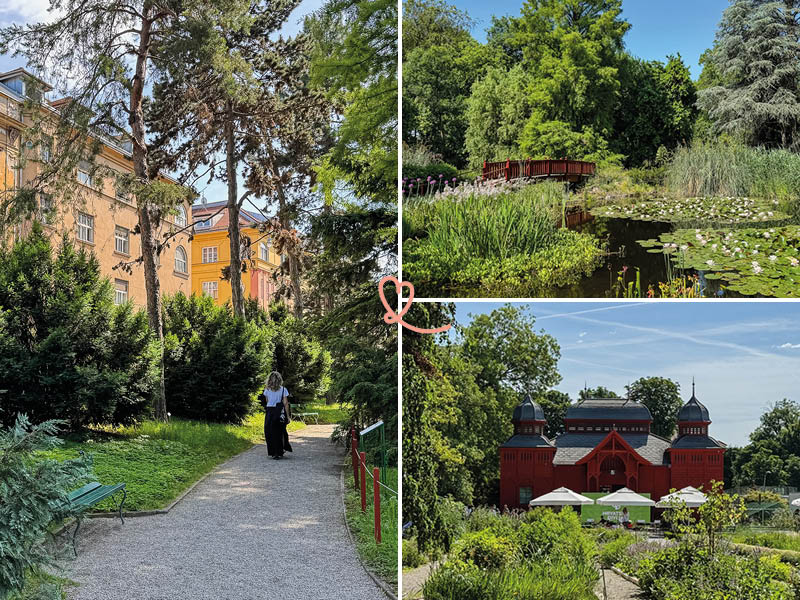
- The water lily basins: linked by a wooden bridge, we enjoyed the peace and serenity of this area. A true haven of peace in the heart of the city.

History in brief
- 1889: Founding of the Zagreb Botanic Garden by Professor Antun Heinz.
- 1948, 1989 and early 21st century: major renovations to preserve and modernize the site.
- 1971: Protection of the garden as an architectural monument.

How to find us: Botanical Gardens, Zagreb
Where is the Botanical Gardens?
The garden is located at 9a Marulićev trg, right in the center of Zagreb, in the lower part of the city.
How to get there?
- The Botanical Gardens are a 25-minute walk from the city center.
- By streetcar, several lines lead to the Botanički vrt stop, 300m from the garden.
- The drive from the city center takes about 7 minutes.
- And why not by bike, there are plenty of rental options in Zagreb.

Parking
- Parking is restricted to surrounding streets and squares.
- The nearest parking lot is near the Hôtel Esplanade.
- Access by car can be complicated by the limited number of spaces available.
- Bicycle parking is available at the entrance, making access more eco-friendly.
OUR ADVICE FOR RENTING YOUR CAR AT Croatia
- Compare prices on our preferred platform: DiscoverCars – one of the best rated sites.
- Choose a car that is powerful enough (the roads are steep) but compact (some passages are narrow).
- There is a lot of demand, book it early.


See our tips (coming soon)
Useful tips: duration, schedules, eating…
Best time to visit
- Spring and autumn are the ideal seasons to visit the Zagreb Botanical Gardens. You’ll enjoy the varied blooms and colors.
- Prioritize weekday visits for a quieter, more enjoyable experience.

Length of visit and main difficulties
- Allow 1 to 2 hours to explore this vast botanical garden of over 5,000 m².
- Signposted trails make it easy to explore the various theme zones.
- The toilets are located near the main entrance.
- The garden is suitable for people with reduced mobility and strollers.
- Please note that bikes and scooters must be left in the racks at the entrance.
- There are no lockers or changing rooms on site.
- Dogs are not allowed.

Advice on how to visit
The tour is free, with no set direction. We recommend you head for the red pavilion to the east, before climbing back up to the west to discover themed gardens such as the Japanese garden and the alpinum.

Visiting with children
The garden is suitable for families with children. Strollers are allowed, and accessible paths make it easy for the whole family to enjoy a stroll.

Schedules and rates
- Opening hours: Monday and Tuesday, 9 a.m. to 2.30 p.m. (last entrance at 2.10 p.m.), Wednesday to Sunday, 9 a.m. to 7 p.m. (last entrance at 6.40 p.m.)
- Winter closure from January to February, as well as some public holidays
- Adult price: €2.00
- More details on the official website here

Guided tours
Guided tours are organized by biology students or garden staff. They enable visitors to discover the botanical collections and the history of the site.
No audioguide available.
Catering
There is no on-site catering at the garden. To eat, you’ll find several restaurants and cafés in downtown Zagreb, close by. To continue the vegetarian experience, we chose to have lunch at Restaurant Zrno Bio Bistro, less than a 15-minute walk from the garden, which offers some fine vegetarian dishes.

A walk between water, shadow and light
Ponds, bridges and soothing reflections
At the heart of the arboretum, the small ponds known as Jezerca, are pretty pools dotted with water lilies, offering a peaceful atmosphere. The wooden bridge linking them invites contemplation.

It naturally reminded us of the Japanese bridge in Claude Monet’s garden at Giverny. The reflections of the water, combined with the meticulous planting, create a subtle play of light that soothes and invites relaxation.

Tree-lined avenues and shaded areas
The garden paths are largely lined with trees, providing shady areas ideal for a quiet, and above all, cool, break. It was very hot during our stay in Zagreb, and we particularly appreciated the shade of the foliage.

The organization of the trees creates vast perspectives where the light gently filters through. Benches scattered here and there allowed us to fully appreciate this peaceful atmosphere, where the cool shade invites us to stroll in complete serenity.

Discover the greenhouses and emblematic sites
Regional collections and specimens from elsewhere
The Zagreb Botanical Garden houses an exceptional collection of over 6,000 plant species. Here you’ll find carefully cultivated Croatian endemics and rarities, as well as species from other parts of the world. We spotted a Wollemia Nobilis, a conifer native to Australia.

You won’t want to miss the aquarium-like exhibition greenhouses, where you can see sensitive and exotic plants, including carnivorous plants. These spaces allow you to observe rare specimens in a controlled environment, promoting scientific research and conservation.

Flowerbeds and seasonal varieties
The garden features numerous themed zones, including a Japanese Zen garden, an alpinum and a simple garden. Each season offers a different spectacle, with spring and autumn blossoming in particular. Summer was already well underway during our stay, and we missed out on the lovely spring colors.

An open-air botanical voyage
Tropical universe and rare species
We also found a number of greenhouses which, unfortunately, we were unable to enter. They house rare exotic plants, recreating the ideal conditions for their preservation.

At the center of the garden, one of them, Victoria’s House, caught our eye. Circular in shape, it has been specially designed to house a botanical treasure: the Victoria amazonica, a protected giant water lily native to Amazonia.

The red pavilion and other curiosities
The red pavilion, at the eastern end of the garden, is a real visual landmark, immediately catching the eye with its brilliant color. It is a venue for various exhibitions and events. It was in fact privatized at the time of our visit. We were unable to enter.

But there are many other fascinating sights, such as the Park u Vrtu‘s finely carved woodwork, punctuated with motifs. And at the far end of the garden, we spotted a huge painted wall. A bridge and trees are depicted, creating a poetic perspective that extends the space and enriches the walking experience.

Subscribe to our Newsletter
- Get away from it all with Region Lovers’ beautiful destinations!
- Once a month
- Advertising-free

Frequently asked questions
What do the plaques on the garden benches tell us?
The plaques on the benches in Zagreb’s Botanical Garden reflect the restoration efforts and donations that support the garden’s upkeep. It is possible to adopt a bench in exchange for a donation, and have a plaque affixed to it.

Are there any secret corners in the garden?
Yes, the garden has its quiet corners, especially around the small ponds called Jezerca. We also found a gazebo where we could take refuge out of sight.