Do you know Split’s St. Domnius Cathedral, a religious jewel nestled in the heart of Diocletian’s Palace? This architectural masterpiece houses the former mausoleum of Emperor Diocletian, transformed over the centuries into an iconic place of worship.
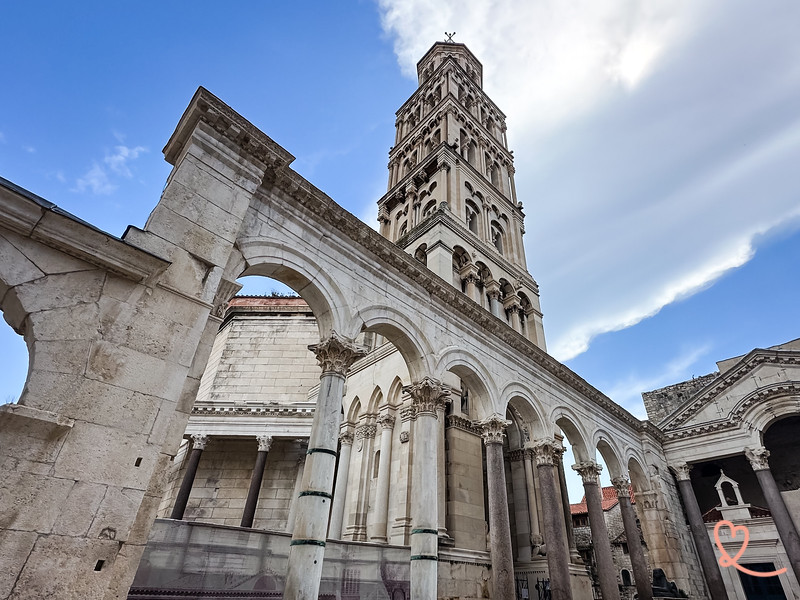
Facing the Peristyle, the cathedral’s elegant silhouette and slender campanile tower can be seen from almost anywhere in the old town. As you stroll through the cobbled streets, it’s impossible not to look up at this tower that dominates Split’s skyline. We fell in love with the panoramic view from its steeple – an experience not to be missed!
In this article, we share our practical tips and our best photos to help you prepare your visit and make the most of this site steeped in history and emotion.
This opinion is completely independent, based on our experiences. We made our own choices, visited the area anonymously, and paid our bills in full.
Why visit Split Cathedral?
Is Split’s St Domnius Cathedral worth it? Our opinion:
St. Domnius Cathedral is definitely worth a visit. It’s one of Split’s must-sees. We were impressed by the historical and architectural richness of this majestic religious edifice. It’s a place where the Roman past and the Christian faith blend harmoniously, creating an atmosphere both solemn and fascinating. To enter the cathedral is to step back in time to the time of Emperor Diocletian, while admiring the transformation of his mausoleum into a sacred edifice.
The campanile, with its slender columns, remains for us one of the highlights of the visit. The climb may seem a little steep, but the reward is worth it: a spectacular view of Split, the port and the surrounding mountains. The panorama alone is worth the detour!

Why is Split Cathedral famous?
Split’s St. Domnius Cathedral is famous above all for its exceptional origin: it occupies the former mausoleum of Emperor Diocletian, one of the few examples in the world where the tomb of a Roman emperor has been transformed into a Christian church. This contrast between imperial grandeur and religious fervor makes it a deeply symbolic place.
The cathedral is also distinguished by its rich detailing: carved wooden doors from the XIIIᵉ century, finely decorated altars, and bas-reliefs recounting the life of St. Domnius, Split’s patron saint. These elements testify to the skill of Dalmatian craftsmen and the artistic continuity between Roman and medieval times.

Our favorite moments
During our visit, we were particularly struck by several moments:
- Climb to the top of the bell tower of St. Domnius Cathedral: the view over the old town and the Adriatic Sea is nothing short of spectacular. This is undoubtedly one of Split’s most beautiful vantage points!
- Admire the interior architecture of the church building, which exudes sober elegance with its harmonious dome, richly decorated altars and the recumbent statue of St. Domnius, protector of the city.
- Visit the crypt of Saint Lucia: the calm, solemn atmosphere, enhanced by the miraculous spring, invites reflection. We enjoyed this more intimate and introspective moment.

History in brief
St. Domnius Cathedral has its origins in the mausoleum of Emperor Diocletian, built in the early IVᵉ century at the heart of the palace he had built in Split. Transformed into a Christian church around 650, this unique site perfectly illustrates the transition from Late Antiquity to the Middle Ages. Over the centuries, the cathedral has been enlarged and embellished: the campanile, erected between the XIIIᵉ and XVIᵉ centuries in Romanesque style, still dominates the city’s rooftops; the walnut entrance door carved by Andrija Buvina in 1214 (a 13th-century sculptor), and the high altar built between 1685 and 1689, bring a Baroque touch to the whole.
Today, the cathedral remains a true symbol of the city, bearing witness to its rich imperial and religious past. Beneath its floor, the crypt of Saint Lucia houses a miraculous spring, offering a place of contemplation imbued with mystery and serenity, a tangible link with the Middle Ages.

How to get there: St. Domnius Cathedral, Split
Where is the cathedral?
The exact address of St. Domnius Cathedral is: Ul. Kraj Svetog Duje 3 in Split (Croatia). Here are some spatial reference points:
- In the heart of the old town
- Inside Diocletian’s Palace
- Facing the Peristyle of Diocletian’s Palace
- The Vestibule of Diocletian’s Palace
- 2min walk from Split Ethnographic Museum
How to get there?
St. Domnius Cathedral is within easy reach of the historic heart of Split. As you stroll through the old town, you’ll soon come across the Peristyle of Diocletian’s Palace, dominated by the cathedral’s bell tower.
If you’re coming from outside the city center, the most convenient way to get here is by public transport: the “PAZAR 2” bus stop is just a few minutes’ walk away. Find out more about available routes here.
We do not recommend access by car, as the palace is entirely pedestrianized. You’ll need to park in one of the parking lots outside the old town, then walk to the cathedral. This walk through the cobbled streets adds to the charm of the visit.

OUR ADVICE FOR RENTING YOUR CAR AT Croatia
- Compare prices on our preferred platform: DiscoverCars – one of the best rated sites.
- Choose a car that is powerful enough (the roads are steep) but compact (some passages are narrow).
- There is a lot of demand, book it early.


See our tips (coming soon)
Parking
St. Domnius Cathedral has no parking facilities, as it lies in the heart of the Diocletian’s Palace, an entirely pedestrian zone.
We do not recommend parking in the parking lots at the entrance to the historic area, as they are very expensive. Opt instead for the parking lot at Istarska ul., a 4-5 minute walk away.
Useful tips: duration, schedules, eating…
Best time to visit
The best time to visit St. Domnius Cathedral is around spring and autumn, when the weather is pleasant and the crowds reasonable. To get the most out of the site, it’s best to visit early in the morning, just after the cathedral opens: the soft light illuminates the bell tower and the Peristyle of Diocletian’s Palace, creating the ideal atmosphere for photos.
At the height of summer, in July and August, the cathedral stays open late, but the crowds are much greater. In this case, you’ll need to be patient to explore the different areas and enjoy the climb to the bell tower.

Length of visit and main difficulties
For a complete tour of St. Domnius Cathedral, including the bell tower and St. Lucia crypt, allow 45min to 1h. If you also wish to explore the Cathedral’s Treasure Museum, allow a further 45min to 1h.
Some areas are difficult to access. The bell tower and crypt are not accessible to wheelchair users, as the stairs are narrow and steep. Claustrophobic visitors may also feel uncomfortable in these confined passages. Even to enter the church, you have to negotiate a row of steps, making access more complex for visitors with mobility difficulties.

Advice on how to visit
The tour itinerary will depend on the type of ticket you choose: some include the Crypt of Saint Lucia, the Bell Tower, the Cathedral Treasure Museum and the Temple of Jupiter (Baptistry of Saint John the Baptist), while others allow only partial access. It’s up to you to decide whether you want to take the full tour or just explore certain areas.
In general, the tour is self-guided and begins at the Peristyle of Diocletian’s Palace, where you can observe the cathedral’s main façade. If you opt for the full tour, we recommend starting at the bell tower, for an exceptional panoramic view of Split and the Adriatic Sea. Then head inside the building to explore the nave and chapels, finishing with the Crypt of St. Lucia and the Treasure Museum if you’re a fan of sacred art. To round off your visit in style, don’t forget to pass through the vestibule of Diocletian’s Palace, which adjoins the cathedral.

Visiting with children
St. Domnius Cathedral is a must-see for the whole family in Split, offering spectacular views and an insight into the city’s history and architecture. There are no play areas or interactive activities, but curious children who can walk well will particularly appreciate the climb to the bell tower, which rewards the effort with a breathtaking view of the old town and the sea. To keep the visit enjoyable for all, plan a suitable pace and keep an eye on the narrow stairs to the campanile and St. Lucia crypt. This experience allows children to combine culture, discovery and panorama, while sharing a unique family moment.

Schedules and rates
Schedules:
The cathedral, bell tower, crypt and baptistery are open from 8am to 4pm Monday to Saturday, while the Cathedral Treasure Museum is open from 9am to 4pm. On Sundays, the cathedral and bell tower are open from 12pm to 6pm, while the crypt, baptistery and Cathedral Treasure Museum are open from 10am to 6pm. Last entry 30min before closing time.
Rates:
Several combined ticket formulas exist, depending on the areas you wish to visit, with prices ranging from €9 to €15:
- Cathedral
- Bell tower
- Crypt
- Baptistery
- Treasury Museum
You can also visit the cathedral alone for €5. Children under 13 are free, making it easy for the whole family to visit.

Guided tours
Many guided tours of Diocletian’s Palace include a detour in front of St. Domnius Cathedral, but they don’t usually allow you to go inside. You’ll hear fascinating historical accounts of the transformation of Diocletian’s mausoleum into a Christian church, but you’ll need to buy your own ticket to explore the building on your own.
>> Book your walking tour of Diocletian’s Palace here <<

Catering
The cathedral is located in the heart of the old town, surrounded by numerous restaurants and cafés. You’ll easily find options for all tastes, from quick meals to more refined dining. For a gourmet break, explore the alleyways around the Peristyle of Diocletian’s Palace, including Restaurant Fig, which offers light, modern and creative cuisine focused on fresh produce, with a particular focus on vegetarian and vegan dishes. Stay tuned for our selection of the best places to eat in Split.

Beginning of an architectural and spiritual journey
The impressive columns of the Peristyle of Diocletian’s Palace
Split’s St. Domnius Cathedral is perfectly integrated into the heart of Diocletian’s Palace, overlooking the peristyle from its high bell tower. This former Roman imperial court offers a unique atmosphere, blending ancient remains with lively urban life. The architecture bears witness to centuries of transformation, from the mausoleum of Emperor Diocletian to the Christian church we know today. A visit in the early morning is preferable to avoid the crowds that throng this area throughout the day. The peristyle is the meeting point for guided tours of Diocletian’s Palace, and quickly becomes saturated with tourists.

Walking along the majestic columns of the peristyle, you feel the full historical power of the site. The bustle of the modern city contrasts with the solemnity of the ancient stones, creating an atmosphere both lively and contemplative. Today, ancient remains stand side by side with terraces, cafés and street musicians, creating a vibrant atmosphere where the past dialogues with the present. It’s this unique contrast that makes Split’s historic heart a living, spiritual and deeply captivating place.

The cathedral’s imposing carved wooden doors
Among the treasures of St. Domnius Cathedral, we found that its carved walnut entrance was undoubtedly one of the most remarkable elements. Created in 1214 by the Split sculptor Andrija Buvina, these doors are composed of 2 panels, each adorned with 14 finely chiselled panels illustrating the great episodes in the life of Christ, from the Annunciation to the Resurrection. Considered one of the finest medieval works of art in Croatia, this creation impresses with the finesse of its relief and the depth of expression that animates each scene, testifying to both the religious fervor and the exceptional talent of its author.

Panoramic view from the cathedral bell tower
The 57-meter-high bell tower of St. Domnius Cathedral can be climbed via a narrow staircase to one of Split’s most spectacular panoramas. Once at the top, we were captivated by the 360° view of the old town, the islands of Šolta and Brač, the green hill of Marjan and the Mosor and Kozjak massifs on the horizon. This suspended moment, between sea, city and mountains, offers total immersion in the Dalmatian landscape and remains for us one of the highlights of the visit. The campanile, the city’s emblem, embodies Split’s beauty and verticality.

Climbing to the top is a bit of an effort, but each step offers a new perspective on the rooftops of the old town. We recommend climbing in the morning, when the golden light illuminates the port and the sea breeze makes the climb more pleasant.

A LITTLE MORE patience
All the photos, maps, information, good addresses to make your stay in Provence a success, will soon be gathered in a single ebook!
If you’d like to be notified when our Madeira guide is published, please subscribe:

Immersion in the heart of Split Cathedral
Inside the cathedral: a crossroads of styles
The interior of St. Domnius Cathedral captivated us with its harmonious blend of Romanesque, Gothic and Baroque styles, offering a solemn yet contemplative atmosphere. The circular nave, punctuated by sculpted columns and sacred works, immediately draws the eye to the high altar and its gilded altarpiece, built between 1685 and 1689, where golden reliefs diffuse a mystical light. On either side of the high altar, 2 side chapels house the recumbent figures of Saint Domnius, salonitan bishop and martyr, and Saint Anastasius of Aquileia, martyr and tanner. If you look up, the ceiling of the dome completes the experience, enveloping the entire space in a majesty that sublimates the history and art of the place.

The relics of Saint Domnius, silent guardian of the site
Above all, St. Domnius Cathedral remains a living liturgical place, where the millennia-old continuity of the church is evident every Sunday at mass and during the majestic procession on the feast day of St. Domnius, patron saint of Split. The right side altar, dedicated to the Salonitan bishop and martyr, houses a late-Gothic ciborium by Bonino of Milan, dating from 1427. Since 1770, the relics of St. Domnius have rested in the altar in the north niche, designed by the Venetian master Morlaiter in 1767, previously housed in Bonino’s altar. We were deeply moved by the silent presence of these relics, which lends the place a unique atmosphere, both sacred and steeped in history, a reminder of the cathedral’s spiritual and cultural richness.

Subscribe to our Newsletter
- Get away from it all with Region Lovers’ beautiful destinations!
- Once a month
- Advertising-free

Ending the tour on a high note: between mystery and sacred treasure
La Crypte Sainte-Lucie: legend of a miraculous spring
Beneath Split’s St. Domnius Cathedral, the Crypt of St. Lucia exudes a calm, solemn atmosphere. This mysterious place is home to a miraculous spring, reputed to restore sight according to local legend. You can throw a coin in for good luck. Every December 13, on the feast of Saint Lucia, the crypt becomes a place of recollection and spiritual celebration. As we descended the narrow stairs, we felt a deep serenity, enhanced by the silence and subdued light that enveloped the circular room.

The Split Cathedral Treasure Museum: a preserved religious heritage
To complete your visit, we recommend a visit to the Cathedral Treasure Museum, which can be reached by crossing the peristyle to reach the ticket office, as the museum is located in the same building. This museum preserves a remarkable collection of relics, manuscripts and religious works of art, bearing witness to Split’s spiritual and artistic wealth over the centuries. Continuing our visit, we returned to Saint Domnius, this time represented by a silver bust made in Venice in 1699 in the Baroque style. Each piece invites you to immerse yourself in local history and faith.

Frequently asked questions
Can I visit the crypt of Split’s St Domnius Cathedral?
Yes, the Saint Lucia crypt is open to visitors. It lies beneath St. Domnius Cathedral, accessible via a narrow, stepped corridor leading to a circular room. This crypt is famous for its miraculous spring, said to restore sight, where visitors throw coins for good luck. The atmosphere is calm and solemn, offering a contrast with the nearby Peristyle of Diocletian’s Palace.

Can you climb to the top of the bell tower of Split’s St Domnius Cathedral?
Yes, you can climb to the top of Split Cathedral’s bell tower. The 57-metre bell tower offers spectacular panoramic views. From the campanile, you can admire Split, the islands of Šolta and Brač, as well as Marjan Hill. This experience is the perfect complement to a visit to Split Cathedral.